Account Restrictions and Market Access on Exchanges vs Sportsbooks
Sportsbooks charge vigorish on every bet while exchanges only take commission on wins.

How each model prices a bet over time
Start with the math on a standard sportsbook line. A -110/-110 price on a genuinely 50/50 market implies a break-even win rate of 52.4%. A bettor has to win more than half the time just to tread water, and the gap between true even-money probability and that 52.4% threshold is the vig, running around 4.55% in theoretical hold on a standard market. It gets paid on every bet, win or lose, regardless of who's right.
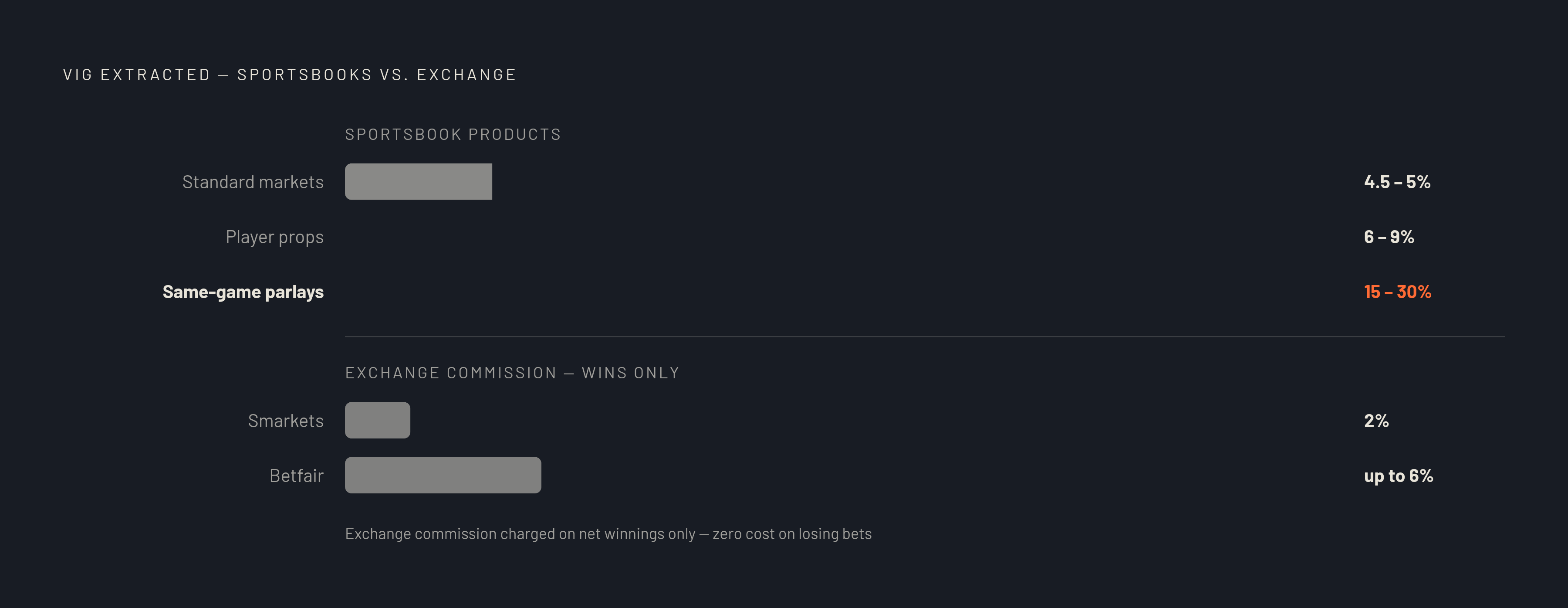
Vig scales with how exotic the bet gets. Standard markets run 4.5 to 5%. Player props run 6 to 9%. Same-game parlays, the product sportsbooks have pushed hardest over the past several years, carry an effective hold somewhere in the 15 to 30% range, the sportsbook's entire business model concentrated into a single bet slip. That's the sportsbook's entire business model concentrated into a single bet slip. It's the point of the product.
Exchanges price differently because there's no margin built into the line itself. The price reflects whatever two bettors actually agreed to trade at, which sits close to true probability since the market sets it rather than a house trying to guarantee itself a hold. Commission structures vary across platforms but land in a narrow band: Smarkets charges a flat 2% on net winnings, Matchbook runs 2% in the UK and Ireland but 4% elsewhere (with volume discounts down to 1% or 0.75% for high-turnover accounts), Betfair charges up to 6% on its default plan with reductions for loyalty and volume, and SX Bet charges 0% on single bets and 5% on parlay profit only.
Even Betfair, at the higher end of exchange commission, only charges on winning bets. A sportsbook extracts its vig regardless of outcome, on every wager, forever. Over a full season, that gap, roughly 2 to 3 percentage points, since a liquid exchange market typically prices around -103 to -105 on both sides against a sportsbook's -110/-110, tends to be the single largest variable in a bettor's long-run results. Not the app. Not the boosts. The pricing decides who's still betting in three years and who isn't.
The same margin logic that forces a sportsbook to charge more than the fair price on every bet is also what forces it to manage the accounts that manage to beat that markup anyway.
Why sportsbooks restrict winning accounts and how they detect them
Since the sportsbook is the counterparty on every bet, a winning bettor is a direct liability to the house, and limiting that bettor protects the margin the whole pricing model depends on. This isn't a rogue habit at a handful of shady operators. A UK Gambling Commission study found that 4.31% of all active accounts, roughly 650,000 out of 14.9 million, carry some form of commercial restriction.
Who actually gets caught complicates the tidy story. Of restricted accounts, 46.78% were profitable, but 51.29% were losing accounts. The practice functions less like a scalpel aimed at winners and more like a blunt filter that catches losers right alongside them. Operators restrict on suspicion and pattern-matching as much as on any confirmed long-run edge, and that should trouble anyone who assumes the system only punishes skill.
The primary signal is Closing Line Value, or CLV: a bettor who consistently gets better odds than the final pre-event line is behaving like someone with an edge, whether or not that edge has shown up in results yet. Industry data and regulatory scrutiny have reinforced what professional bettors have long suspected: sportsbooks treat consistent winning as a signal for restriction, not just confirmed long-run results. Sportsbooks price risk on process, not outcome.
Secondary signals feed the same models. A stake ending in an odd decimal rather than a round number reads as calculator output, not a casual gut call. Betting patterns tied to arbitrage or to following sharp tipsters get flagged, and device fingerprinting, IP data, and location history tied to known professional activity all feed in too. So does timing: bets placed the instant a line moves, or at hours that don't match recreational behavior, run through machine learning systems doing real-time risk profiling against a baseline built from how ordinary bettors actually behave.
Operators don't deny any of this. They frame it as protective rather than punitive. At a Massachusetts Gaming Commission roundtable, BetMGM's senior director of compliance, Sarah Brennan, said the platform limits roughly 1% of Massachusetts patrons, framing the practice as preserving competitive odds for the other 99%. Consultant Brianne Doura-Schawohl pushed back at the same roundtable, arguing that a platform advertising itself as open to all comers while quietly disqualifying the customers who actually win is making a claim its own back-office practices contradict. She has the better argument. A business that markets fair odds for everyone and then builds a detection system specifically to exclude its most skilled customers is offering a filtered market and calling it open. It's offering a filtered one, and calling it open anyway.
The forms restriction takes, from stake cuts to full account closure
The industry has a word for this: gubbing. It describes the process by which a bookmaker limits an account after a run of wins, without necessarily closing it outright, and it arrives in degrees.
The mildest version is a promotion lockout: the account stays open for regular betting but loses access to odds boosts, free bets, and bonus offers. Next comes stake reduction, where a maximum bet ceiling that once sat at $1,000 drops to $5 or $10 on most markets, which functionally kills the account for anyone betting at meaningful size. Market restriction narrows things further, pulling entire sports or bet types out of view. A softer, more ambiguous form is the pending review queue, where bets sit for manual approval before being accepted or quietly declined. And at the far end sits account closure: the platform shuts the account and refunds the balance, full stop.
Coral and Ladbrokes, both owned by Entain Group, share risk data, so a restriction on one account can propagate to the other without the bettor ever having touched the second brand's specific triggers.
For a serious bettor, the real cost is cumulative. Most professional and semi-professional bettors spread action across a wide roster of operators precisely because each one caps out eventually. The asset that matters is the whole portfolio, and every closure shrinks the total monthly volume that portfolio can absorb.
Regulators have started paying attention. Massachusetts adopted a notification rule, confirmed for implementation in February 2026 with a rollout date of June 1, requiring operators to notify a restricted bettor within 48 hours with a specific explanation rather than generic boilerplate. The UK Gambling Commission's 2025 position was blunt on the underlying question: being good at betting isn't a protected characteristic under discrimination law, so operators stay free to limit winners even as scrutiny of the practice grows.
Why exchanges have no structural reason to limit winners
Flipping the counterparty relationship collapses the entire restriction logic. When a sharp bettor wins on an exchange, the money comes out of the pocket of whoever sat on the other side of that trade, not out of the platform's balance sheet. Restricting a winning trader would cost the exchange commission revenue for no offsetting benefit, so there's no incentive to do it. None.
The incentive actually runs the opposite direction. Skilled bettors push prices toward true probability, and tighter, more accurate pricing draws more counterparty interest, which deepens liquidity and generates more commission volume overall. A sharp trader on an exchange looks less like a liability and more like a market-making asset.
SX Bet states this outright as policy: no account limits, ever, framed not as a marketing line but as a structural commitment baked into how the platform runs. The company points to cumulative platform volume several times over what it traded the previous year as evidence the model scales fine without excluding its best players.
Thin markets create a different kind of ceiling, though, and this distinction matters. A large wager on an illiquid market might only get partially filled, or filled at a worse price than quoted, simply because there isn't enough opposing action available. That's a market depth problem, not an account decision, and conflating the two misreads what's actually happening. Exchanges can and do suspend accounts for fraud or rule violations, but that's a wholly different category from restricting someone for the offense of winning too often.
Prediction markets built on exchange architecture follow the identical logic, for the same reason: sharp traders add liquidity to the same book everyone else trades against, which reinforces rather than threatens the platform. No exchange adopted this out of generosity. It's a property of the model itself, baked into how the ledger balances.
The sharp vs. soft bookmaker spectrum within sportsbooks
Not every sportsbook behaves the same way, even though every sportsbook shares the same basic architecture. Soft bookmakers chase recreational volume: heavy promotions, slow odds adjustment, and aggressive restriction the moment a customer looks like a threat to the model. Sharp bookmakers do the opposite, courting professional action with tight margins and high limits, treating sharp money as useful price information instead of a problem to manage away.
Pinnacle is the reference point the industry uses for the sharp end of that spectrum. It accepts large stakes, keeps margins tight, and uses sharp betting activity to sharpen its own lines rather than punishing the bettors producing that activity. Across betting forums and industry commentary, it gets cited repeatedly as the standard for a no-limits sportsbook operation.
The major US operators sit at the other end, and there's no ambiguity about why. FanDuel, DraftKings, Caesars, and BetMGM restrict fast, because the recreational bettor base is the commercial engine of the business and sharp action is a direct cost against that engine, not a feature of it. Operators frame this the way BetMGM did in Massachusetts: restricting a small sliver of advantage players, cited there at roughly 1%, subsidizes competitive pricing and promotions for everyone else.
Platform choice matters even within the sportsbook category alone, then. A bettor using only the major US softbooks is on a faster clock toward restriction than one who diversifies into sharper operators. But no sportsbook, however sharp its reputation, escapes the underlying fact that it remains the counterparty on every bet. Pinnacle tolerates sharp action far longer than FanDuel does, and that's a difference of degree, not of kind. It doesn't eliminate the incentive to eventually manage a winner down. Only removing the house-as-counterparty structure does that, which is what the exchange model delivers.
The US market landscape: where each model is available
The sportsbook model dominates the US by sheer footprint. Roughly 35 jurisdictions now run licensed sportsbooks under post-PASPA frameworks, DraftKings and FanDuel together hold around 70% of US handle as of the first quarter of 2026, and the market recorded nearly $150 billion in wagers in 2024, up about 22% year-over-year.
Exchange access, by contrast, is close to nonexistent. Sporttrade holds licenses in a handful of states and has pursued federal registration with the derivatives regulator as a designated contract market and derivatives clearing organization. Prophet Exchange operates in two states. Combined, licensed sports betting exchanges run in fewer than six states and account for under 1% of US handle even where they're available. That's a gap wide enough to mean the exchange model essentially doesn't exist yet for most bettors in the country.
The gap traces back to path dependency: the US market grew up fast, post-legalization, around app-first sportsbook promotion, while the UK and Ireland matured around exchange pricing well before their own comparable legalization moments, giving exchange infrastructure and consumer habits time to root there in a way they never got the chance to in the US.
Prediction markets have become the de facto workaround. Kalshi is available in more than 40 states, and sports event contracts have made up roughly 80% of Kalshi's total volume since July 2024, with CFTC regulation giving it a reach no state-by-state sportsbook license can match. But the legal ground under that arrangement shifted hard in the second half of 2026. On August 28, the Ninth Circuit ruled 3-0 against Kalshi on sports event contracts in KalshiEX, LLC v. Assad, affirming that sports event contracts aren't swaps under federal commodities trading law and that federal law doesn't preempt state gambling regulation. That ruling puts the Ninth Circuit in direct conflict with the Third Circuit, which makes Supreme Court review a real possibility and leaves the outcome unresolved for now.
Traditional operators are hedging on which model wins, and their money says the exchange side has a real future in the US. DraftKings acquired the CFTC-registered exchange Railbird, rebranding it DKEX, and FanDuel moved its sports-related exchange activity from CME Group over to Crypto.com's Nadex. Neither move makes sense unless both companies expect the exchange model to gain real regulatory footing over time. For a sense of what a mature exchange market actually looks like, Betfair Exchange runs multibillion-dollar monthly volume across the UK and Ireland, a scale that shows just how early-stage the US exchange landscape still is by comparison.
Behavioral tactics bettors use to delay sportsbook restrictions
None of what follows defeats the underlying incentive. It only slows it down. A sportsbook that identifies genuine, sustained edge will eventually act on that information regardless of how well the account is disguised, so what these tactics actually buy is time.
Everything comes down to one principle: make account activity indistinguishable from how a recreational bettor actually behaves. Round stake sizes ($25, $50, $100) beat the precise, calculator-derived figures ($473.82, $23.69) that immediately flag a model doing the sizing. Mixing in "mug bets," casual accumulators and mainstream match bets with no real edge behind them, dilutes the signal coming from the sharper selections sitting alongside them. Varying sport, stake size, and time of day accelerates detection far faster than consistency along any single dimension, always the same sport, always the same stake, always placed at 6am.
Hedging matters for a separate reason. When a matched-betting or arbitrage strategy calls for a hedge leg, placing that hedge on a different sportsbook or on an exchange, rather than back on the operator offering the original promotion, keeps the promotional account looking like a one-sided recreational customer instead of a two-sided trader. Building an account slowly, without an outsized initial deposit or an immediate jump to max stakes, and withdrawing in smaller, periodic amounts rather than one large lump sum, both reduce how visible the account is to risk teams.
For bettors operating across multiple brands under the same parent company, varying usernames and email addresses across those accounts can cut cross-brand profiling exposure, without ever crossing into falsifying identity, which is a different matter. Multi-accounting under false identities, using network-masking tools to bet from a restricted jurisdiction, or exploiting a platform's software bugs all carry legal and terms-of-service consequences well beyond a stake cut or account closure. None of that belongs in the same conversation as the legitimate camouflage tactics above. Anyone who blurs that line is making a different bet entirely, one against the law rather than against the house.
If CLV keeps flagging genuine edge, no amount of behavioral camouflage holds the line indefinitely. Diversifying across enough platforms, sportsbooks and exchanges both, so that no single restriction takes out a meaningful share of total volume, is the only answer that actually holds up over time.
Allocating bets across exchanges and sportsbooks in practice
The allocation logic follows directly from everything above, and it points in one clear direction: put skill-driven, straight bets on exchanges wherever one exists, and reserve sportsbooks for the promotional and prop-heavy stuff that carries no real long-run edge anyway. Exchanges win on pricing and on account longevity for straight bets, since there's no counterparty incentive to limit a winner and the commission-only structure means a bettor keeps far more of the edge over time. Sportsbooks win on breadth: same-game parlays, player props, live in-play markets, and the sign-up and reload bonuses that, used carefully, can offset some of the vig cost discussed earlier.
A bettor running a real operation treats this as a portfolio question. Straight bets on liquid markets, moneylines, spreads, totals on major sports, belong on an exchange wherever one is licensed and available, because a pricing edge of a few percentage points compounds hard across hundreds of bets a season. Where exchange access doesn't exist, which in the US today means most of the country, that same bettor still benefits from spreading action across several sportsbooks rather than concentrating it in one or two. Diversification is what protects total volume once any single account starts drawing scrutiny.
Promotional and prop-heavy plays can reasonably stay on sportsbooks, since that's where the promotional value actually lives and where a recreational-looking bet slip does double duty protecting the account. The Kalshi litigation working through the courts, along with DraftKings' and FanDuel's own moves toward exchange infrastructure, suggests the sportsbook-versus-exchange line in the US keeps shifting and won't settle for a few years yet. Until it does, the safest position for any serious bettor doesn't depend on which side eventually wins: hold accounts across both models, size bets according to each platform's actual incentive structure, and never let one operator's restriction decision determine total access to the market.