Commission Structures Across Major Betting Exchanges
Fee structures vary enough between exchanges to swing a betting strategy from profit to loss.

Betting exchanges don't work like bookmakers, and the commission structures built on top of them differ so much from one platform to the next that the fee alone can decide whether a betting strategy actually turns a profit. This piece breaks down how the major exchanges each charge for access to their markets, and where those charges diverge enough to matter.
How betting exchanges generate revenue and what "commission on net winnings" actually means
A bookmaker sets a price, builds in a margin, and takes that margin whether the punter wins or loses. An exchange works the other way round. It matches one user's bet against another user's opposite view, and the platform itself never takes a side. Its money comes only from the winner of each market, taken as a cut of profit rather than as a hidden markup baked into the odds.
That's what "net winnings" means in practice. Stake £100 and get back £200, and commission applies only to the £100 profit, never the full £200 payout. Lose that same bet, and the exchange charges nothing at all. That's a structural difference from fixed-odds betting, where the bookmaker's edge is invisible and applies regardless of outcome. Because exchange odds come from supply and demand between users rather than a margin a bookmaker needs to protect, exchanges can often offer better prices even after commission is factored in.
What complicates the picture is that no two exchanges charge that commission the same way. Some run a flat rate. Others scale by trading volume, by whether a user posted a price or accepted one already sitting on the book, or by cumulative profit over time. Every platform covered here shares the same basic principle: no commission on losing markets. Past that point, the rates diverge fast enough to change which platform makes sense for which bettor.
Betfair's standard commission tiers and the June 2025 rate increase
Basic sits at 2% commission but locks users out of promotions and some platform features. Rewards is the plan most exchange users sit on by default, and it moved from 5% to 6% on 1 June 2025. Rewards+ rose from 8% to 9% on the same date. The Basic tier held steady at 2% throughout.
Layered on top of the headline rate is something called the Discount Rate, recalculated every week from a user's Betfair Points balance at midnight GMT each Sunday. That balance then decays on a weekly basis, which means the rate an active bettor actually pays sits below the number advertised. Across the exchange as a whole, the effective average commission works out to roughly 2.5%, a long way under the 6% headline, largely because high-volume users get pulled down by the discount mechanism.
Australian users see a different structure entirely. The base rate on sport and international racing markets runs at 6%, NRL markets carry a 10% commission, and racing rates shift again depending on the state.
None of this changes the basic tension at the heart of Betfair's pricing: its headline rate is the highest among the major exchanges by a clear margin. But Betfair also holds an estimated 70% of global exchange trading volume, and that liquidity is the counterargument. Commission isn't the only cost of trading on an exchange; slippage and unmatched bets cost money too, and a thin market can quietly erode more value than a higher commission rate ever would.
The Expert Fee: what replaced Betfair's Premium Charge from January 2025
On 6 January 2025, Betfair scrapped its long-standing Premium Charge and replaced it with something called the Expert Fee. The old system could take up to 60% of a user's earnings, and it was calculated on lifetime profitability, meaning a bettor's entire trading history counted against them indefinitely.
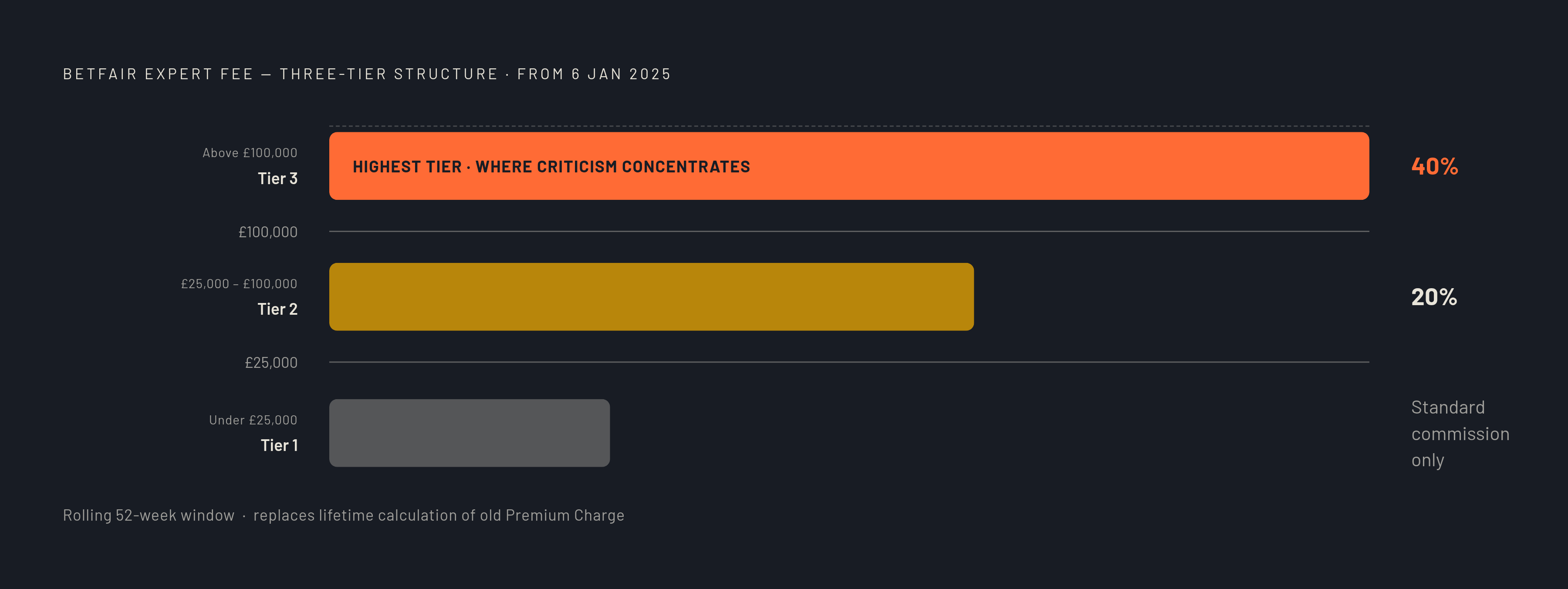
The Expert Fee works differently. It's assessed on gross profit over a rolling 52-week window rather than a lifetime one, and it's tiered: gross profit under £25,000 attracts no Expert Fee beyond standard commission, profit between £25,000 and £100,000 gets charged at 20%, and anything above £100,000 gets charged at 40%.
The rolling window is the single biggest structural change. A bettor who had a strong run five years ago and has traded at a loss since no longer gets penalized for history that's fallen out of the 52-week frame. Betfair also built in a buffer: losses and commission already paid since the last fee assessment can be deducted before the Expert Fee gets applied, and the whole thing is assessed and deducted weekly rather than in the lump-sum hits the old Premium Charge was known for.
By Betfair's own figures, around 80% of players affected by the change pay less than they would have under the Premium Charge, and roughly half pay nothing extra at all. The exception sits at the top: bettors clearing more than £100,000 in gross profit over a rolling year face a 40% fee on everything above that line, and that tier has drawn real criticism from high-stakes, consistently winning bettors who now carry a heavier ongoing cost than the old system's framing might have suggested.
Inflation-adjusted UK and Irish win market traded volumes on Betfair fell from over £1.5 billion in the January to March window of 2020 to below £1 billion across the same months in 2024. The Expert Fee redesign reads, at least in part, as a response to that decline in participation, not simply a goodwill gesture toward winning bettors.
Smarkets, Betdaq, and Matchbook: how the 2% alternatives actually differ from each other
All three of these platforms advertise something close to a 2% commission rate, but the resemblance stops there once you look at where their liquidity actually sits.
Smarkets charges a flat 2% on net market winnings, with no loyalty tiers and nothing resembling Betfair's Expert Fee. New users get 0% commission for 60 days on bets that settle within that window. Smarkets' real strength is in football lay strategies and political markets, where it is considered a genuine cost-saving alternative to Betfair. Its racing markets are thinner by comparison. It offers an API, though third-party automation tools built around it are far less developed than Betfair's ecosystem.
Betdaq also charges a standard 2%, and it's been operating for a long time as one of the established exchange alternatives. New users get 100 days of 0% commission using the code 0COMM100. Its liquidity is concentrated almost entirely in UK and Irish horse racing, where it has built a loyal user base over the years, and it's thin on football and most other sports. That makes it best understood as a racing specialist or a backup account rather than a primary exchange for multi-sport bettors. It runs commission promotions including its 0COMM100 offer.
Matchbook, founded in 2004 and licensed by the Alderney Gambling Control Commission and the UK Gambling Commission, breaks from the flat-rate model entirely with a maker-taker structure. Takers, meaning users who accept a price already sitting on the book, pay 1.5% standard commission. Makers, who post their own price and wait for someone else to match it, pay just 0.75%. Geography matters too: customers outside the UK, Republic of Ireland, Channel Islands, and Isle of Man pay 4%. Commission applies only to winnings, never to losing bets, and Matchbook runs a promotion called Matchbook Zero on selected events, offering 0% commission and no market margin at all. New users get 110 days of 0% commission, the longest introductory window of any major exchange. Matchbook has also launched a prediction market product in the UK, putting it somewhere between a regulated exchange and the newer prediction-market model. The maker-taker rate looks like the best deal on paper, but it only pays off for bettors actually willing to post prices and wait to get matched, rather than take whatever's on offer.
OrbitX and the broker-access exchange tier
OrbitX sits in a different category altogether: a professional exchange reached through specialist betting brokers rather than direct sign-up, commonly accessed via AsianConnect. Commission runs at roughly 3% of net profit per settled market, and a small number of long-term winning customers may face something equivalent to Betfair's old Premium Charge. There's no verified public API.
This tier suits professional bettors, exchange traders, and arbitrage bettors already comfortable working through a broker rather than a direct exchange account. The tradeoff is straightforward: OrbitX's commission sits above the 2% flat-rate exchanges, but broker access bundles multiple exchanges and sharp bookmakers under one account, which matters more to bettors chasing market breadth and price comparison at scale than to anyone chasing the single lowest commission figure.
Other broker-access platforms occupy similar ground. Sharp Exchange charges 2.5% to 4% and is reached only through BetInAsia, suited mainly to arbitrage betting and consistently winning accounts. Molly Exchange runs inside the MollyBet platform with commission built directly into the displayed odds rather than charged separately, and it's accessed only through brokers such as Sportmarket, BetInAsia, and MadMarket. Rather than running its own standalone order book, it aggregates liquidity pulled in from multiple sources.
For professional and systematic bettors, the number that actually matters is how commission interacts with other costs. It's total friction: commission plus slippage plus whatever access limitations come with the broker structure.
Decentralised and emerging exchange models with different fee logic entirely
A newer set of platforms skips the traditional exchange model altogether. BetDEX runs on blockchain infrastructure, charges 1% commission, and can be reached directly or through the Sportmarket broker, though its liquidity is still developing. SX Bet, a decentralised exchange, charges 0% on single bets and 5% on winning parlays, is accessible only directly, and is accessible only directly through cryptocurrency wallets rather than a conventional account. EasyBet, a newer platform from the EasyGroup brand, is another entrant in this space, with direct access and liquidity still building out.
Prediction markets add a further wrinkle. Monthly trading volume across prediction markets grew from around $1.2 billion in 2025 to more than $20 billion a month by early 2026, and the fee logic there looks nothing like exchange commission. Instead of a cut of net winnings, these platforms use different fee structures that vary considerably depending on the platform and the contract.
The tradeoff with decentralised platforms is real in both directions. They remove the exchange as a revenue-taker sitting between two users, which genuinely lowers cost. But that comes packaged with liquidity risk and regulatory uncertainty that a bettor doesn't face on a licensed exchange. Matchbook's own move into prediction markets places it at that junction, offering regulated exchange liquidity alongside the newer model.
How to read the rate comparison across platforms: liquidity changes the real cost
On paper, the gap between Betfair's 6% standard rate and Smarkets' flat 2% looks enormous, more than double. But commission only ever applies to net winnings, and Betfair's much deeper markets mean less price slippage and faster matching, especially in-play and across racing. With a dominant share of global exchange volume, Betfair's effective cost after slippage can end up lower than a 2% exchange with thin books, even once the higher headline rate is factored in.
That said, the 2% exchanges do win outright in specific corners of the market: liquid football, particularly major top-tier soccer leagues, and political markets on Smarkets; horse racing on Betdaq; and major US sporting events on Matchbook. Matchbook's 0.75% maker rate is genuinely the lowest commission available on any major regulated exchange, though it only works for bettors willing to post prices and accept the risk of sitting unmatched.
Introductory offers are worth lining up side by side too. Matchbook gives an extended 0% commission window, Betdaq gives 100 days with the code 0COMM100, and Smarkets gives 60 days. All three provide a genuinely low-risk window to test a platform's liquidity in the sports a bettor actually trades before committing longer term.
The Expert Fee changes this calculus for anyone trading at real volume. For a bettor generating more than £25,000 in gross profit over a rolling 52 weeks, the effective Betfair cost isn't 6%, it's 6% plus a further 20% or 40% depending on how far past that threshold the profit runs. That shift in the entire cost comparison for systematic and professional traders is why the research consistently points toward holding accounts across multiple exchanges rather than settling on one. Comparing live prices and commission in real time, market by market, beats committing exclusively to whichever platform has the best headline rate.
Matching exchange choice to betting style: a practical decision framework
Recreational and casual bettors are usually best served sticking with Betfair. Its liquidity and market range are unmatched, the standard 6% rate is simply the cost of trading in the deepest marketplace available, and the Expert Fee won't come into play at typical betting volumes anyway.
Matched bettors and anyone running systematic, low-margin strategies stand to gain the most from switching. Smarkets' flat 2% and Matchbook's maker-taker range of 0.75% to 1.5% both translate into real long-run savings, and the 0% introductory windows on both platforms give a safe runway to test them before moving volume over.
Horse racing specialists have a clear best-value alternative in Betdaq, where the 2% rate combines with racing-focused liquidity to make it the strongest option for that sport specifically, though Betfair still matters for in-play depth during races.
High-volume, consistently profitable bettors clearing more than £25,000 in gross profit over a rolling 52 weeks face a materially different calculation. The Expert Fee tiers mean Betfair's true cost runs well past its headline 6%, and for bettors in that bracket, splitting volume across Smarkets, Betdaq, and Matchbook, rather than concentrating it all on Betfair, is worth serious consideration before the 20% and 40% tiers start eating into a full year's profit.