Laying Bets on Exchanges vs Backing at Sportsbooks
Exchanges offer better odds than sportsbooks, but only if there's enough money to match your bet.
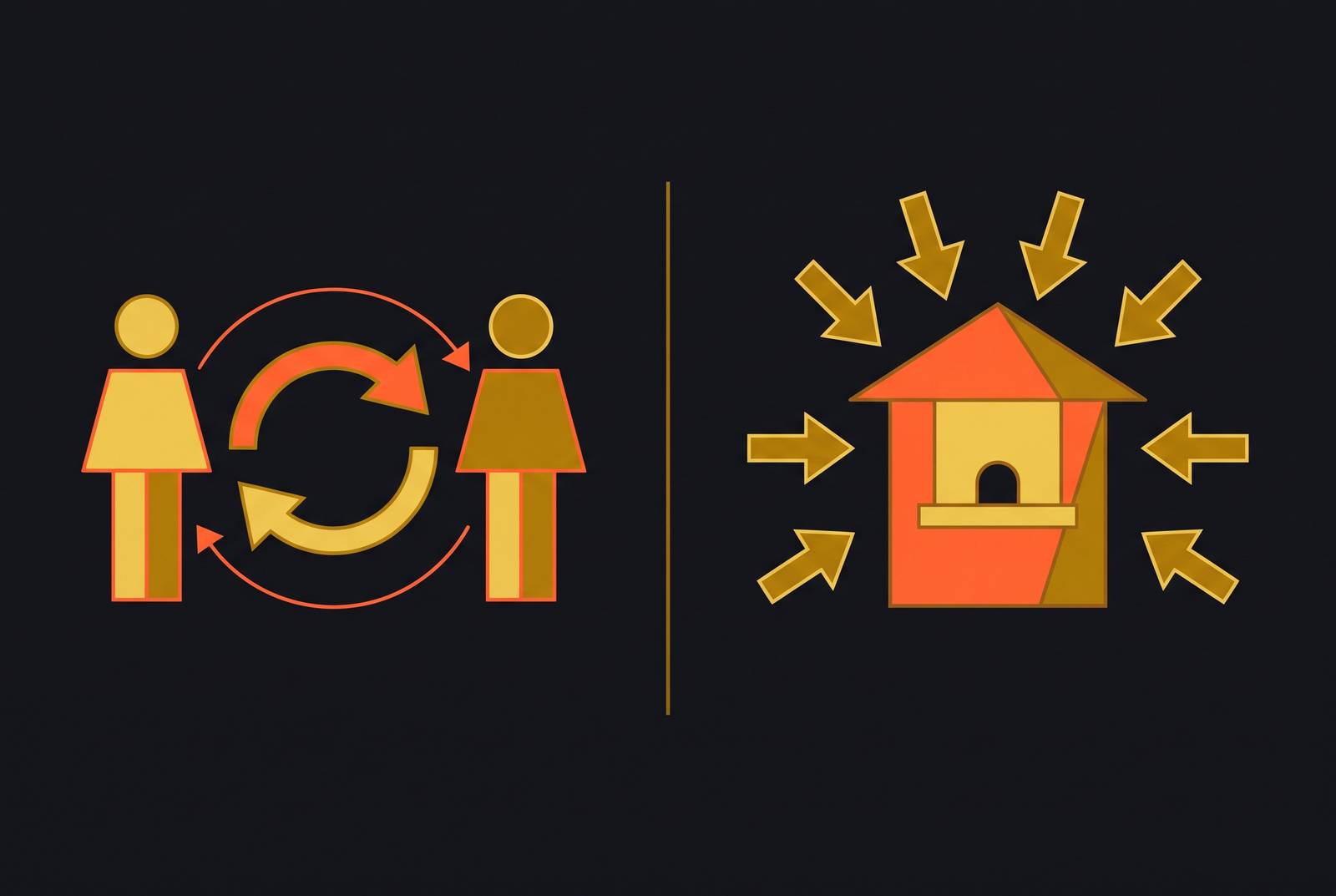
A sportsbook takes the other side of every bet placed against it. The bettor backs an outcome, the book sets the price, and the book absorbs the risk on paper while guaranteeing itself a profit in practice. That guarantee is the vig, and it's built into the number before a bettor ever sees it.
Take a genuine coin flip, a 50/50 proposition. Fair odds on each side would be +100: bet $100, win $100. Sportsbooks instead price both sides at -110. Bet $110 to win $100 on heads, bet $110 to win $100 on tails. Whichever side wins, the book keeps a slice of the total money wagered.
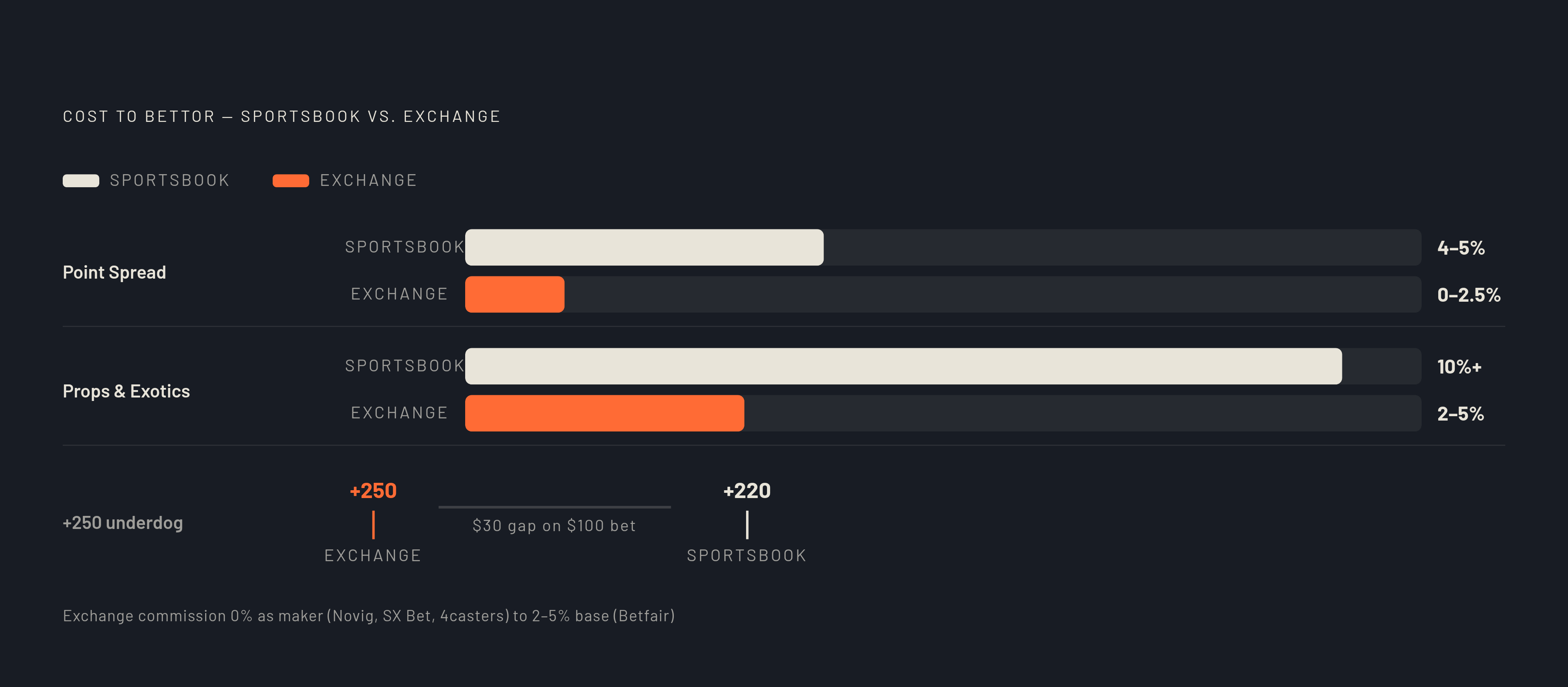
The vig isn't uniform across bet types, and this is where most bettors get the math wrong: they price the moneyline in their head and assume every other market on the board carries the same hit. Point spreads typically run a house edge in the 4 to 5% range. Player props and exotic bets, the parlay-adjacent stuff with more variables and thinner pricing scrutiny, can push past 10%. A bettor who treats those two markets as equivalently priced is giving away money without knowing it.
Because the book carries all the risk, it manages exposure aggressively: adjusting odds as money comes in, and limiting or closing accounts that consistently win. That's not a fringe outcome. It's the business model working as intended. A sportsbook that lets a sharp bettor keep betting at full size is a sportsbook eating a loss it doesn't have to eat.
There's also a timing problem baked into fixed-odds betting. Once a bet is placed, the price is locked. If news breaks that shifts an outcome's true probability, an injury, a lineup change, a weather report, after the bet is down, that new information does nothing for the bettor already committed at the old number.
None of this makes sportsbooks a bad product for the right user. Wide coverage across leagues and bet types, promotional structures like free bets and cashback, an interface simple enough that placing a bet takes seconds: for a casual bettor, that combination can outweigh the vig. But the vig is real, it's structural, and it doesn't disappear because the app is polished.
How a betting exchange actually works: peer-to-peer mechanics and liability
An exchange is not a bookmaker. It's a marketplace where bettors trade against each other, and the platform's revenue comes from commission on winnings rather than a margin baked into the price. That single difference reshapes almost everything downstream of it.
Odds on an exchange are set by supply and demand among the participants placing bets, not by a house protecting its position. If enough money backs a team, the odds on that side shorten. If money floods the lay side, they drift out. No one is setting a price designed to beat the bettor, because there's no single counterparty on the other end of every trade.
Laying a bet comes with liability that scales with the odds, and this is the part that trips up bettors moving from sportsbooks for the first time. The formula: liability equals stake multiplied by (odds minus 1). Lay a bet at odds of 2.10 with a €100 stake, and the liability comes to €110, meaning €110 at risk to win €100 if the bet loses for the backer.
The math gets sharper at longer odds. A €100 lay stake at 5.00 odds creates €400 of liability, four times the potential profit. That's the core mechanic a layer has to respect before placing a bet: exchanges require the full liability to sit in the account as available funds before the platform lets the bet through. No exposure beyond what's covered, no exceptions.
Because the platform isn't taking the other side, risk in the system sits with the participants themselves rather than getting absorbed by a house. And unlike a sportsbook's opaque pricing, the exchange's order book is visible in real time, so a bettor can watch where money is actually moving on a market before deciding to back or lay.
What exchanges charge and how commissions compare across platforms
Exchanges make money on commission taken from net winnings, not from a margin folded into the odds. That alignment matters more than it sounds: a platform earning commission on winning positions has no incentive to work against a profitable bettor, since profit is exactly what generates its revenue.
Commission structures vary by platform going into 2026. Novig, SX Bet, and 4casters charge 0% commission for bettors acting as makers, meaning those who set the price rather than accept an existing one. ProphetX charges 2% on straight-trade markets and nothing on parlay trades. Smarkets runs a flat 2% with no premium tier layered on top. Matchbook uses a maker/taker model: 0.75% for makers whose orders sit in the book waiting to be matched, 1.5% for takers who accept an existing price. That structure rewards patience over urgency, plainly.
Betfair, the largest exchange by volume, charges a base commission of 2 to 5% depending on the market, and layers an additional Expert Fee on top for high-volume winners. Effective January 2025, that fee applies to accounts generating more than £25,000 in rolling 52-week gross profit: 20% on profit up to £100,000, 40% above that threshold. A trader running £50,000 in rolling gross profit ends up paying roughly £10,000 a year in Expert Fee charges alone, stacked on top of standard commission. Anyone assuming Betfair's liquidity comes free of tradeoffs hasn't run that number.
Strip out the sportsbook's embedded margin, and exchange odds tend to run 10 to 20% better than sportsbook equivalents. A true +250 underdog, priced fairly, might show up at a sportsbook as +220. On a $100 bet, that's $30 left on the table, and the gap widens as the odds get longer. Novig has reported that its exchange users are more than ten times as likely to turn a profit as bettors on conventional sportsbooks, a figure that lines up with what the vig-versus-commission math predicts.
Liquidity: why it determines whether the better odds are actually available to you
Better odds mean nothing if no one on the other side will match the bet. That's the constraint governing every exchange, and it's the variable commission tables don't capture.
Liquidity differs sharply by platform and by market. On a Premier League match, Smarkets might show €50,000 to €100,000 matched, while the same fixture on Betfair shows upward of €500,000. For a bettor staking under roughly €500, that gap rarely bites, since even a thinner market usually has enough depth to fill a small order near the target price. Push into larger positions, or into a niche competition with a small following, and getting matched at the price shown on screen gets genuinely difficult, sometimes impossible.
That's the real weakness of exchange betting on less popular sports: the odds advantage on paper evaporates once liquidity runs thin, because a bettor stuck partially matched, or not matched at all, hasn't actually captured the better price.
Serious traders in the UK market tend to work around this with a two-account approach. Smarkets as the primary book, since the flat 2% commission with no premium tier can compare favorably to Betfair's effective rate once the Expert Fee is factored in, and Betfair held in reserve for markets where depth matters more than commission. It's less a choice between the two platforms than a division of labor.
US exchanges, for context, generally show thinner liquidity than their UK and European counterparts, a fact that bears directly on the platforms below.
The main exchange platforms operating in 2025–2026 and where each fits
Betfair remains the largest exchange globally and carries the deepest liquidity across sports by a wide margin. Its commission, 2 to 5% at the base rate, plus the Expert Fee introduced in January 2025 for high-profit accounts, makes it the most expensive option for consistently winning traders at volume. It suits markets that demand depth: matched betting strategies, in-play trading during major events, anything where getting matched matters more than shaving a point off commission.
Smarkets charges a flat 2% with no premium-fee equivalent to Betfair's Expert Fee, but carries significantly less liquidity on the same markets (the €50,000 to €100,000 range against Betfair's €500,000-plus on a Premier League fixture, as noted above). For small-to-mid stakes, the flat 2% often beats Betfair's effective rate once the Expert Fee is factored in, which is why Smarkets tends to anchor the two-account approach UK traders favor.
Matchbook runs the maker/taker model, 0.75% for makers and 1.5% for takers, and its strongest markets sit in American football, basketball, and tennis. It suits patient bettors willing to set a price and let the order book come to them, rather than accepting whatever's on offer. For active traders working the maker side, it can be the cheapest platform available.
Novig, operating in the US, charges 0% commission and has seen its annualized trading volume exceed $4 billion following a tenfold increase in 2025. The company has has pursued federal regulatory standing with the CFTC to operate as an exchange across 47 states (Arizona, Michigan, and Nevada remain geofenced), and raised a $75 million Series B led by Pantera Capital, with Multicoin Capital and Makers Fund participating, bringing total capital raised past $105 million. For US bettors, it's the clearest option for commission-free peer-to-peer pricing, and its regulatory trajectory is worth watching.
ProphetX, also US-based, holds a CFTC Designated Contract Market designation and Derivatives Clearing Organization registration. It charges 1% commission. It suits US bettors comfortable operating inside a CFTC-regulated derivatives framework, with zero-commission derivatives markets as the added draw.
Strategic situations where exchanges give bettors a structural edge
No account restrictions, first and foremost. Because exchange revenue comes from commission rather than from bettors losing, a winning account isn't a liability to the platform, it's the point. Sportsbooks, by contrast, routinely limit or close accounts that win consistently, since a winning bettor is a direct cost against the book's margin. That single fact should reframe how anyone thinks about where to place a serious, model-driven bet: a sportsbook will eventually treat skill as a problem to manage, while an exchange has no mechanism to punish it.
In-play trading is where the exchange model does something a sportsbook structurally cannot. Back a team early in a match, then lay the same selection later as the odds shift, and it's possible to lock in a guaranteed profit regardless of how the match ends. That only works where both back and lay bets exist on the same market, which restricts it entirely to exchanges.
Hedging futures runs on the same principle over a longer horizon. A bettor backs a team to win a championship at 15.00 odds before the season starts. The team reaches the final, and by then the odds have collapsed to 2.50. Laying that same selection on the exchange locks in a profit no matter which team wins, an option that doesn't exist once a sportsbook bet is placed and the price is fixed.
Matched betting, a strategy built around using free bets and promotional offers systematically, depends on lay betting as its core mechanical tool. It can't be run without exchange access, since there's no way to lay off a back bet at a sportsbook.
For analytical bettors working from models or pricing inefficiencies, the exchange's market-driven pricing rewards being right before the broader market catches up and corrects. And because there's no vig baked into the price, a genuine edge doesn't have to clear an extra 4 to 10% hurdle before it turns into real profit.
When the sportsbook model is actually the better fit
Exchanges aren't the better tool in every situation, and pretending otherwise does a disservice to how most people actually bet. Liability calculations, order matching, maker/taker fee tiers, commission schedules that vary by market: that's a real learning curve, and for a beginner or casual bettor, a sportsbook's fixed-price, one-click structure is simply faster to use correctly.
Niche and low-volume markets favor sportsbooks too, for the liquidity reason covered above. Once an exchange market thins out, the pricing advantage disappears along with the ability to get matched, whereas a sportsbook line, however marginally worse the price, is always available at the number posted.
Promotional value shouldn't get dismissed either. Free bets, risk-free offers, and cashback carry real, tangible short-term value that exchanges generally don't replicate. A bettor whose strategy leans on harvesting welcome offers will find sportsbooks the more useful vehicle, full stop.
Sportsbooks also cover a broader range of sports, leagues, and bet types than most exchanges manage, especially outside football, basketball, and horse racing, where exchange liquidity concentrates. And fixed-odds pricing offers a certainty exchanges can't match: the price at placement is the price paid, with no risk of a partial fill or a bet that never gets matched.
How to decide which model to use and when to use both
The decision comes down to three variables: whether the bet requires laying as well as backing, how the stake size compares to available liquidity on the chosen platform, and whether the bettor is optimizing for simplicity or for expected value over time.
Casual bettors placing occasional back bets on popular sports don't lose much by staying at a sportsbook, and promotional offers can offset a real chunk of the vig cost if used deliberately. Value-focused bettors backing major markets at meaningful stakes, though, are leaving money on the table by ignoring exchanges. Odds running 10 to 20% better than sportsbook equivalents compound heavily across volume, and that gap doesn't shrink with experience. It just gets more expensive to ignore.
Anyone running in-play trading, matched betting, or futures hedging doesn't have a choice in the matter. Lay betting can't be replicated at a sportsbook under any circumstances, so exchange access isn't a preference, it's a requirement.
The two-account approach, a low-commission exchange as the default, a deeper-liquidity exchange held in reserve, is how experienced traders solve the liquidity constraint without giving up the commission advantage entirely. US bettors are working with a market still finding its footing: Novig and ProphetX are the primary regulated options, and the CFTC pathway Novig has filed for signals the space maturing, even as liquidity still trails what's available in UK and European markets.
Within the exchange world itself, the same logic that governs the sportsbook-versus-exchange decision applies one level down. Commission rate matters far less than liquidity at the actual stake size a bettor trades. The cheapest platform available is worth nothing if the order sits unmatched.
Sources
- Betting Exchange vs Sportsbook: Back & Lay Betting Explained
- How Betting Exchanges Are Changing the Game with Advanced Software in 2025
- Betting Exchanges Explained: How Betfair, Smarkets & Matchbook Work | Bet Hero
- Matchbook Review 2026: How Commission Really Works (0.75% Calculation) -
- betherosports.com