Line Movement Patterns Before NFL Kickoff
Sharp money, public bias, and injury news drive predictable line shifts before kickoff.
Line movement is the change in a market's odds between the moment a book posts its opening number and the moment the game kicks off. It is not random. Every shift, whether it's a half-point on a spread or a two-point swing on a total, encodes a cause: new information, sharp money, public betting patterns, or some combination of the three. Point spreads, totals, moneylines, and props all move, though spreads and totals draw the most scrutiny because they carry the highest volume and the clearest key numbers.
The opening line is a book's initial estimate, built from power ratings, historical matchup data, and early market expectations. The closing line, by contrast, is the most information-rich price of the week, because it has absorbed every bet, every injury report, and every weather update that arrived before kickoff. The principle of closing line value has established the standard that bettors who consistently beat the closing number, getting a better price than what the market settled on, are the ones who show long-term profitability. That's not a minor academic point. It reframes the closing line as the benchmark against which all movement should be measured, and it means learning to read movement is really learning to read what the market already knows before the ball is snapped.
The three forces that drive lines from open to close
Sharp money comes first. Professional bettors using data-driven models place substantial, informed wagers, and books react to that action before they wait around for more volume to confirm it. The asymmetry here matters: a single large sharp bet can move a line more than a much larger pool of scattered recreational money, because books price in the quality of the bettor, not just the size of the bet.
Public money behaves differently. It arrives late and it arrives concentrated, with a notable portion of weekly handle landing in the hours before Sunday afternoon kickoffs. That's a lot of money hitting the board all at once, and it's directional in predictable ways. Teams like the Cowboys, Chiefs, Packers, and Eagles pull in retail cash regardless of matchup or injury report, purely on name recognition, and books shade spreads to account for that bias before the public even logs in to place a bet.
This produces what's sometimes called the spread tax. Favorites of seven points or more win outright the large majority of the time, but they cover the spread at a rate that falls short of what their popularity would suggest over the long run. The gap between winning and covering is the price of popularity, baked into the number by bettors chasing a big favorite regardless of value.
Then there's information. Injuries, roster decisions, practice reports, and weather forecasts move lines independent of any betting volume. Wind and rain compress totals far more than they move sides, so a forecast update calling for strong gusts at an outdoor stadium is a totals signal, not a spread signal. Injury news, meanwhile, gets absorbed fast. Sharp bettors quantify the impact of a missing starter within minutes of the announcement, and the first few minutes after that news breaks capture most of the value that will ever be available on it.
Why crossing key numbers matters more than the size of the move
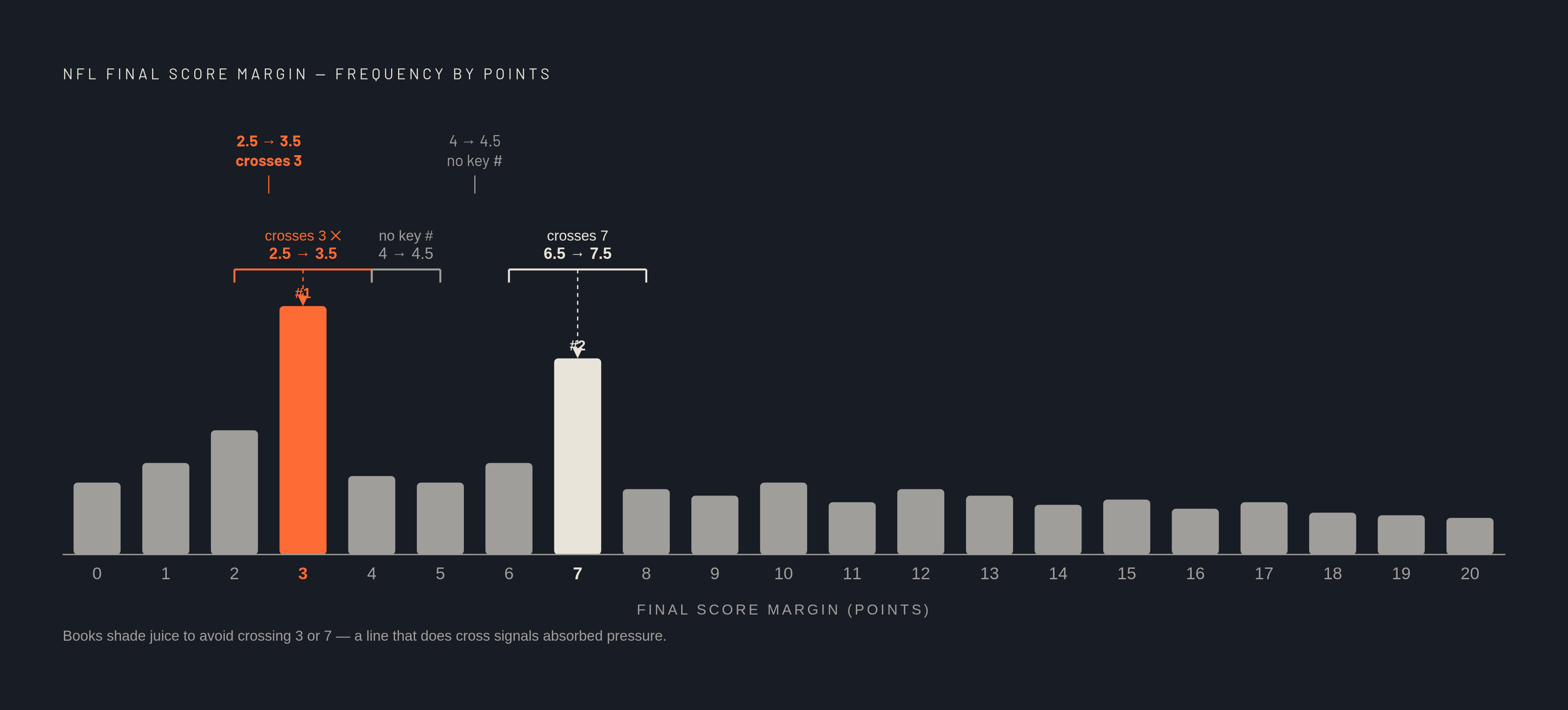
Not all half-point moves carry equal weight. Context decides everything, and the context that matters most in the NFL is the distribution of final scoring margins. Games land on a margin of exactly 3 points more often than any other number, with 7 as the second most common margin.
That distribution is why a spread moving from 2.5 to 3.5 is meaningful in a way that a move from 4 to 4.5 simply isn't. The first move crosses the single most common final margin in football. The second move crosses nothing structurally important. A shift from 6.5 to 7.5 carries similar weight to the 3-point crossing, because it passes through the second most common margin.
Books know this better than anyone: they'll often shade the juice, moving odds from -110 to -120, for example, rather than move the actual number across 3 or 7. So when a line does cross one of those key numbers, it tells you something: the book absorbed enough pressure that protecting the number wasn't worth it anymore. That's a stronger signal than an equivalent half-point move sitting anywhere else on the number line.
Totals cluster differently. A total moving from the mid-40s to the high 40s doesn't cross a key number in the same structural sense, but it reflects a change in expected game script, in how the market thinks the game will actually be played, which is its own kind of signal.
Reverse line movement: when the line contradicts the crowd
Reverse line movement happens when a line moves opposite to the direction of public betting percentage. It's the clearest tell the market produces, because it exposes a direct fight between the two dominant forces acting on a line.
Picture 70% of public bets landing on a favorite, yet the spread shrinks instead of growing. That's backwards from what public volume alone would produce, and it means sharp money is on the underdog heavily enough that the book adjusted to limit its own exposure. A concrete version: 70% of bets come in on Dallas -5, and the line drops to -4.5 anyway. The reverse move says sharp bettors believe Dallas is overvalued at the original number, and the book agrees enough to act on it.
Books don't shift against the majority of their tickets without a reason. Doing so means accepting more bets on the side with fewer total dollars, which only makes sense if the money on the smaller side is sharp enough to justify the risk.
Caution belongs here too. Reverse line movement tells you where sharp money sits, not what's going to happen on Sunday. Markets get things wrong, and sharp consensus doesn't always turn into a winning result. Reading this signal properly also requires tracking betting percentages and line direction at the same time. The line movement alone, without knowing what the public percentage looked like, only tells half the story.
Steam moves: when sharp action crosses books simultaneously
A steam move is a sudden, sharp line shift that hits multiple sportsbooks within seconds of each other. The usual cause is coordinated sharp betting, often a syndicate firing large, near-simultaneous wagers across several books before the market can adjust. Breaking injury news or a weather update landing across the whole market at once can trigger the same effect.
Spotting one early comes down to watching for outliers. If one book moves a line by a half-point ahead of the rest of the market, that's often the first sign of steam, and other books tend to follow within minutes. This is different from gradual sharp action, which unfolds over hours or days as books absorb bets and adjust incrementally. Steam is a single, compressed event.
Speed is the whole story here. Once a steam move registers across the market, the value it represented gets priced away almost immediately. For a recreational bettor watching from a phone screen, the practical use of a steam move isn't catching it in real time so much as recognizing after the fact that something significant just entered the market.
Timing and value across the betting week
Timing changes what's actually available to bet. Early in the week, sharp bettors move first, testing freshly posted lines that carry lower limits precisely because books expect to get tested. Books know these numbers are soft and treat the early action as a diagnostic.
Midweek is the most information-dense window of all. Injury practice reports, updated weather forecasts, and continued sharp positioning refine the number day by day, so a line on Wednesday can look meaningfully different from the same line on Monday even with no public money involved yet.
Late in the week, and especially Sunday morning, retail volume floods in. That late surge of retail volume pushes popular favorites toward inflated prices. The timing implication is straightforward: betting a popular team means betting it early, before public money drives up the cost. Betting an underdog means waiting, often until Sunday morning, when public pressure on the other side has pushed the underdog to its best price of the week.
The final 30 to 60 minutes before kickoff carry the highest limits of the week. Some sharp bettors wait deliberately for this window, betting maximum size at the best number still available. Markets have gotten efficient enough that most news, an injury designation, a forecast update, gets priced in within minutes of hitting the wire. Waiting past that window to react to public information is, more often than not, waiting too long.
The 2026 season adds a new late-week variable. Under the Dynamic Kickoff rule change reported by Sports Illustrated, teams can attempt an onside kick at any point in a game, regardless of score, whether they're winning, losing, or tied. When a coach confirms or declines to declare onside intent during a press conference, that declaration can move totals and first-possession markets. Watching those press conferences has become part of the late-week information cycle in a way it wasn't before.
Current 2026 lines and movement examples
Totals movement in September 2026 shows the independence of that market from the spread clearly. Some early-season totals opened in the mid-40s at major books and climbed by several points as the week progressed, even as the spread on the same games held in roughly the same range. That's a meaningful rise in expected scoring with the point spread barely reacting, showing that totals and sides respond to different inputs.
The reverse pattern appeared on other early-season games, where totals that opened near the high 40s drifted downward as the week unfolded, the same game-script logic running in the opposite direction.
A single game can show both forces working simultaneously rather than in isolation, with spread and total moving in tandem as sharp money and new information arrive together across the week.
BetQL's tracker for Week 2 of the 2026 season shows the range of line sizes on a typical slate, with examples including Dolphins +13 against the 49ers and Colts +6.5 against the Chiefs with a total of 46.5. That spread, from a 4-point game to a 13.5-point blowout number, reflects how uneven the competitive gaps are across a given week.
Preseason data from 2025 gives a benchmark for how sharp money performs in lower-information environments: preseason markets, with backups playing limited snaps and coaches managing workload rather than trying to win, behave very differently from regular-season markets, so any preseason performance data should be read as context rather than a promise of similar returns once the games count.
The 2026 kickoff rule changes are still working their way through the market. Along with the onside kick change, Under the 2026 rule, touchbacks are spotted at the 20 rather than the 35. Return rates jumped to 74.5% in 2025 from 32.8% in 2024, with early-season totals this year likely reflecting some uncertainty about how often teams will actually declare onside attempts and how the new field-position math shifts scoring expectations, a market still calibrating. That's a market still calibrating, not one that's settled.
Reading line movement without chasing noise
Every notable move breaks down to one question: is this new information, or is this just volume? Legitimate signal comes from injuries, weather, and sharp money. Noise comes from public dollars piling onto a popular team, and noise, more often than not, creates value on the other side of the bet.
Four questions filter almost any move worth paying attention to. Which direction did the line move? What's the public betting percentage on that same side? Did the move cross a key number like 3 or 7? Was there a news event, an injury, a weather update, a roster decision, that explains the move independent of betting volume?
When the line moves against a heavy public percentage, crosses a key number, and has no news event to explain it, that's about as close to a clean sharp signal as the market ever produces. When the line follows the public money, doesn't cross a key number, and has no news attached, the move is probably just retail pressure, and it carries very little information.
There are real limits to how far this gets a bettor. Markets have gotten more efficient over time, and algorithmic tools, including the kind Dimers.com has built out for 2026, have sped up how fast profitable opportunities get identified and priced away. The edge available to a recreational bettor from reading movement alone has narrowed, and it keeps narrowing. Trackers like BetQL's NFL Line Movement Tracker at least put the raw material in one place, consolidating opening and current spreads alongside public betting percentages, which is the minimum data set needed to run the four-question filter above.
Line movement was never meant to hand anyone a winner; it's a map of where informed money went and why it went there. It's a map of where informed money went and why it went there. Paired with injury reports, weather data, and a working knowledge of the key numbers, that map sharpens the questions a bettor asks before money changes hands, and that's the most any market signal is built to do.