Arbitrage Between Sportsbooks and Betting Exchanges
Structural differences between platforms make most calculated arbs unprofitable in practice.

Arbitrage between a sportsbook and a betting exchange is not the same trade as arbitrage between two sportsbooks, even though most guides price them as if they were. The two platform types set odds through different mechanisms, charge fees on different bases, and treat winning customers in opposite ways. An arb that looks clean on a calculator can fail entirely once those structural differences get applied to it, and figuring out which arbs survive contact with reality is the actual skill here.
Arbitrage betting, in its plain form, means covering every possible outcome of an event across two or more platforms so the combined payout beats the combined stake no matter what happens. The math is old and simple. What's changed is the landscape it runs on: the global sports betting market is projected to grow from $124.88 billion in 2026 to $325.71 billion in 2035, a compound annual growth rate of 11.24%. More platforms means more pricing gaps to exploit, but it also means faster line movement and sharper detection systems watching for exactly this kind of activity. The gap between an arb that's mathematically visible and one that's actually executable is where this whole practice either works or falls apart, and that gap is built entirely out of the structural differences between a sportsbook and an exchange.
Divergence between sportsbook pricing and exchange pricing on the same event
A sportsbook is a market maker. It sets its own odds based on its own liability, its own read on where the public money is going, and its own models, then takes the other side of every bet it accepts. A standard two-sided market priced at -110/-110 carries a theoretical hold of roughly 4.55%, with the house edge baked into the number before a single bet lands. Soft books, the ones with less sophisticated trading desks, tend to lag behind sharp money and slow-moving news. That lag is where most of the mispriced lines on the sportsbook side of an arb actually come from. These books aren't exactly making mistakes; different operators carry different margins, different accumulated liabilities on a given market, and different pricing philosophies, and those differences appear as gaps between books.... Different operators carry different margins, different accumulated liabilities on a given market, and different pricing philosophies, and those differences appear as gaps between books.
Exchanges work on a different logic. There's no house price to set. The number floats to wherever a backer and a layer agree to trade. The price is a direct reflection of what two informed parties think the outcome is worth. A liquid exchange market on the same event typically settles around -103 to -105 on both sides, a 2 to 3 percentage-point tighter margin than the sportsbook equivalent, before commission even enters the picture. That tightness matters for one reason: exchange prices sit closer to the market's true probability, which is what makes them useful as the reference leg against a sportsbook's mispriced line.
Predictable places show the gaps to watch for. Slow-moving sportsbooks sitting behind exchange prices that have already absorbed sharp action. Three-outcome soccer markets, where the draw price at one operator is frequently the outlier. Live markets, where a line can move several times a minute and a sportsbook simply hasn't caught up yet. Knowing which leg is the "wrong" one, usually the sportsbook, tells an arber how fast they need to move and which side to place first.
The effect of commission on the exchange leg on the math of the arb
A sportsbook's vig is baked into the price. Exchange commission works differently: it's charged only on net winnings, typically somewhere between 2% and 5%, and that distinction changes how it has to be treated in the arb calculation. That distinction changes how it has to be treated in the arb calculation, since it's a cost that occurs on only one side of the outcome.... It's a cost that occurs on only one side of the outcome.
Run the numbers on a gross arb margin at the low end of the typical range, say 1% to 2%. A 2% to 5% commission charged against the winning exchange leg can eat that margin entirely, sometimes pushing the trade negative. And because the commission only triggers when the exchange leg wins, the arb's actual return is asymmetric: full profit when the sportsbook leg hits, a commission-reduced profit when the exchange leg hits. Treating commission as something to subtract after the fact, rather than something to build into the stake sizing up front, is how a paper profit turns into a real loss.
Lay betting on an exchange adds another wrinkle. The layer isn't staking the bet amount, they're posting liability equal to the potential loss, which has to be funded upfront and ties up more capital than the stake alone would suggest. Combine that with a thin margin and the practical threshold becomes clear: arbs with thin gross margins are high-risk of going negative after commission, unless the exchange offers a reduced rate through a volume or loyalty tier. The "free money" pitch that arb software often leans on falls apart fast on anything but a wide gap, because the exchange's commission is simply the toll for trading on the side of the market that's priced more accurately.
Liquidity on the exchange leg as the constraint most arbers underestimate
An exchange price is only as real as the money sitting behind it. A displayed price of 2.10 might have only $50 matched at it, well short of the $2,000 an arber needs. That gap between the number on screen and the number actually available is where a lot of arb strategies quietly break.
Liquidity is not evenly distributed. Marquee markets, an NFL spread or an NBA total on a major exchange, can absorb five-figure positions without blinking. Lower-division soccer, niche combat sports, or obscure props might offer a few hundred dollars of depth at the target price and nothing more. Once the exchange leg only partially fills, the arb stops being an arb. The bettor is now holding an unhedged position on the sportsbook side, exposed to the very outcome the whole trade was supposed to neutralize.
One figure captures how often this goes wrong: one study found that 85% of retail traders attempting arbitrage on betting exchanges fail because of unmatched bets or poor stake balancing. Live markets make this worse. Odds in basketball or tennis can shift multiple times inside sixty seconds, and a price that looked matchable when the order was placed may have already moved by the time it fills. The practical fix is to check exchange depth before doing anything else: target liquid markets first, use limit orders instead of market orders wherever the platform allows it, and size the position to what the order book can actually absorb rather than what the arb calculator says is optimal. That means assessing the exchange leg before placing the sportsbook leg, which reverses the order most bettors instinctively follow.
How sportsbooks detect and respond to arbitrage activity
The incentive structures could not be more different. A sportsbook's revenue comes directly out of its customers' losses, so a customer who consistently wins is a direct hit to the book's margin, and the business model treats that customer as a liability to be managed. An exchange earns commission on net winnings regardless of who wins, because one customer's profit is another customer's loss on the same order book. A skilled bettor who wins more on an exchange actually generates more commission revenue for the platform. There's no structural reason for an exchange to want a sharp customer gone.
Sportsbooks build entire risk operations around finding and slowing down exactly that kind of customer. Automated systems watch for bets placed consistently at or near the best number on the board, for timing patterns that match arb software's execution speed, and for accounts betting opposite sides of the same market across a group of sister platforms. Device fingerprinting, IP intelligence, and behavioral biometrics get layered on top to link accounts that are trying to look separate. Arb bots that fire bets automatically are especially easy to spot, because software leaves a timing signature that human betting behavior doesn't replicate.
The trajectory is consistent enough to plan around. A new account might open with a $5,000 max stake on an NFL spread. Within two to six months of heavy arb activity, consistent winners on the major US platforms, DraftKings and FanDuel among them, typically see that ceiling drop to $50 or less per bet. At that point, the sportsbook leg of any meaningful arb is dead because the account can no longer place the stake the arb requires. That makes account health a strategic resource in its own right. Burn through sportsbook accounts fast and the infrastructure needed to run the strategy disappears, even though the exchange side never changed at all. The exchange relationship is durable. The sportsbook relationship is perishable, and how fast it decays sets the long-run life of a sportsbook-exchange arb, if it has any at all.
Footprint management on the sportsbook side
The behavior that makes an arb mathematically perfect is also the behavior that gets flagged fastest. That tension is unavoidable, and managing it means deliberately betting a little worse than optimal in exchange for staying under the radar longer.
The tactics are mostly about looking human. Stake round numbers, $200 instead of $204.73, because an exact calculator output is a software tell. Throw in the occasional small recreational bet that has nothing to do with an arb, just to look like an ordinary customer. Spread activity across as many sportsbook accounts as possible so no single account carries the full weight of the volume. Avoid placing the same market at the same moment across multiple accounts, since synchronized timing is one of the easier patterns for a risk system to catch. Three-way arbitrage, splitting stakes across the home, draw, and away outcomes in soccer, spreads exposure across three books instead of two and tends to look less like the classic two-way arb pattern that detection systems are built to find.
None of that applies on the exchange side. Exchanges don't cut limits on sharp customers, they price-discriminate through liquidity instead: a bettor trying to move size simply faces thinner depth at the best price as their volume grows, not account closure. A handful of sportsbooks have built their whole model around welcoming sharp action rather than fighting it. Pinnacle Sports is the clearest example: it runs on tighter margins, earns on volume instead of recreational losses, and offers high maximum stakes without limiting regular winners. Pinnacle isn't available to US bettors, though, which removes the single most arb-friendly sportsbook from the table for anyone betting domestically. A sportsbook based in a Central American jurisdiction and part of a larger offshore betting group has historically accepted US players and tolerated arb activity with reduced juice on markets like NFL and NBA spreads. Industry reports from early 2026 suggest it's drifting toward a more recreational-focused model, which makes its limit tolerance less predictable going forward than it's been historically.
The strategic asymmetry that falls out of all this is straightforward: protect sportsbook access aggressively, because it's the resource that depletes. The exchange side is the stable half of the trade and doesn't need the same defensive posture.
The US market structure problem: exchange access is the missing leg for most American arbers
Roughly 38 to 39 US states now run licensed sportsbooks under the post-PASPA framework, and that number has grown steadily. True betting exchanges, by contrast, remain almost nonexistent at any meaningful scale. Sporttrade operates in five states. Prophet Exchange operates in two. Combined, exchange-style platforms account for under 1% of total US betting handle even in the states where they're licensed to operate. That's not a rounding error, it's the entire missing leg of the strategy for most American bettors.
The dominant sportsbooks in the US are also the ones with the least tolerance for winning customers. DraftKings and FanDuel together hold roughly 70% of US handle as of the first quarter of 2026, and both run aggressive, well-resourced risk operations aimed at identifying and limiting sharp bettors quickly. So the two biggest sportsbooks by volume are also the worst candidates for the sportsbook leg of a long-running arb strategy.
This feels backward to anyone used to betting in the UK, where the picture is inverted. Betfair Exchange handles a multibillion-dollar monthly volume in the UK and Ireland, because that market matured with exchange pricing as a normal, mainstream part of how people bet. The US market grew up differently, built around app-first sportsbook promos and welcome bonuses rather than peer-to-peer trading, and exchange liquidity never developed the way it did in the UK.
What's filling part of that gap now is CFTC-regulated prediction markets. Kalshi and, following its CFTC approval in November 2025, Polymarket both function much closer to an exchange than to a sportsbook: prices float based on trader positioning rather than a house-set line. For many event markets, these platforms are now the closest thing to genuine exchange liquidity available to a US bettor, and at least one software platform, Claw Arbs, is built explicitly around running sportsbook-to-prediction-market arbs with sub-second execution. What that means practically is that a US bettor running a "sportsbook-exchange" strategy is very often actually running a sportsbook-to-prediction-market strategy instead. The mechanics rhyme, but the regulatory footing and the liquidity behavior are different enough that treating the two as interchangeable is a mistake.
When sportsbook-exchange arb is executable: the conditions that have to hold simultaneously
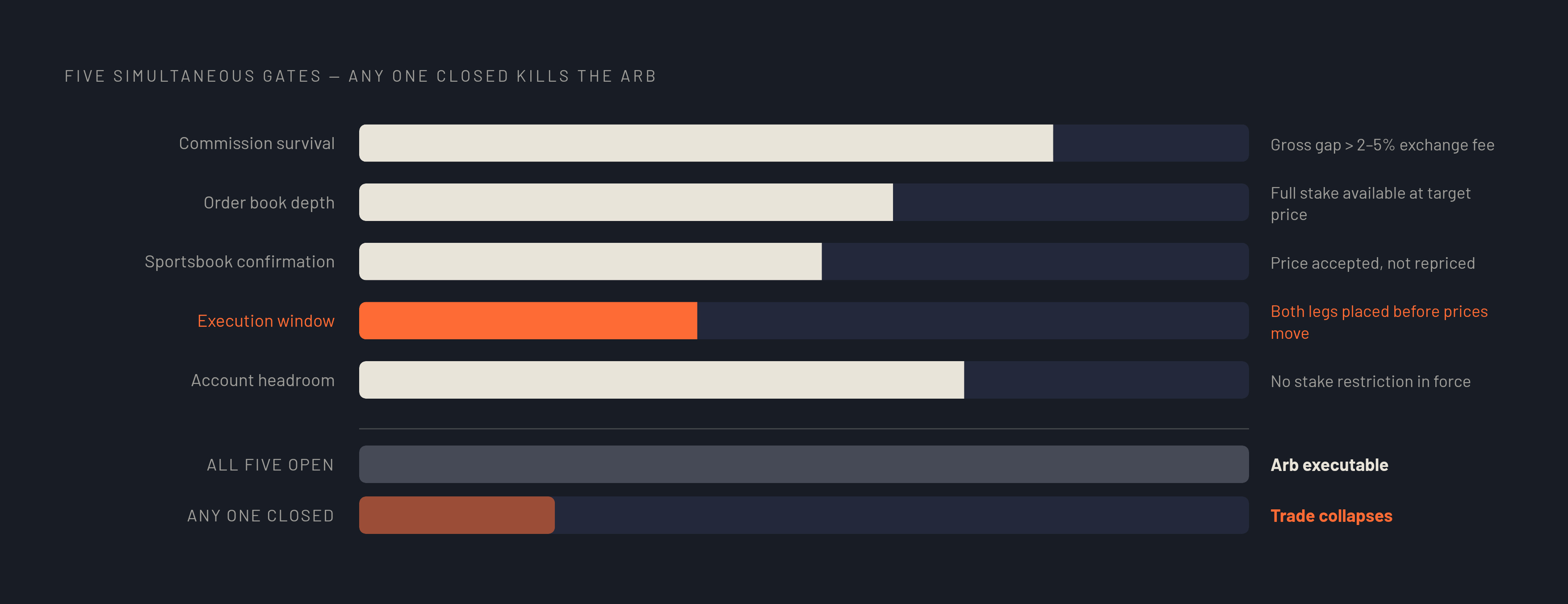
Five conditions have to hold at once for this trade to work, and losing any one of them collapses the whole thing.
The gross price gap has to survive commission. Against a 2% to 5% exchange commission rate, a thin gross margin is often not enough once commission and stake rounding are applied, and the trade needs real breathing room above that line.
Exchange liquidity has to actually support the stake being placed. That means checking order book depth at the target price before the sportsbook leg goes in, not after, since a partial fill on the exchange side turns the trade into an unhedged bet rather than an arb.
The sportsbook leg has to go through at the price shown on screen. Sportsbooks can reject, limit, or delay a bet, and the confirmed price can differ from the one displayed in the software a moment earlier. The window between placing the sportsbook leg and the exchange leg has to be short enough that neither price has time to move.
The sportsbook account itself can't already be restricted below the stake the arb calls for. An account capped at $50 a bet cannot carry the stake size most arbs require that needs balanced stakes in the hundreds or thousands.
And the market definitions on both legs have to match exactly: same event, same settlement rules, same selection. A bet on "Over 2.5 goals" at one book and "Under" at another only functions as an arb if both platforms settle that line identically, and any daylight between the two rule sets turns a hedge into a gamble.
All five conditions have to hold at the same time, not most of them. That's the discipline this strategy actually demands, and it's a much narrower window than the arb calculators tend to suggest.