Betfair vs Kalshi for US Sports Traders
Kalshi is the only US platform where sports traders can actually operate right now.

Betfair does not accept US registrations. Its platform blocks American IP addresses outright, and the closest it ever came to a domestic foothold, a regulated horse-racing exchange in New Jersey, shut down in 2020 after failing to draw enough activity to justify the overhead. So when someone asks how Betfair compares to Kalshi for a US sports trader, the honest answer is that the comparison itself is a category error. One is a model a US trader can only read about. The other is a market that exists on US soil right now, and it's the only one worth actually trading on.
What the Betfair model actually is, and why US traders find it appealing in theory
Betfair's core mechanic is simple to describe and hard to replicate. Traders back and lay against each other directly, not against a bookmaker, and Betfair takes a commission on winning bets rather than setting odds designed to beat the customer. The lowest base commission sits at 2%, though the standard rate climbed to 6% in June 2026.
Layered on top of that is what Betfair calls the Expert Fee, introduced January 6, 2025, to replace the older Premium Charge. It hits a small slice of consistently profitable users, calculated on gross profit over the trailing 52 active weeks rather than lifetime earnings. Profits up to £25,000 face no additional charge. Between £25,000 and £100,000, Betfair takes 20% of everything above the £25,000 threshold. Above £100,000, that rate jumps to 40% on the excess. The old Premium Charge could run as high as 60%, so calling the Expert Fee a mercy is fair, if a little generous. Because the lookback window rolls, a trader whose profits drop the following year can watch the fee rate fall back to zero just as fast as it rose.
Sit with that structure for a second: the better a trader gets, the more Betfair wants back. That's not a design flaw. It's a progressive tax on skill, built deliberately, and it's a big part of why the progressive nature of that fee structure can undercut the platform's appeal for consistently profitable traders.
What genuinely sets Betfair apart is in-play trading. Bettors back and lay a market in real time as an event unfolds, adjusting positions and closing out before the final whistle. Combine that with two decades of accumulated liquidity on tennis, Premier League football, horse racing, and cricket, and the result is order books deeper than almost anything else in the world for those sports. None of it is something a US-based trader can touch. The appeal is conceptual: trade the price movement instead of picking a winner, at tighter margins than a sportsbook offers. It's a compelling idea, and it's also completely off-limits, which is precisely why holding it up as the standard against Kalshi gets the comparison backwards from the start.
How Kalshi became the closest thing to an exchange-style sports trading platform that US traders can actually use
Kalshi's workaround to the state-by-state gambling patchwork wasn't clever positioning. It was structural. Kalshi operates as a CFTC-regulated designated contract market, classified as a financial exchange rather than a sportsbook. That classification lets it offer contracts nationally under federal law, sidestepping the fragmented, license-by-license approach that has kept something like Betfair Exchange out of the US entirely.
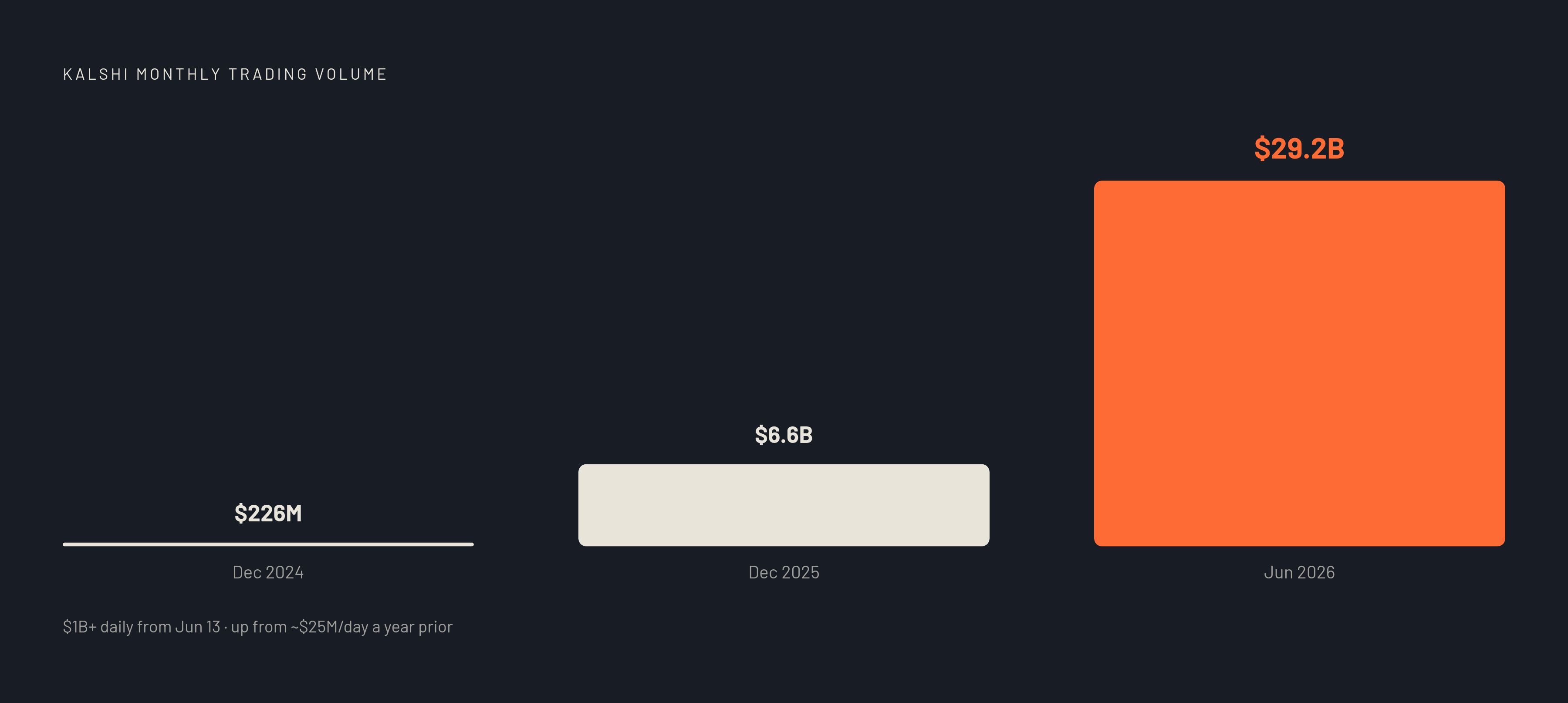
The growth curve since that structure took hold does most of the arguing on its own. Monthly volume went from $226 million in December 2024 to $6.6 billion in December 2025, then to $29.2 billion by June 2026. Daily volume has cleared $1 billion every single day since June 13, 2026, up from roughly $25 million a day approximately a year earlier. Over 10 million users now trade on the platform, and three million of those signed up during the 2026 World Cup alone.
Sports isn't a side business here. It's the business. More than 90% of site activity and 89% of 2025 revenue came from sports contracts. The week spanning the NBA Finals and the World Cup group stage, ending June 15, 2026, produced $8.99 billion in total volume, 86.9% of it from sports, and that single week outdid all of Kalshi's 2023 volume combined. Valuation followed the same climb: $2 billion in June 2025, up to a $22 billion pre-money valuation by May 2026.
What US sports markets on Kalshi actually look like for a trader
The contract menu covers championship futures, playoff paths, season-long team outcomes, and individual game markets: NFL futures, moneylines, spreads, and player props, NBA Finals contracts, soccer including the World Cup, baseball, and golf. NFL volume alone shows where this is headed. DeFi Rate projects roughly $3.2 billion in trading through Week 1 of the 2026 to 2027 season, and $57 billion across the full season, up from $7.21 billion in the prior cycle. Kalshi set a single-day record on September 5, 2026, when NCAA football generated over $318 million in volume, and total college football prediction market trading topped $790 million in Week 1 alone.
Traders can track open positions and close them early to lock in a gain or cut a loss, liquidity permitting. That "liquidity permitting" clause is doing real work: it's the closest functional stand-in for Betfair's in-play trading that exists on US soil, but how well it works depends entirely on how deep the order book is on that specific contract at that specific moment. Liquidity is strongest on US game-by-game markets, particularly NFL and NBA daily contracts, where Kalshi has concentrated the bulk of its trading volume.
Betfair's depth on Premier League football, horse racing, and cricket is real, built over two decades of accumulated liquidity on those markets. That comparison is academic, though, for a US trader who can't open an account in the first place. The order book itself runs on the same maker-taker logic found on any financial exchange: resting orders add liquidity and get better pricing, while orders that fill immediately take liquidity and pay for the privilege. Kalshi ran a Liquidity Incentive Program paying traders for placing resting orders, a direct attempt to seed the kind of depth Betfair spent twenty years building on its own.
How Kalshi's fee structure compares to what Betfair charges, and what it means for a US trader's edge
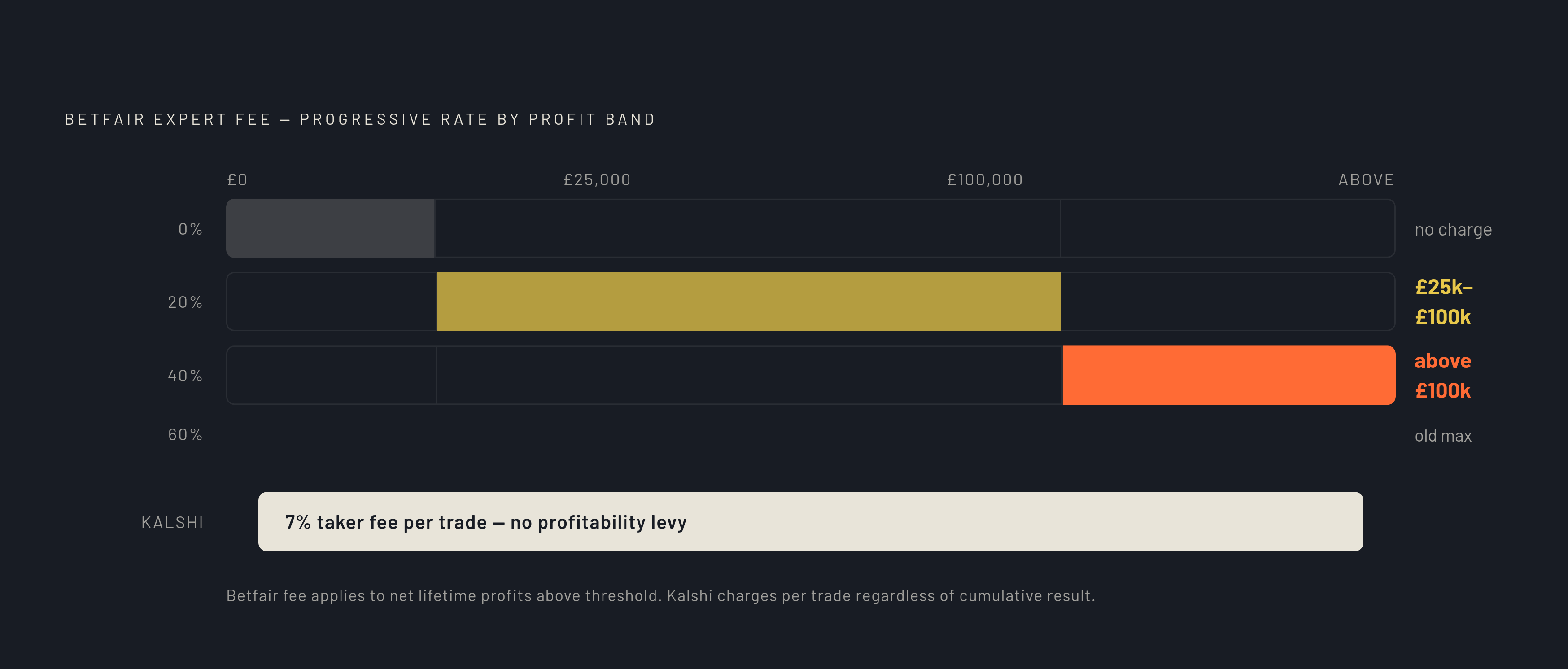
Kalshi's fee model scales with contract price under a maker-taker structure. Takers, meaning orders that fill immediately, pay more than makers, whose resting orders sit in the book and wait. Fees peak near the $0.50 mark, where outcomes are most uncertain, and shrink toward the $0.01 and $0.99 extremes, where the market has mostly made up its mind. Kalshi's taker coefficient runs at 7%.
Set that against Polymarket US, the other major CFTC-regulated platform, which charges zero trading fees on sports contracts and carries a taker coefficient of 5%. At equivalent contract prices, that makes Kalshi roughly 40% more expensive per trade, and the gap doesn't disappear once money-movement costs are added: a 2% fee on debit card deposits and a flat $2 withdrawal fee, both of which start to matter for anyone trading at volume.
Against Betfair, the picture flips entirely, and this is where most people get the comparison wrong. Betfair's 2 to 6% base commission looks cheap next to Kalshi's 7% taker fee, right up until the Expert Fee kicks in and takes 40% of everything a serious winner earns above £100,000. Kalshi has no equivalent mechanism. Its fees charge per trade, not against cumulative profitability, so a trader who gets consistently sharper at reading a market never gets punished for it the way a high-volume Betfair winner eventually does. Betfair taxes success. Kalshi taxes activity. For a US trader, the Expert Fee question is moot since Betfair isn't reachable anyway, but understanding it clarifies what "expensive" actually means here: the real cost on Kalshi isn't a ceiling on how much you can win, it's whether the 7% taker coefficient quietly eats your edge on tight, mid-range contracts, and whether placing maker orders is even realistic once you're outside the marquee NFL and NBA windows where the book runs thin.
The regulatory uncertainty that still hangs over Kalshi's US availability
Federal classification hasn't stopped the states from fighting. Nevada challenged Kalshi and Polymarket directly, arguing their sports, election, and entertainment contracts amount to gambling products that require state gaming licenses. a district court judge issued a preliminary injunction barring Kalshi from operating in the state, and the Nevada Gaming Control Board separately secured an injunction against Polymarket. Kalshi's case went to the Ninth Circuit and was decided there; Polymarket's remains in Nevada state court, after the Ninth Circuit declined to take jurisdiction over it.
The CFTC, under chair Mike Selig, has pushed just as hard in the other direction, suing Arizona, Connecticut, and Illinois, and later expanding that fight to New York, Wisconsin, Minnesota, and other states over their attempts to regulate prediction markets at the state level. Availability shifts depending on where a trader happens to be sitting, and none of it is settled. Nevada is the clearest example of what that instability looks like in practice: access that existed one day and got cut off the next by court order. Anyone opening an account should check current state status before funding it, because that status isn't fixed, and it may not be fixed a month from now either.
Set that against Betfair's footprint in its home markets, where TSE Malta LP operates under a Gambling Commission license (Licence Number: 000-039561-R-319411-007) that's been in place for roughly two decades. That's a settled regulatory arrangement, the kind Kalshi hasn't had the runway to build yet. The irony is worth sitting with: Betfair's strength abroad is stability, earned over twenty years inside a fixed rulebook. Kalshi's strength in the US is federal reach, but that reach is being contested state by state, in real time, while traders are actively using the platform underneath the fight.
What a US trader actually gets with Kalshi, and what remains genuinely missing versus the Betfair model
Strip away the theory and what's left is fairly concrete. Kalshi gives US traders legal, federally regulated access to exchange-style trading on NFL, NBA, MLB, college football, and soccer markets, with real depth on the major US game-by-game contracts. The platform's contract structure allows some position adjustment before settlement, within whatever liquidity that specific contract happens to carry at that moment. There are no sportsbook-style stake limits or account restrictions, since the exchange model doesn't punish a trader for winning the way a bookmaker's risk team eventually does. And there's no tiered levy on cumulative profit, so a trader who gets good doesn't watch the platform's cut grow alongside them.
What's still missing is just as concrete, and worth naming plainly rather than softening. True in-running trading, with continuous price movement across the length of a live event, isn't really what Kalshi's contract structure delivers: it's closer to static than fluid next to Betfair's live book. Depth on non-US sports, Premier League football, horse racing, cricket, tennis, barely exists on Kalshi, and that gap comes from twenty years of Betfair liquidity that won't close on any short timeline. The third-party ecosystem, trading software, bots, and APIs that grew up around Betfair over two decades, is also still early-stage on Kalshi's side.
None of that changes who Kalshi actually suits: US-based traders who want deep liquidity on the sports America actually watches, straightforward per-contract pricing, and a platform built around US financial regulation rather than borrowed from a UK gambling framework. Betfair was never a real alternative for these traders. It's simply inaccessible, and treating it as the benchmark obscures more than it reveals. Kalshi isn't a consolation prize standing in for it. It's the market that exists, and it's grown into one of the largest sports trading venues by volume in the country in under two years. Whether $57 billion in projected NFL volume this season can generate the kind of order-book depth traders have long associated with Betfair's marquee markets is the real test ahead, and whether Kalshi's infrastructure holds up cleanly once that volume actually lands.