Bid-Ask Spread Dynamics on Betting Exchanges
Spreads determine whether patient makers profit or impatient takers lose money.
The bid-ask spread on a betting exchange works exactly like the one on a stock exchange: the gap between the highest price a backer will pay and the lowest a layer will accept. That gap moves constantly, and the real question is who gets paid for that movement and who eats the cost. Most bettors never ask, which is the whole problem this piece is trying to fix.
Start with vocabulary, because it does real work later. A limit order book, or LOB, is a list of standing offers to buy or sell at fixed prices. A limit order joins that queue at a price the bettor picks; a market order skips the queue and takes whatever's on offer right now, which means it eats liquidity rather than adding it. Cancellations pull an order before it matches, and on an active market they happen by the thousand. Put those three actions together and the spread stops being a fixed number and turns into something closer to a pulse.
Three cost components sit inside that pulse, whether the venue is the NYSE or a Saturday football market. Order processing cost covers the overhead of running the matching engine. Adverse selection cost prices in the risk that whoever's on the other side of the trade knows something the market doesn't. Inventory risk covers the danger of getting stuck holding a position nobody wants to take off your hands. None of these show up as a line item on the Betfair screen, but all three are sitting inside the gap between best back and best lay, quietly deciding who profits.
Here's the position this piece is going to take and defend: most bettors think of the spread as a rounding error, a couple of ticks that barely matter next to the size of the bet. The data in the sections ahead shows how wrong that assumption is. A tight spread means the market agrees on the probability. A wide one means either nobody's paying attention or somebody knows something and everyone else is too nervous to quote against them. Everything below works through that idea, starting with the plumbing that makes it possible in the first place.
How Betfair's market structure maps onto a financial order book
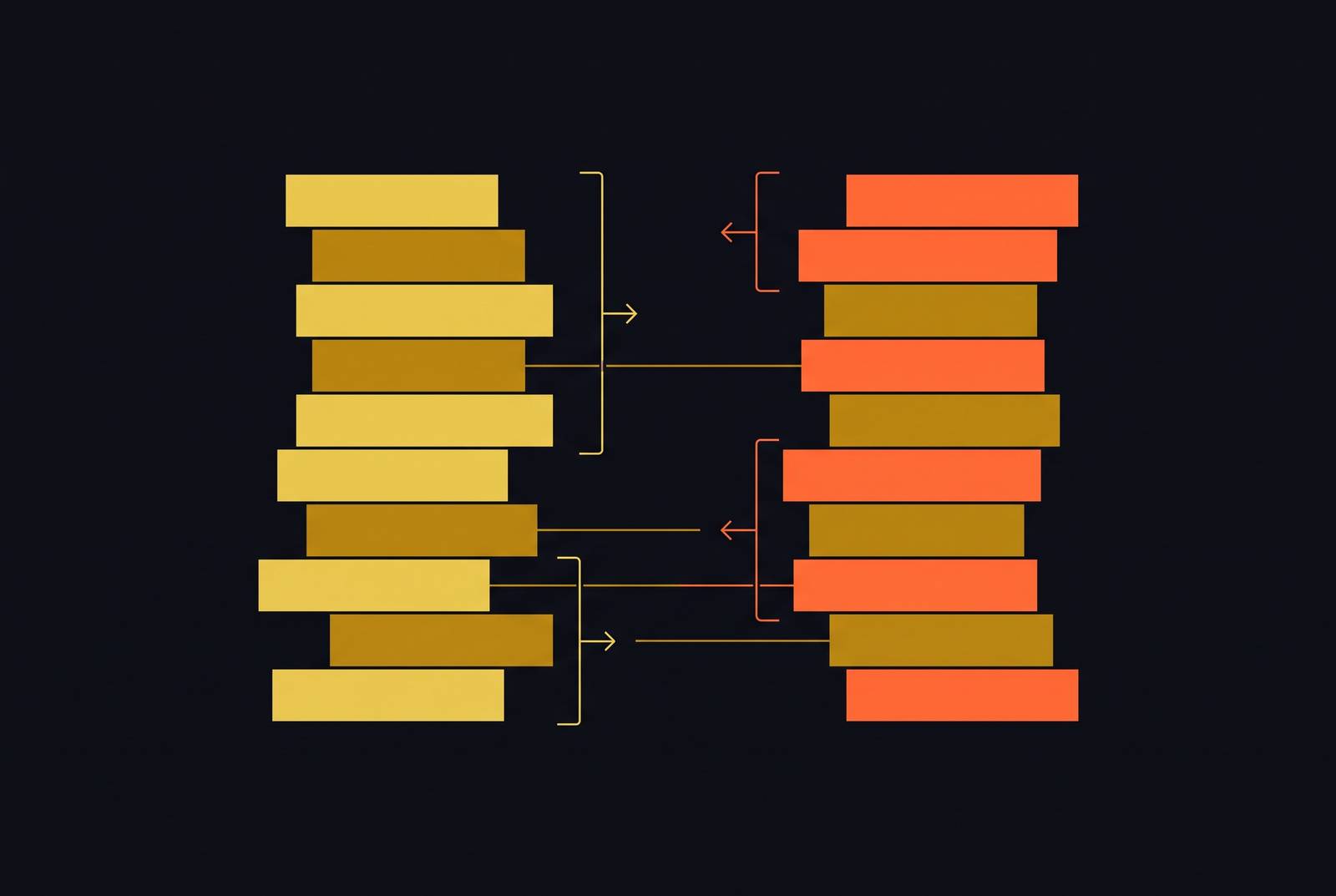
Betfair's real innovation was cutting the bookmaker out as counterparty and replacing it with a double-auction order book, the same basic architecture that clears trades on a stock exchange, where backers act as buyers and layers act as sellers. Each market is a grid: every cell holds an odds value and the total money waiting to be matched at that price.
Backs stack in descending order of odds, lays stack in ascending order, and the gap between the best back and the best lay defines the spread on that selection. When a back order meets a lay order at the same number, the system matches them with no human in the loop and no bookmaker adjusting a board by hand. Two bettors trade directly against each other; the house just runs the pipes.
The comparison to equities breaks down on the asset itself, though. A share of Apple can sit in a portfolio for thirty years, but a bet on a football match has a fixed expiry. Kickoff and full time bracket the entire life of the contract, and a binary payoff waits at the end of it. There's no rolling it over, no holding out for a better exit six months later. That constraint shapes how the spread behaves as the clock runs down, and Betfair's decision to keep the grid trading after the whistle blows created a second, far more volatile spread environment layered on top of the pre-game one. More on that later, in the section built for it.
The maker-taker asymmetry that determines who captures the spread
Here's the part most casual bettors get backwards: the spread carries a real cost, and one side collects it while the other pays it, every time, without exception.
Makers post limit orders and wait; they set the price and let someone else decide whether to cross it. Takers accept whatever's sitting on the book and execute immediately, which means they cross the spread and pay its cost on every single bet. That cost compounds fast. A 2025 University College Dublin working paper, built on more than 200,000 soccer matches from 2022 to 2024 with order book data recorded at one-second intervals, found that takers lose the most money betting on longshots before kickoff or early in the first half, while makers land close to break-even across most bets and turn a real profit laying favorites.
Sit with that for a second, because it flips the usual story about longshots being a harmless flutter. They carry a real, measurable cost, specifically for whoever's crossing the spread to get one.
Call the losing side "sitting duck" bettors, the exchange's version of uninformed retail flow in equity markets. They're betting on gut feel, club loyalty, or a hunch about a striker's form, and on the other side sits a small population of professional layers who function, in every practical sense, as bookmakers wearing a different jersey. Those layers use information and patience to skim value off the noise. That's adverse selection working exactly as designed, and it's the reason the system pays makers to show up at all. Take away that asymmetry and nobody bothers quoting tight prices anymore.
What makes a spread wide or narrow: the five forces at work
Volume matters most, and it isn't close. High trading activity means a maker isn't stuck holding an unmatched position for long, so the risk per trade drops and makers compete harder for that flow by quoting tighter. Drop into a lower-league fixture or a niche sport and watch the opposite happen: thin books mean every trade carries more risk per pound wagered, so makers protect themselves by quoting wide and hoping nobody notices the difference.
Adverse selection showed up already, but it deserves its own line here because it works as a pricing decision, not just background risk. When informed money starts flowing into a market, makers widen quotes to cover the expected loss from trading against someone who simply knows more than they do. It's the same instinct that makes a bookmaker shorten a horse's odds after a suspicious run of large bets; on an exchange, the professional layers do that repricing themselves, in real time, with nobody telling them to.
Volatility pushes the same direction, for a related reason. The less certain the outcome, the more inventory risk a maker carries on any unmatched position, so the spread widens as a form of self-insurance, the same logic that widens equity quotes ahead of an earnings release nobody's seen yet.
Tick size is the least glamorous item on this list, and also the most mechanical. A spread is always measured in whole ticks, the minimum price increment the exchange allows, so no matter how badly a maker wants to shave a sliver off their quote, the tick size sets a floor they can't get under. Financial microstructure research has flagged price discreteness, alongside the timing gaps between trades, as a genuine driver of spread behavior for decades; Betfair's odds ladder runs on the exact same constraint.
Last, competition among makers, which is really just volume measured a different way. More liquidity providers chasing the same order flow means more undercutting, and undercutting is the only thing that reliably narrows a spread. Betfair's scale in football and horse racing produces some of the tightest spreads anywhere in exchange betting for exactly this reason. Wander into a market with three interested parties and one stubborn layer, though, and the spread balloons right back out. Scale drives most of this story, and the other four forces mostly explain the exceptions.
How spreads self-correct after a shock — and why they don't snap back instantly
A red card, a shock goal, a late scratching: something knocks the market off balance and the spread spikes. What follows is a slow decay toward whatever the new equilibrium turns out to be, and that lag is the part worth actually paying attention to.
Order book research calls this self-exciting behavior: one liquidity shock raises the odds of another shock following soon after, an effect captured formally using Hawkes process models in market microstructure literature. Cancellations beget more cancellations, which widens the spread further; a rush of matched trades tightens it just as fast. The dependence between these order types clusters, it doesn't scatter randomly, and layered on top of that clustering is a daily rhythm: order intensity, and spread tightness with it, runs narrower during peak trading windows and wider once the crowd's attention has drifted elsewhere.
That has a blunt, practical payoff for anyone actually placing a bet. The moment right after a market opens, or right after something unexpected happens, is when the spread sits at its widest and taking a price costs the most. Patience earns its keep specifically here: posting a limit order and waiting for the spread to compress costs less than reacting instantly and crossing it while it's still blown open. It's the betting equivalent of not buying a stock in the thirty seconds after an earnings surprise, before anyone's worked out what the number actually means.
In-play betting: where spread dynamics become most extreme
Pre-game markets get information in occasional bursts: team news, an injury update, a weather report, and the spread sits relatively calm between those moments. In-play markets get information constantly, timestamped to the second, and the spread behaves like something closer to a live news feed than a static price.
Goals and red cards move odds in discrete jumps, not smooth drift; between those jumps, prices creep gradually as the clock runs and momentum shifts one way or the other. On marquee football matches, some bettors on Betfair place thousands of bets across a single game, reacting to what's unfolding on the pitch in something close to real time. Academic work on how spreads actually behave during live play is thin on the ground, a strange gap given how much money moves through this window.
Here's the mechanism that matters: the instant a goal goes in, the spread widens sharply because makers pull their quotes or reprice them fast, trying to dodge adverse selection from bettors whose data feed is running a second or two ahead of theirs. Then it self-corrects as the new probability settles and makers regain enough confidence to quote around it again. Low-latency API traders hold a real structural edge in this window for exactly that reason: they post the new price before the rest of the market catches up, which means they capture the spread instead of paying it. Speed matters more here than almost anywhere else in the exchange.
How exchange spreads compare to the bookmaker's built-in margin
A bookmaker's overround, sometimes called the vig or the juice, is a permanent spread the bettor always crosses and never gets the other side of. There's no maker on the other end of that transaction; the house is always the counterparty, and its margin sits baked into every price on the board whether the bettor notices it or not.
On an exchange, the spread moves and can be avoided, partly, by posting a limit order and waiting for a match instead of taking the standing price. A bookmaker's margin moves far less and is harder to dodge that way. The liquidity data draws a sharp line around exactly where the exchange's advantage runs out.
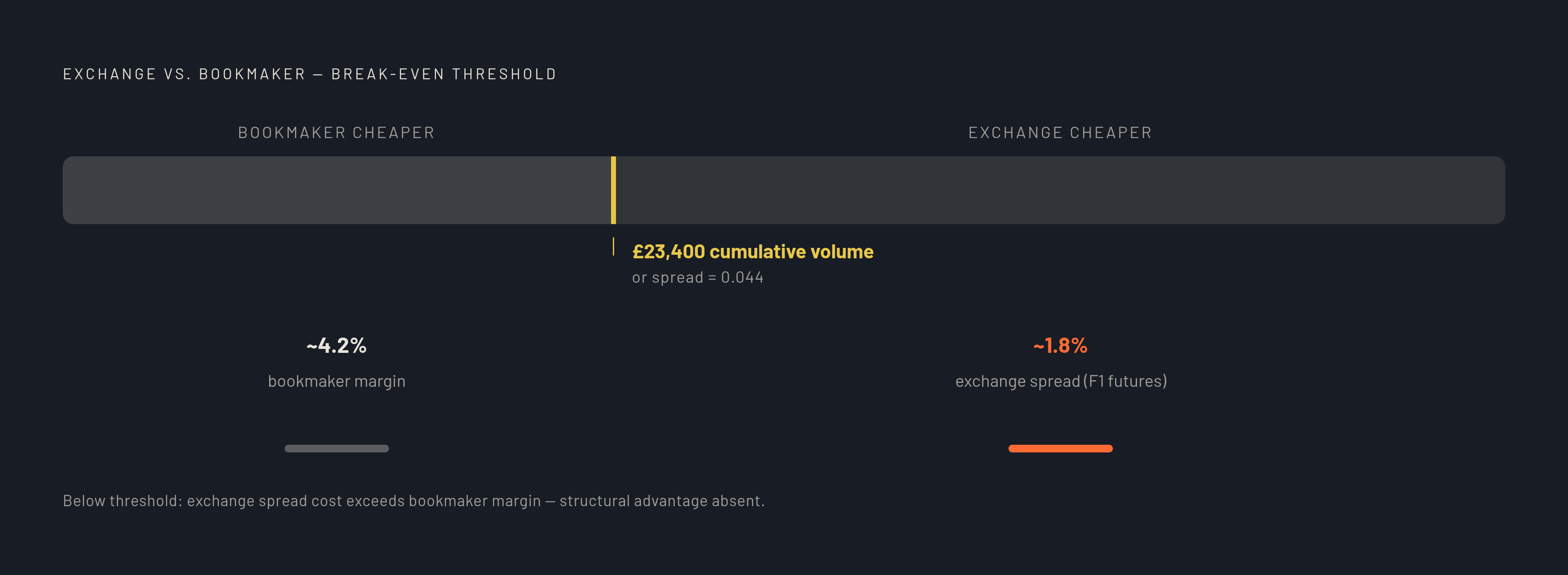
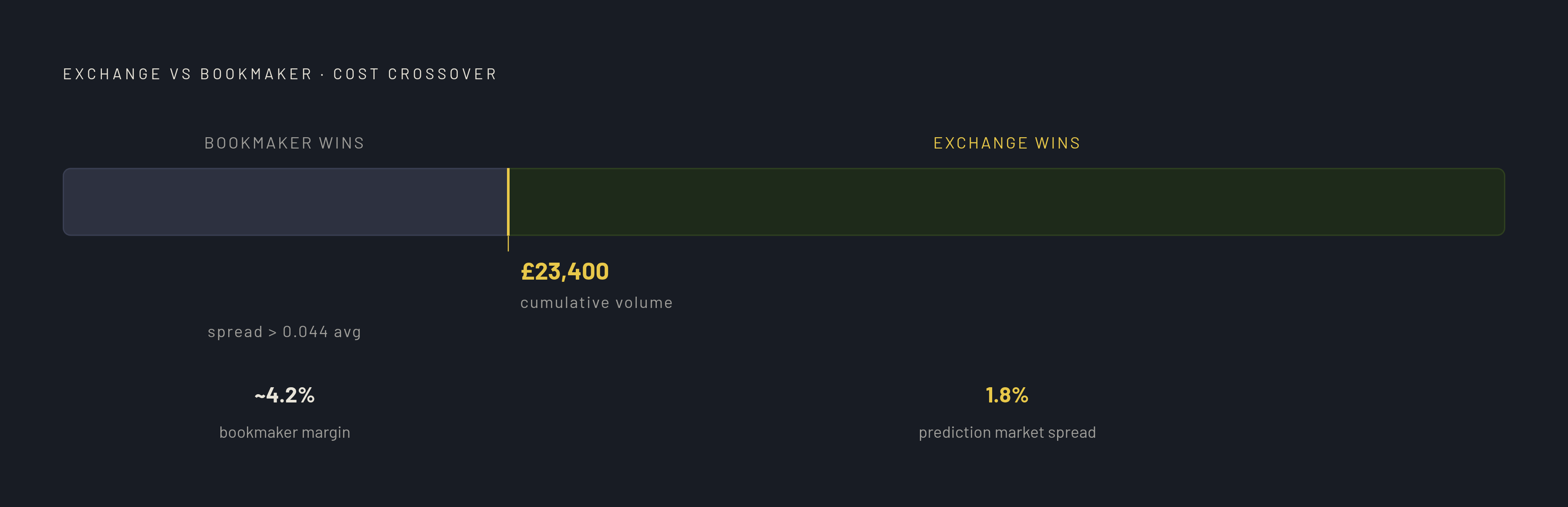
Research matching more than 1.8 million bookmaker and exchange odds across 17,410 soccer matches found a threshold worth remembering: bettors got better prices at the bookmaker whenever cumulative exchange volume sat below £23,400, or when the quoted exchange spread ran wider than 0.044 on average. Below that line, the theoretical edge of trading on an exchange disappears; the spread can genuinely cost more than the bookmaker's built-in margin would have.
Above that line, the picture flips hard, and this is the part worth getting right if only one number sticks. Prediction market spreads on Formula 1 futures average around 1.8%, against roughly 4.2% for bookmaker margins on comparable markets. That gap isn't close to a contest. Liquidity, more than pricing philosophy, is doing most of the work in that number.
Commission structures and how they widen the effective spread beyond the quoted one
The number on screen understates the full price of doing business. Commission gets charged on winnings, and that charge widens the effective spread a bettor actually pays well past whatever gap showed up on the order book at the moment of the trade.
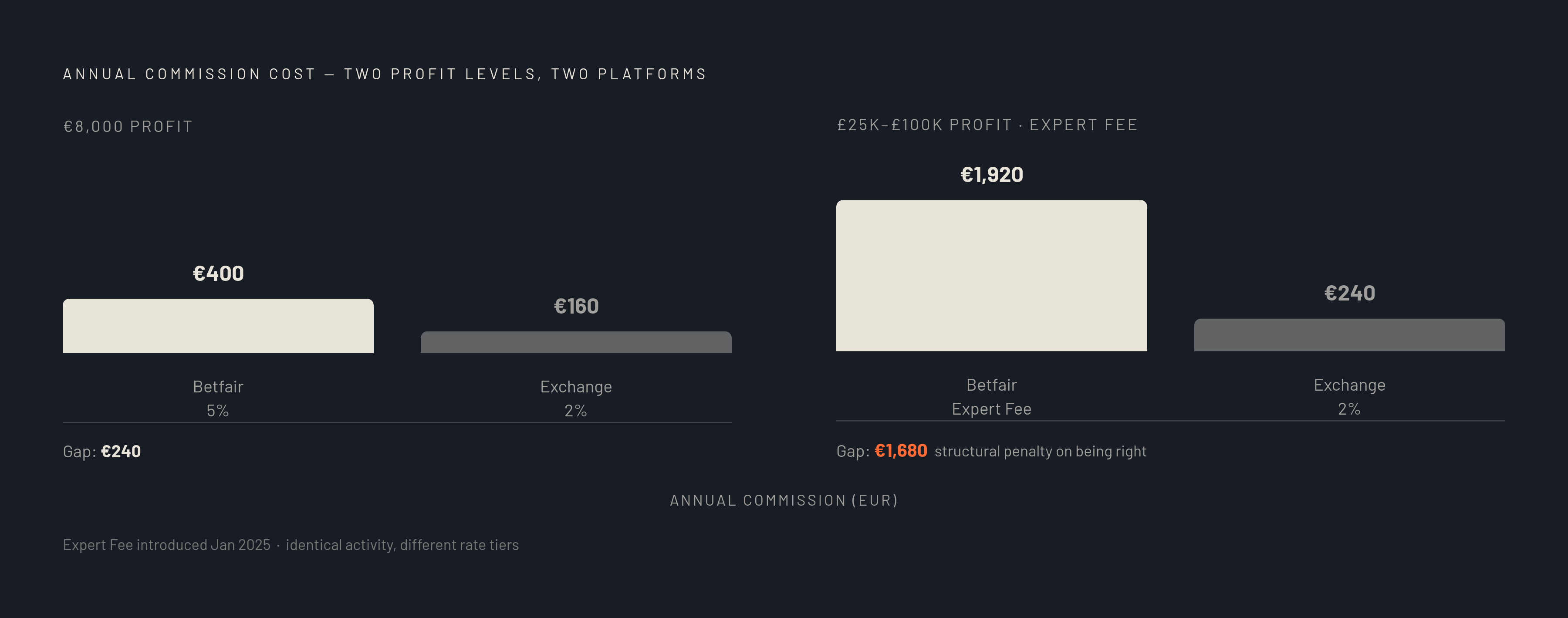
Betfair charges 5% standard commission in the UK, the highest among the major exchanges; Smarkets, Matchbook, and BETDAQ all sit at 2%. Run €8,000 of profit through both and the gap is stark: €400 in commission at 5%, versus €160 at 2%, a €240 difference before anything else enters the picture.
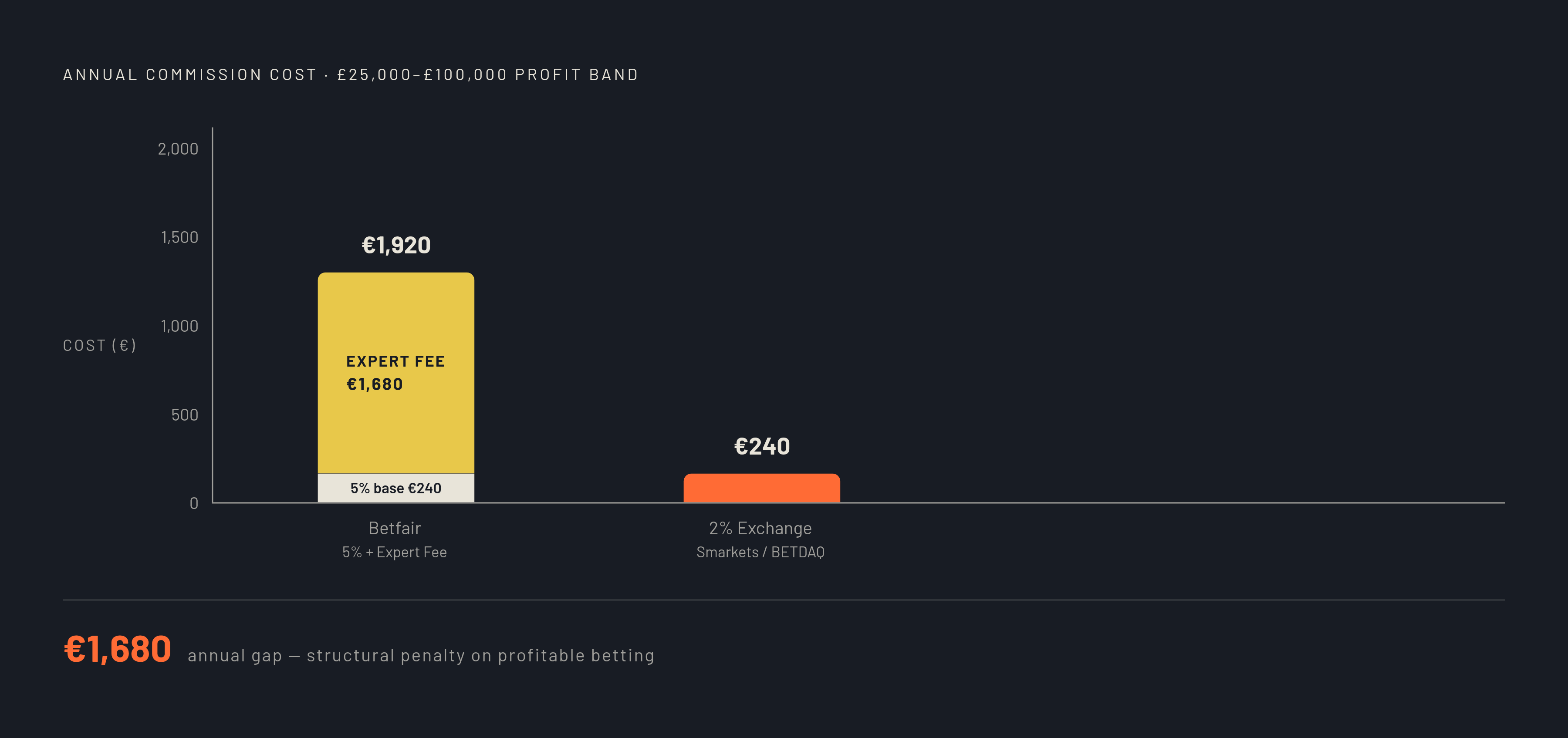
It gets worse for anyone betting seriously, and this is where the fee structure stops being a rounding error and starts being a design choice. In January 2025, Betfair introduced a new commission structure called the Expert Fee. Bettors under £25,000 in gross profit over a rolling 52 weeks pay nothing extra; cross into the £25,000 to £100,000 band and a 20% Expert Fee applies. Work through what that means for someone who qualifies: total annual cost reaches €1,920 on Betfair, against €240 on a 2% exchange, a gap of €1,680 a year on identical betting activity. That functions as a structural penalty on being good at this.
The volume numbers suggest bettors have noticed. Inflation-adjusted traded volume on Betfair's UK and Irish win markets dropped from over £1.5 billion in 2020 to below £1 billion in 2024, and the causes of that decline extend beyond commission changes alone. There's a feedback loop worth naming plainly: higher effective spreads chip away at a maker's incentive to quote tight, which widens the quoted spread further, which makes life worse for takers, and the cycle feeds itself without needing any outside push.
Where the major exchanges stand on the liquidity-versus-cost tradeoff in 2025
Strip away the noise and the choice between exchanges comes down to one tradeoff: a wider quoted spread on a cheap platform, or a tighter quoted spread on an expensive one. Nobody gets both for free, and pretending otherwise is how bettors end up losing money to a fee schedule instead of to bad predictions.
Betfair still runs the deepest liquidity in football and horse racing, opens markets earliest, and covers more events than any competitor. Because so much of that liquidity comes from organic user activity rather than injected market-making, its odds tend to reflect genuine consensus, which is exactly why professional traders keep using Betfair for the biggest markets despite everything in the section above. Yet the 5% commission, and the Expert Fee sitting on top of it, make the platform expensive to be consistently profitable on once volume clears the £25,000 threshold. That's not a small asterisk. It defines the whole tradeoff.
Smarkets, at 2% commission, is the better home for anyone finishing the year in the black; its liquidity, while growing, still trails Betfair by a wide margin outside the most popular markets. BETDAQ and Matchbook sit at 2% too, occupying a middle tier on depth, most useful as a secondary check against Betfair's prices or a fallback when commission eats too far into an edge.
Here's the actual conclusion: for casual, low-volume betting, Betfair's liquidity is worth the 5%. For anyone consistently clearing £25,000 in profit, staying on Betfair out of habit means paying the Expert Fee for the privilege of being right too often. The £23,400 liquidity threshold from the matched-odds research draws the sharper line, though, sharper than any commission comparison. Below that volume, the exchange spread may already run wider than a bookmaker's overround, and at that point the exchange has lost its structural advantage no matter what percentage it charges on winnings. Betting seriously means combining three habits, rather than picking one venue out of loyalty and sticking with it forever: use the deepest-liquidity exchange for the biggest markets, post limit orders instead of taking whenever patience allows, and fold commission into the real cost of the trade before comparing platforms at all. Skip that last step and the comparison was never real to begin with.