Implied Probability vs True Probability in Event Contracts
Market prices embed behavioral bias that structural fixes can't eliminate.
Event contracts price probability directly: a contract at $0.65 pays $1 if the outcome happens, $0 if it doesn't, and the price sits between those extremes because two sides genuinely disagree about which way things break. Most people read that price as a probability and stop there. That reading skips a step: the gap between price and probability is where informed traders make money and everyone else bleeds it out slowly, one contract at a time. Here's the position worth stating up front, because the rest of this piece argues for it section by section: the structural fixes people get excited about, order books instead of sportsbooks, no vig, transparent pricing, matter less than the behavioral bias that survives all of them. Fix the plumbing and the water still runs uphill at the extremes.
There's no partial credit on an event contract, no "sort of happened." Convention says to read the price as a probability, and that's fine as far as it goes. But "the market thinks" is doing an enormous amount of unpaid labor in that sentence. Figuring out what it's actually saying requires knowing where the price came from, and that's a different question entirely from whether the price is right.
A sportsbook takes the other side of the bet, so it prices to make money regardless of who wins. An order-book market like Kalshi or Polymarket matches buyers and sellers instead and lets the price land wherever the two sides agree. One structure bakes a margin into the number; the other doesn't. The tempting conclusion is that the second one must therefore be trustworthy, and that conclusion needs qualifying. Strip out every structural distortion available and a stubborn behavioral error still sits in the price. That error gets its own section further down, and it's the one that should worry a careful trader more than any sportsbook's vig ever will.
Implied probability: what the price is literally saying
Implied probability is the win chance baked into a price, expressed as a percentage. For American odds, the conversion depends on which side of zero the number lands on. Positive odds, say +150, convert with 100 ÷ (odds + 100), landing at 40%. Negative odds, say -200, convert with |odds| ÷ (|odds| + 100), landing at 66.67%. Decimal odds skip the branching logic entirely: take 1, divide by the decimal. A 2.50 becomes 40%, the same number as the +150 above, arrived at through a different calculation.
On an order-book prediction market, none of that conversion is necessary. The traded price is the implied probability. A contract sitting at $0.65 means the market is pricing a 65% chance, full stop, no unit conversion required.
Here's the part worth sitting with, because it's the single most common error in reading any event contract: implied probability tells you what the price is offering. What is actually going to happen is a separate question, and the rest of this piece argues about how far apart the two can drift, and under what conditions the drift gets predictable enough to trade against.
Where the gap comes from in sportsbook pricing
Sportsbooks build in profit by making sure implied probabilities across all outcomes add up to more than 100%. That excess has a name depending on which corner of the industry you're standing in: overround, vig, juice, the same math measured differently.
A two-outcome market priced at -110 on both sides, standard for a lot of point spreads, converts to roughly 52.4% on each side. Add them together and the total lands somewhere north of 104%, well above the true total of 100%. That extra four-and-change percent doesn't belong to either team. It belongs to the house. In a genuinely fair market with no margin, each side would sit at exactly 50%, and nobody's cutting a check for the privilege of betting.
Every implied probability at a sportsbook therefore runs inflated above the true likelihood, favorite and longshot skewed the same direction, just by different amounts depending on how lopsided the line runs. Devigging fixes this, and the arithmetic isn't hard: sum both sides' implied probabilities to get the overround, then divide each side's number by that total. What comes out is the no-vig probability, the market's actual assessment with the house's cut peeled off.
Worth flagging: no-vig probability is still just the market's opinion with the profit motive subtracted. It carries no independent guarantee of accuracy. Devigging clears one layer of distortion, and the layers underneath matter more, which is exactly where this piece spends the rest of its time.
How prediction market order books change the gap's structure
Order-book markets skip the overround entirely, because there's no house taking the other side of the trade that needs protecting. Fees still apply, structured differently and generally a lot smaller: Polymarket takes roughly 2% on winning positions, Kalshi charges up to a 3% taker fee. Set that against sportsbook vig running several times higher per side, and fee drag on an order-book market starts to look almost incidental by comparison. Keyrock's 2025 analysis of more than 5,000 comparable markets found Kalshi and Polymarket offering 77% better odds on average than traditional sportsbooks, which is the structural difference showing up as a real, countable number.
That's the strongest evidence here that mechanism design matters before anyone's psychology even enters the picture. A lot of prediction-market enthusiasm quietly overreaches here, treating a cleaner pricing mechanism as a guarantee of an accurate one, and the two are separate claims. Removing structural margin removes one source of distortion; the price still has to earn trust rather than inherit it.
What remains, once nobody's deliberately padding the number, is a function of how informed the traders showing up actually are, how much liquidity the contract has attracted, and one behavioral bias that doesn't care how the market is built. That bias is stubborn enough to earn its own section below.
How well prediction market prices track reality in aggregate
Calibration asks one question: do contracts priced at 70% actually resolve true about 70% of the time, close enough across a large enough sample? The standard measurement is the Brier score, the mean squared error between predicted probability and actual outcome. Random guessing scores 0.25. Lower is better, and zero would mean perfect prediction, which nothing achieves.
A Kalshi calibration study covering 2,243,741 resolved markets, from launch through mid-2026 across eleven categories, found the aggregate Brier score falling from roughly 0.08 to 0.09 at a three-month horizon down to about 0.02 right at close. Prices tighten hard as resolution approaches, which is exactly what a functioning market is supposed to do: uncertainty resolves as events unfold, traders update on new information as it lands. High-liquidity contracts, over $1 million in total volume, did even better: 0.0256 twelve hours out, tightening to 0.0159 a day before resolution.
That's the aggregate picture, and it's a good one. An average, though, is a number built to hide its own worst cases. The next section is where those cases live, because the mean masks a bias that shows up reliably at the edges of the price range, and it's the part of this piece that actually matters for anyone trading rather than just admiring the scoreboard.
The favourite-longshot bias: the most persistent gap between price and reality
Most people assume a clean structure, no vig, a transparent order book, real money on both sides, guarantees an accurate price. The evidence complicates that assumption considerably. The error runs in one direction so consistently, especially at the extremes, that it has a name, and it survives every structural fix covered above.
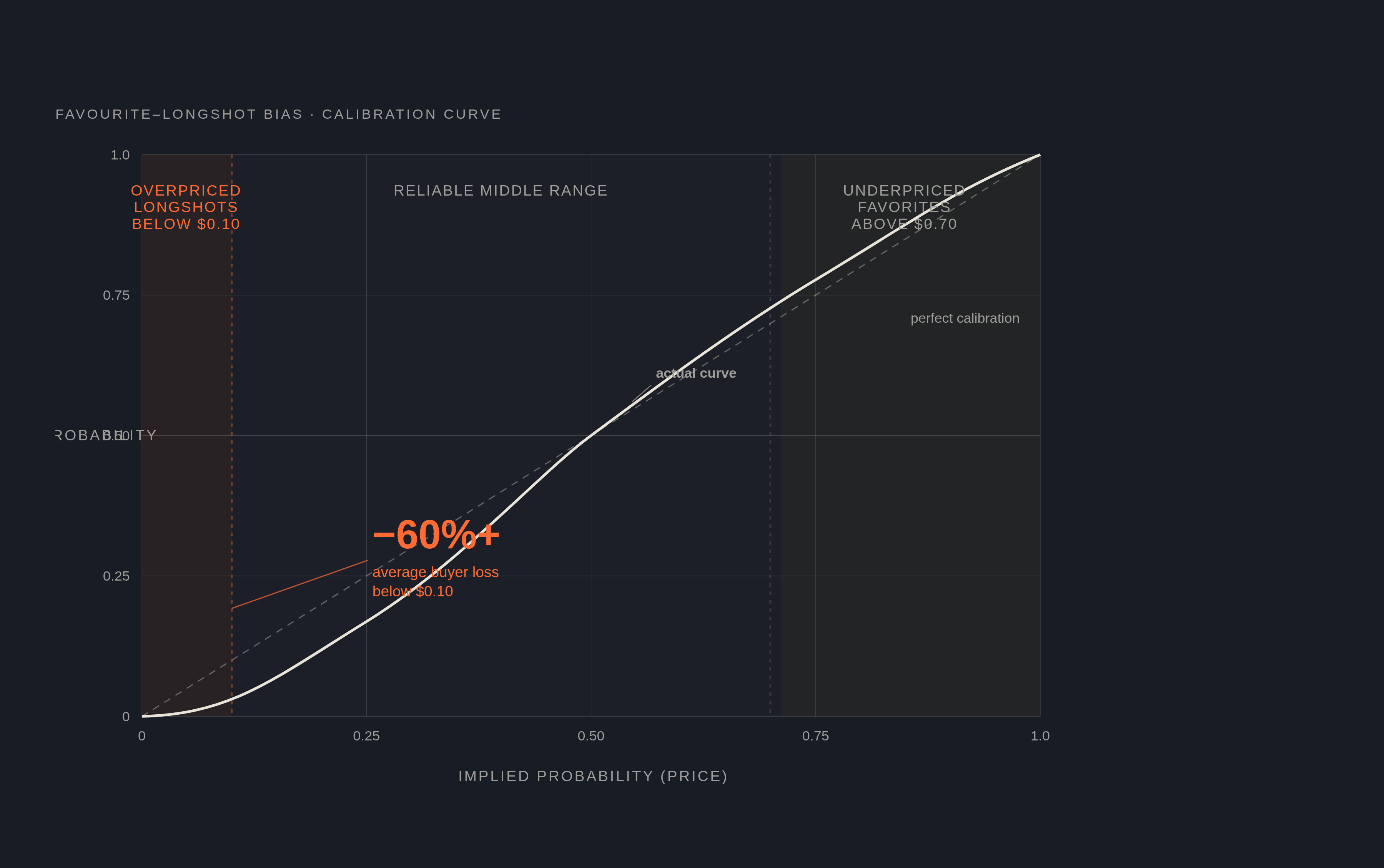
An analysis of over 300,000 Kalshi contracts documents a clear favourite-longshot bias. Low-priced contracts win far less often than their price implies; high-priced contracts win more often than theirs does. Investors buying contracts priced below $0.10 lose over 60% of their money on average. This pattern is systematic, not noise, and it's the single most tradeable fact in this entire piece.
Worth unpacking slowly, because the mechanism is the whole point. A contract priced at $0.70 corresponds, empirically, to a true win probability higher than 70%: the favorite gets systematically underpriced. A contract at $0.10 corresponds to a true probability lower than 10%: the longshot gets systematically overpriced. The calibration curve behaves like a rubber band stretched between 0 and 1, pulled inward from both ends toward the middle: extreme probabilities get compressed, understated at the top, overstated at the bottom.
Maker and taker behavior makes it worse. Takers, traders who cross the spread to fill an order right now, lose an average of roughly 32% on longshot contracts. Makers, who post limit orders and wait, lose roughly 10% on the same category. That 22-point gap is the price of impatience: wanting into a longshot immediately costs measurably more than waiting for one to come to you.
This isn't confined to thin markets with three people trading, either. The bias holds across all five liquidity quintiles, including the highest-volume markets, which rules out "not enough traders" as the explanation. Snowberg and Wolfers documented the identical pattern in horse racing back in 2010, long before anyone built an order-book prediction market. That's the tell. The bias shows up wherever people bet on binary outcomes, across technologies and eras alike, which puts the cause in human psychology rather than market microstructure. A low-priced contract's sticker price should be read as a probable overestimate, because the data says that's exactly what it usually is.
Where calibration varies by domain and liquidity
Calibration isn't one number. It shifts by category, by time horizon, and by how much money is actually moving through the contract, and treating a single Brier score as universal is how people get burned trusting a market that doesn't behave like the one they read about.
Economic and macro markets, the ones tracking CPI prints, Fed decisions, jobs reports, post the best calibration of any tracked category. Not a coincidence: these outcomes are objective, quantitative, and tied to scheduled data releases that sophisticated participants have already modeled to death before the market even opens. Sports markets calibrate well too, with pre-game prices beating in-game prices for accuracy; live markets lag actual events by 10 to 30 seconds after a score changes, a narrow mechanical window that's exploitable for exactly as long as it takes the market to catch up.
Crypto and entertainment markets sit at the other end of the table. Sentiment and narrative push those prices around in ways that resist modeling, and a single viral clip moves them faster than any actual underlying development does.
Thin markets are a separate problem, and this is the one worth taking seriously regardless of category. Single-game sports contracts, low-volume weather markets, a freshly listed political contract with no trading history: a handful of large orders can shove the implied probability far from any defensible base rate, and correction takes hours or days instead of minutes. A market with only a few hundred contracts traded is a hypothesis, not a number worth leaning on, and treating it as settled fact is the most common mistake a newcomer makes.
Liquidity is the biggest single driver of accuracy across every category in the data, more than category, more than time horizon, and it's the point most people underweight when they cite a Kalshi Brier score without checking volume first. High-liquidity contracts clear the 0.1 Brier score threshold that marks good performance, while thin markets vary far more widely. Volume functions as the actual mechanism here, informed traders need enough depth in the book to find a mispriced contract and correct it. Correction and convergence toward the true number simply don't happen without it. Some thin markets still post scores below 0.1, so this is a tendency rather than a law, but the variance around the low-liquidity average runs a lot wider than around the high-liquidity one, and that width is the actual risk.
Reading the gap in practice: what an informed participant actually does differently
The gap between implied and true probability has structure. Understanding that structure is the actual skill, more valuable than any single piece of insider information, and it holds regardless of which platform the contract lives on.
Start by naming what kind of gap sits in front of the price. Sportsbook prices carry a structural margin, so devig first, before comparing anything to an independent estimate. Order-book prices sit closer to raw probability, with fee drag sitting alongside as a smaller, separate cost rather than something baked into the number.
Then locate the contract on the probability spectrum, because reliability depends heavily on where it sits. Below $0.10, implied probability has a documented habit of overstating the true chance, so extra skepticism is warranted, especially if the impulse is to buy in as a taker chasing a longshot. Above $0.70, the pattern flips: implied probability tends to understate reality, meaning favorites are often the better bet than the price admits to. In the middle of the range, calibration tightens, and the price comes closest to earning trust on its own terms.
Check liquidity next. A high-volume market has been stress-tested by a crowd of people putting real money against each other, and that's earned some credibility. A thin market hasn't been tested by anyone in particular, and its price is a hypothesis your own research either confirms or knocks down.
Form an independent estimate next, and hold it against the market's number, honestly. If that estimate clears the implied probability by enough to cover fees and cover residual uncertainty, the gap might be real, positive expected value rather than noise. Comparing an independent number to the market's, and being willing to find out it's wrong, is what separates analysis from a guess with a spreadsheet stapled to it.
None of this promises profit. The favourite-longshot bias persists in liquid markets too, which means professional traders already know about it; awareness doesn't make the bias vanish, it just means everyone's competing for the same sliver of edge. No-vig probability, even after the cleanup, remains the market's opinion with the margin subtracted rather than verified truth, and an independent model has to actually be right before any of this arithmetic pays out. The discipline is thinking through the structure of the price every single time, before money moves.