Settlement Rules and Edge Cases in Sports Event Contracts
How sportsbooks and exchanges decide what counts as a valid bet outcome.
Sports event contracts and sportsbook props both boil down to the same promise: a bet resolves cleanly to a payout, or it doesn't. But "cleanly" is doing an enormous amount of work in that sentence, and the fine print on how outcomes get confirmed, revised, or thrown out is where the real contract lives. What follows is a tour of that fine print, from the settlement engines running underneath Kalshi, FanDuel, and Fanatics, to a federal court fight over whether any of this even belongs to state gaming regulators in the first place.
How the resolution engine actually works across platforms
Kalshi's approach starts with a filing, not a whistle. Every market names a "Source Agency," some data feed, government report, or official statistics release, and that source gets filed with the CFTC through self-certification before a single contract trades. Once the named source confirms an outcome, Kalshi's internal markets team finalizes it. Traders can hit a "Request to Settle" button, but don't mistake that for a lever with any actual mechanical force behind it. It's a suggestion box. The exchange keeps the pen.
That system works beautifully when the source agency does its job on schedule. Box score posts, market settles, money hits the cash balance relatively quickly. The stress test only shows up when the source goes quiet, or delayed, or gets contradicted by some other equally official-looking number.
Sportsbooks never had a single source agency to lean on in the first place, so each operator wrote its own rulebook instead. FanDuel's House Rules settle on the official result declared by the relevant governing body "at time of settlement," regardless of anything that gets overturned later. There's a wrinkle for events with a presentation ceremony: settlement locks to whatever the official result was at that ceremony, and if FanDuel already settled markets before the ceremony happened, it reserves the right to go back and resettle. When no governing body has spoken yet, FanDuel falls back on "reliable independent sources" and settles "acting reasonably," a phrase that sounds soothing right up until you're the one arguing it wasn't reasonable. Within 48 hours, FanDuel may determine whether a settled market should be reinstated in light of new information.
Fanatics runs a tighter clock. Results pass through directly from the governing body or official data provider, and 24 hours after announcement, that result is final. Fanatics can wait out that window if an inquiry or appeal is pending, but anything that surfaces after the 24 hours doesn't touch settlement. FanDuel allows up to 48 hours for new information to reopen a settled market; Fanatics closes the window at 24 hours.
Line all three up and the shared architecture is obvious: name an outside authority, defer to it, and keep just enough internal discretion to cover the gap when that authority is slow, silent, or wrong. Where they split is the width of the reopening window and how much independent judgment the platform is willing to exercise when nobody official has said anything yet. It's the same skeleton wearing different amounts of clothing.
When a match doesn't finish: the abandoned-versus-postponed line and what rides on it
Here's a distinction that sounds like semantics until money changes hands over it. A postponed match gets rescheduled before any action starts. An abandoned match has already started and simply can't finish. Once the ball is kicked, hit, or thrown, anything that stops the game counts as abandonment, not postponement, and that single word choice can determine whether a wager is void, active, or something stranger in between.
The general default across the industry treats abandoned and postponed games as void, unless the match gets replayed within a short window of the original start time. Minimum-play thresholds complicate that further. Some books need at least ten minutes of official fourth-quarter time on the clock before a bet has "action" at all; other sports get their own bespoke cutoffs.
Venue changes turn this into a genuinely tangled problem. Betfair's published football rules let a bet stand if the match moves to a different venue, but void it if the match relocates specifically to the opposing team's home ground. Major tournaments like the World Cup get an exception of their own: every venue there counts as neutral, which affects how venue-change rules apply to those matches. DraftKings solves the same puzzle differently, tying the bet to whichever team is designated "home," regardless of what stadium they're actually standing in. Two operators, two entirely different definitions of what "home field" even means for settlement purposes. Somewhere a soccer purist is holding their head in their hands.
There's a cleaner exception when the outcome already got locked in before play stopped. If a relevant threshold was crossed before an abandonment, some books may settle that specific market on the basis that the outcome which mattered already occurred. Time-sensitive markets like correct score or next goalscorer don't get that grace; if the outcome wasn't determined before the whistle stopped everything, those bets typically void.
A match abandoned mid-play illustrates how far governing-body reality and bookmaker settlement can drift apart. A governing body may award a result through its own disciplinary process. Sportsbooks settle on the score at the time of abandonment, because their contract terms never promised to track a governing body's disciplinary outcome. Two entirely legitimate, entirely official results can exist simultaneously, and neither one defers to the other. That's not a bug in the system. That's the system working exactly as written, which might be the more unsettling conclusion.
Player injury mid-game and the commercial arms race over prop-bet protection
The old rule was simple almost to the point of being cruel: get hurt before kickoff, your prop gets voided and refunded. Get hurt in the third quarter after someone already bet on your rushing yards, tough luck, the timing of the wager is what matters, not the timing of the injury. That asymmetry sat largely unchallenged for years, until it became a marketing opportunity instead of a liability.
Fanatics moved first with "Fair Play" in 2024, covering NFL, NBA, MLB, NHL, WNBA, MLS, international soccer, and both golf and tennis. For the 2025 NFL season, the coverage window stretched from just the first quarter to the entire first half, which sounds like a modest tweak until you consider how many prop bets on skill-position players actually resolve inside that window. When LaMelo Ball went down in the first quarter on New Year's Day 2025 and didn't return, Fanatics voided and refunded every prop tied to his performance under that policy, no drama, no dispute.
The number that actually turned heads came a few months later. Stephen Curry exited Game 1 of the Western Conference semifinals against Minnesota in the second quarter with a hamstring injury, and Fanatics refunded more than $500,000 in props tied to his stat lines. One bettor out of Michigan had a four-leg parlay riding on the slate; with Curry's leg voided and the remaining three legs cashing, the payout landed at $224,773. Jimmy Butler, Ja Morant, and Russell Westbrook triggered the same mechanism during that postseason. That's not charity, and nobody's pretending it is. It's a retention tool wearing a fairness costume, and it works because bettors remember which platform gave their money back and which one didn't.
DraftKings answered in August 2025 with "Early Exit," which handles single bets by crediting the stake back outright, and handles parlays by voiding just the injured player's leg and recalculating odds on whatever's left. The qualifying windows are sport-specific down to a granular level: first quarter for NFL and WNBA, first period for NHL, first quarter for NBA regular season but the entire first half in the postseason, before three outs recorded for MLB pitchers, before a second plate appearance for hitters, subbed off before halftime for soccer (halftime subs don't count), and withdrawal before the second round even starts in golf. Only players who actually start the game qualify, which is its own quiet exclusion worth noticing. When Tyrese Haliburton suffered a lower right leg injury in Game 7 of the 2025 NBA Finals, DraftKings voided certain over props under this exact mechanism.
Widen the lens and the real story isn't generosity, it's competition. Every revision to a coverage window (first quarter to first half, single bets versus parlays, starters only) is a new line drawn in sand that will shift again the moment a competitor draws theirs differently. Worth asking: what happens the season some operator decides half of regulation is too generous and quietly narrows it back? Nobody's said that's coming. But the incentive to redraw these lines runs in both directions, not just toward more coverage.
Kalshi sits entirely outside this dynamic, and a trader found that out the expensive way, losing $30,000 on a tennis market after misreading how Kalshi's settlement mechanics actually work. There's no injury-protection refund policy to fall back on there, because prediction markets and sportsbooks aren't running the same kind of contract underneath the surface, even when the bet looks identical to a casual observer.
Post-settlement disqualification and the finality problem
Once a governing body declares a result, most operators treat that declaration as the end of the conversation, and they say so explicitly. FanDuel's language settles the matter "regardless of any subsequent disqualification or amendment to results." Under some operators' rules, after a set window runs out, later disqualifications simply don't count toward how the bet already settled. Sportsbet in Australia runs the same principle with one narrow crack in it: if an amendment shows up within 24 hours specifically correcting an error in how the result was reported, the book can resettle. Correcting a typo, in other words, not relitigating a verdict.
The ceremony rule adds its own wrinkle to FanDuel's finality clock. Settlement locks to the official result at the moment of the presentation ceremony, not to whatever a governing body decides weeks or months down the line through an appeals process. That's often a much earlier moment of finality than the sport's own disciplinary system provides for.
Doping cases in Olympic cycling make the mismatch between these two clocks almost comically stark. Disqualifications in that world routinely surface months, sometimes years, after the competition ends, running on an entirely different timeline than any sportsbook's 24 or 48-hour settlement window. The operator's rule exists to protect against retroactive liability piling up indefinitely, which is a reasonable business position. But it also means winnings occasionally get paid out on an athlete later proven to have cheated, while a clean competitor bumped from the podium after the fact gets no corresponding refund for anyone who bet against them. Structurally consistent, felt as deeply unfair by more or less everyone involved.
What the 24-hour window is actually built for, in most of these rulebooks, is correcting a reporting error, not relitigating a substantive result. The trouble is that the line between "the scoreboard operator typed the wrong number" and "the governing body changed its mind" isn't always obvious in the moment, and that ambiguity is exactly where disputes tend to land.
The jurisdictional fault line: when federal preemption and state gaming law collide
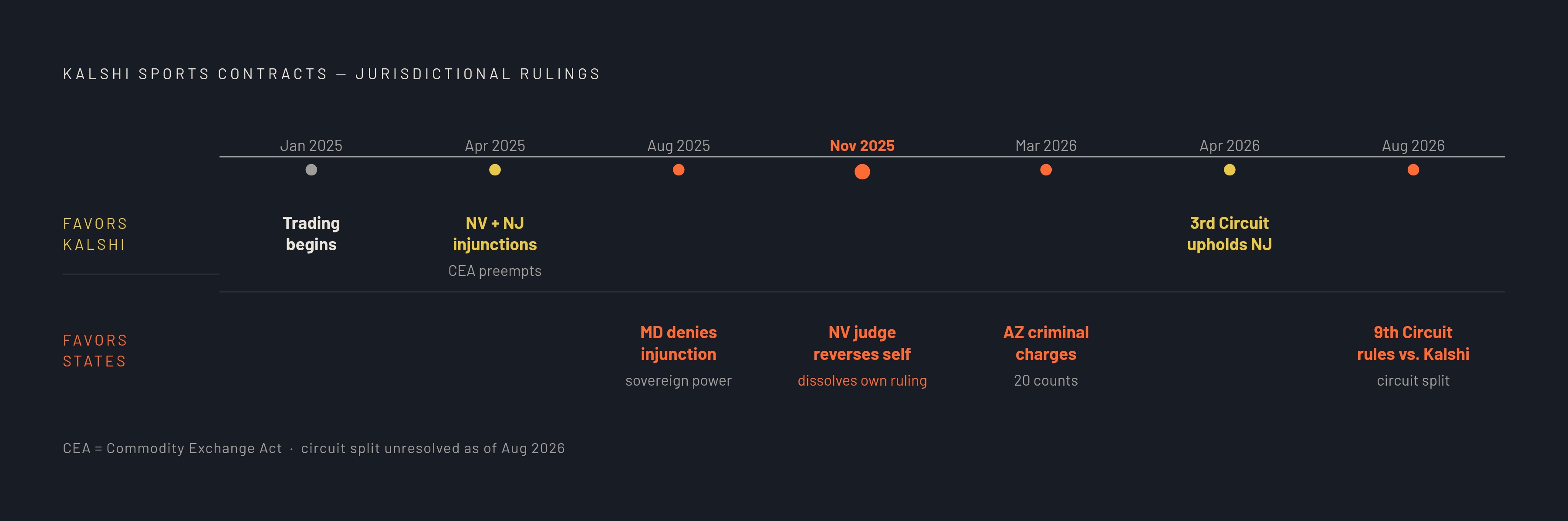
Sports event contracts started trading in January 2025, and within months, state gaming regulators in multiple states had already fired off cease-and-desist letters at Kalshi and other designated contract markets. Kalshi's legal position is straightforward on paper: its sports contracts are swaps under the Commodity Exchange Act, the CFTC has exclusive jurisdiction over anything traded on its designated contract market, and state gaming law simply doesn't reach that far.
Federal courts in Nevada and New Jersey initially agreed, granting Kalshi preliminary injunctions in April 2025 that found the CEA likely preempts state gaming enforcement entirely. The Third Circuit upheld the New Jersey injunction roughly a year later, in April 2026, reasoning that Kalshi had a reasonable shot at proving its contracts qualify as swaps because sporting events are "associated with a potential" financial or commercial consequence, tied to sponsors, advertisers, and television contracts. That's a preliminary ruling, not a final verdict, but it kept New Jersey's gaming enforcement office off Kalshi's back while the underlying case grinds on.
Maryland went the other direction entirely in August 2025, denying Kalshi's injunction request and leaning on the strong presumption against federal preemption of state gambling law, quoting the principle that regulating gambling sits "at the core of the state's residual powers as a sovereign." The Maryland court found Kalshi could simply get a state gaming license while still meeting the CEA's impartial-access requirements, a holding that would functionally subject a federally regulated derivatives market to state-by-state licensing. Then, in November 2025, the very same Nevada judge who granted the original injunction reversed himself, dissolving it and abandoning his own earlier preemption reasoning. That's not two courts disagreeing. That's one judge disagreeing with an earlier version of himself, which tells you something about how unsettled this question actually is at the trial level.
Arizona escalated past civil injunctions altogether in March 2026, when the state's attorney general filed a 20-count criminal information against Kalshi's operating entities, arguing flatly that Kalshi isn't a market at all but an unlicensed gambling house wearing a CFTC costume. Appeals sit pending simultaneously in multiple circuits, with the Third Circuit favoring Kalshi and the Ninth Circuit ruling against it in August 2026, the kind of circuit split that tends to end up in front of the Supreme Court eventually. Former members of Congress and Native American tribes have filed amicus briefs, each with their own stake in whether federally regulated markets can be boxed in by state gaming authority.
The CFTC's own position doesn't make this any cleaner. Chairman Michael Selig withdrew a 2024 proposed rule that would have banned sports and political event contracts outright, executed that withdrawal in February 2026, and rescinded a prior staff advisory urging caution. Yet an earlier CFTC advisory, from September 2025, confirmed the agency had never affirmatively approved DCM-listed sports contracts in the first place. Kalshi self-certified them. Nobody at the CFTC signed off in any meaningful sense, and that gap between self-certification and approval is precisely the kind of technical detail courts have to wrestle with when deciding whether preemption even applies.
Judge Jane Roth's dissent in the Third Circuit ruling captures the counterargument in one line worth sitting with: Kalshi's offerings, she wrote, are "virtually indistinguishable" from regulated sportsbook products, same bet, different label. If she's right, the entire preemption argument rests on financial terminology doing the work that state gambling law was designed to do. If the majority's right, that label is exactly the kind of jurisdictional signal Congress built the CEA to protect.
What the fault lines mean for anyone whose payoff depends on these rules
Pull every thread here and the same conclusion keeps surfacing: no settlement rule runs itself. Every one of them contains a judgment call buried somewhere, which source counts as authoritative, when a result becomes final, what counts as a qualifying injury, which regulator actually has standing to enforce anything. That judgment call is the actual contract, dressed up as fine print.
For anyone trading on Kalshi or a similar exchange, the named Source Agency and its resolution date aren't background detail, they're the entire deal. Knowing who that agency is, how it reports, and what happens when its data is late or disputed isn't optional homework, it's the same due diligence as reading a bond's covenants before buying it.
For sportsbook bettors, the equivalent homework is knowing which operator's finality window applies, whether a 24-hour clock or a 48-hour one, and what "acting reasonably" has meant in practice when a governing body goes quiet. Those aren't marketing footnotes. They're the actual terms determining whether a bet that looks settled stays settled.
And for the industry writ large, the jurisdictional fight running through federal courts right now isn't a side plot to the settlement mechanics. It's the same question at a higher altitude: who gets to decide what counts as the outcome, and whose rulebook wins when two authorities disagree. Every abandoned match, every voided prop, every disqualification arriving eighteen months too late is a small, contained version of the exact fight playing out between the CFTC and a half-dozen state attorneys general. The stakes are just smaller, and the drone flag involved is, mercifully, optional.
Sources
- Place Your Bets: US District Courts are Split on Whether the Commodity Exchange Act Preempts State Gaming Laws with Respect to Sports Event Contracts
- Sports Event Contracts: Balancing Federal and State Regulation | Sports Betting Operator
- Predictions market regulator scraps proposed ban on sports contracts, says new rules are coming
- Disagreement Deepens Among Federal Courts Over Whether Sports Event Contracts Are Subject To State Regulation
- Sports Event Contract Litigation Generates Bizarre Results
- support.betfair.com
- sportshandle.com