Injury News Impact on Odds Movement in NBA Markets
Single-star absences reshape NBA betting odds more drastically than in any other sport.
Injury News Impact on Odds Movement in NBA Markets.
Why NBA betting markets are unusually sensitive to roster news
NBA injury news does not just inform a betting market, it reshapes one, moving through spreads, moneylines, totals, and player props in a sequence that rewards anyone who understands the order of operations. Basketball, counting both the NBA and college game together, accounted for roughly 28% of total US sports betting handle in 2024 docsports.com. By 2025, regulated sportsbooks nationwide had processed $165.58 billion in total handle and generated $16.80 billion in gross gaming revenue, at a hold rate of 10.15% rg.org blog.sportscommand.ai espn.com sportico.com.
The reason for that density traces back to something structural about basketball itself. A single NBA player can account for 25 to 35% of a team's offensive creation, a concentration of value that neither football nor baseball replicates at the individual level blog.sportscommand.ai. Taking a franchise quarterback out of an NFL lineup makes the offense suffer, but eleven players still touch the ball on every snap espn.com. Taking an elite NBA point guard out of a lineup forces the entire offensive structure, spacing, shot creation, tempo, to be rebuilt around someone else, often in real time. An 82-game regular season, a four-round playoff format, and a load-management culture that keeps stars sitting out selectively add to that picture. Injury risk is essentially live on almost every night of the calendar. This piece is about how markets respond to that reality, the mechanical chain reaction from roster news to final price, not about forecasting who gets hurt next. A typical Tuesday slate in March 2026 listed roughly 14,200 individual NBA betting markets across the seven largest licensed US sportsbooks, more priced markets per night than any other major US sport tech-insider.org.
The NBA's official injury reporting system and its information timeline
The entire apparatus runs on a clock, and that clock is public. Under the NBA's 2025-26 injury reporting rules, teams must designate a participation status by 5 p.m. local time the day before a game, other than the second night of a back-to-back, and that designation has to name a specific injury, illness, or other condition affecting the player blog.sportscommand.ai. When a team is playing the second half of a back-to-back, the deadline shifts to 1 p.m. local time on the day of the game itself.
Four designations govern this whole system, and each one carries a specific probability attached by the league. Probable means a 75% likelihood of playing dallashoopsjournal.com Hoop Heads Podcast. Questionable is 50% dallashoopsjournal.com Hoop Heads Podcast. Doubtful drops to 25% blog.sportscommand.ai dallashoopsjournal.com Hoop Heads Podcast. Available needs no explanation. Late in 2025, the league tightened these requirements further, cutting down on the old practice of leaving a star's status vague until the last possible moment, which in turn gives oddsmakers more structured, earlier information to price against blog.sportscommand.ai. The league also polices the pattern itself: a team that keeps listing a player as Questionable and then rolling him out as Available without explanation draws a formal review, and that review can force adjusted designations going forward. None of this is a bureaucratic footnote. It is the timing structure that everything else in this piece hangs on.
The first stage of movement: how lines begin shifting before any official designation
Sharp money does not wait for a press release. Long before a team files anything official, professional handicappers are already reading practice access, watching how a player moves in shootaround, and parsing the hedges in a coach's press-conference language. A coach who says "we'll see how he feels" is saying something different than one who says a player is good to go, and the market treats that difference as information.
By the time a designation reaches a mainstream outlet or a betting app's injury feed, a meaningful share of the line's eventual movement may have already happened. This is the phase where the earliest and often most favorable prices exist, precisely because the signal is incomplete. A "questionable" tag is a 50% probability statement, not a confirmation, and treating it as one is where casual bettors get burned dallashoopsjournal.com Hoop Heads Podcast. The formal reporting system creates predictable windows for information to arrive, but the market itself starts moving well before the first of those windows opens.
The second stage: how confirmed absences move spreads, moneylines, and totals differently
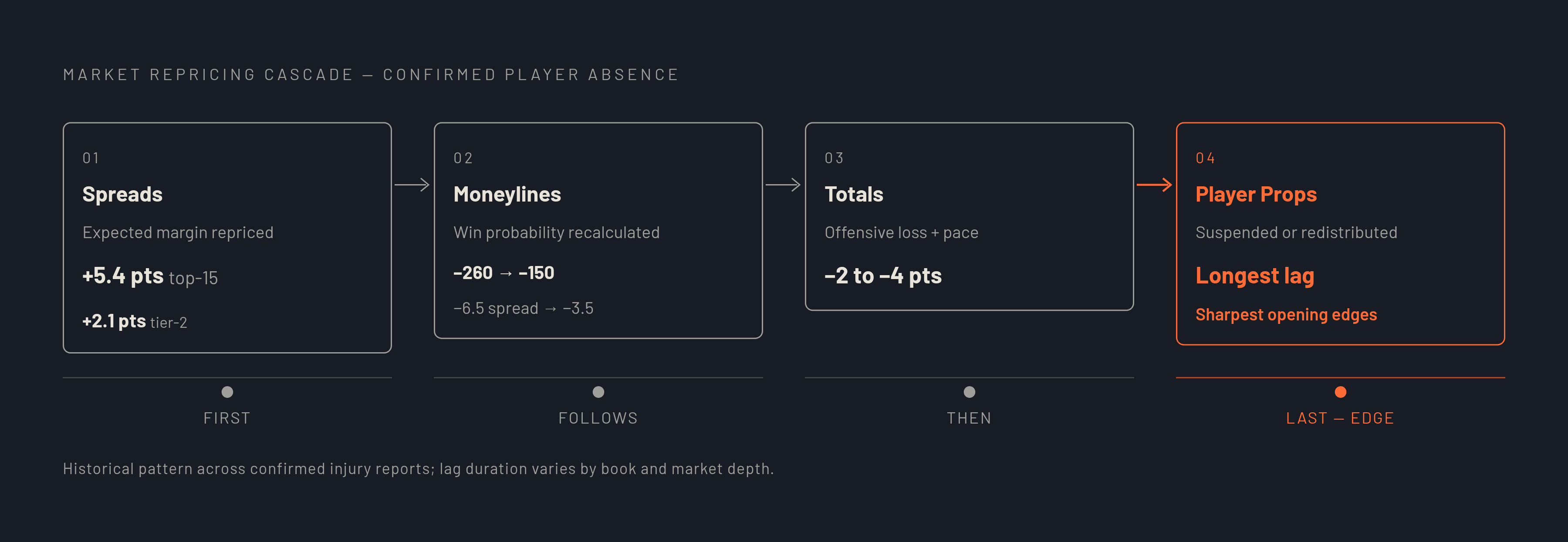
Once an absence is confirmed, the repricing happens within minutes, and the size of the move depends heavily on who is out. A confirmed starter who gets ruled out shifts the spread by an average of 2.1 points if he is a tier-2 player tech-insider.org. For a top-15 caliber star, that average jumps to 5.4 points tech-insider.org.
Moneylines respond in their own way, and the math behind that response explains why. Because win probability is binary, moneyline shifts tend to be proportionally larger than spread shifts for the same piece of news. In one modeled case built around Stephen Curry, a spread moving from Warriors -6.5 to -3.5 corresponded to a moneyline shift from -260 all the way to -150. That is not a small adjustment, and it reflects how much of a team's expected win probability can ride on a single name.
An elite point guard who handles 30% of his team's offensive possessions being ruled out collapses the total by a comparable 2–4 points tech-insider.org allbasketballreview.com.
Different market types adjust at different speeds, and that sequence is not arbitrary. Spreads move first, because sportsbooks reprice the expected margin before touching anything else. Moneylines follow close behind, recalculating outright win probability off that new margin. Totals come next, since they have to account for both the direct offensive loss and however the two teams are expected to adjust pace and defensive approach in response tech-insider.org allbasketballreview.com. Player props, which get their own section below, arrive last because they require the most granular recalculation. A single NBA superstar is generally worth somewhere between 5 and 10 points of margin of victory, and that range is wide enough to explain why the same player's absence can move a line very differently depending on opponent, pace, and matchup oddsindex.com espn.com. A franchise player going out can move a line 4–8 points or more blog.sportscommand.ai. Illustrative example: a team favored by -7 at home whose All-Star point guard is ruled out hours before tip-off might shift to -1.5 or even pick (a swing of 5 to 6 points), and the total might drop from 225 to 218 blog.sportscommand.ai.
How player props cascade from the same injury news
Player props are not a side market anymore. Prop volume is one of the stated reasons NBA betting's share of the national handle keeps growing, which makes the prop board a primary battleground rather than an afterthought. So when a star gets ruled out, the immediate question for a trader is not just what happens to the spread, it is what happens to five other players' scoring and assist numbers blog.sportscommand.ai.
A backup guard's points and assists props typically climb once it's clear he inherits extra possessions. A team's secondary scorer sees his shot-attempt total rise for the same reason. Depending on matchup, even an opponent's defensive props, steals and blocks in particular, can shift, since a weakened offense changes what the opposing defense is likely to generate. Props tied to the injured player himself usually get suspended or voided outright rather than simply repriced, which is a structural difference from how a spread behaves under the same news.
That granularity is why props move slower than spreads. Adjusting a spread is a team-level calculation. Adjusting a full slate of props means estimating how usage redistributes across multiple players individually, and that takes longer to get right. Historically, this lag is where sharper bettors have found their clearest openings, since the spread has often finished moving before the backup's assist prop catches up to the new reality. Sportsbooks know this. A FanDuel trader said, "We're vigilant about monitoring news, injury reports and potential rest spots for players we expect to miss at least a few games for load management". That is an admission that the lag exists and that closing it is an active priority.
Variables that determine how large any given line movement will be
Player role is at the top of the list. The gap between a tier-2 starter (2.1 points average) and a top-15 star (5.4 points average) is not a rounding difference, it is the clearest evidence that markets grade injury impact on a curve tied directly to individual offensive weight tech-insider.org. A team where 30% of possessions run through one creator will see a bigger spread swing when that creator sits than a team that distributes the ball more evenly, because there is no single replacement who can absorb that share of the offense allbasketballreview.com.
Severity and duration matter almost as much as role. A short-term absence, a questionable tag that resolves into a one-game miss, produces a modest, often temporary adjustment. A season-ending injury is a different animal entirely, and it does not stop at the spread. It ripples into futures markets, division odds, and conference odds, sometimes for months.
Schedule context compounds everything. A back-to-back already depresses expected output through fatigue, so stacking an injury on top of that schedule spot magnifies the line's reaction rather than simply adding to it. Public perception plays its own role too: a marquee name draws heavier public betting volume, and that volume itself can push a line further than the pure basketball impact alone would justify. Bench depth cuts the other way. A team with a credible, proven backup at the position in question absorbs an absence more gracefully than a team with no real replacement, and the market prices that difference in fairly quickly. No single formula predicts how far a line will move. Reading a line move well means figuring out which of these variables is doing the most work in that specific case, not applying a fixed multiplier.
The final pre-game window: what happens in the 60–90 minutes before tip-off
A player tagged questionable or listed as a game-time decision leaves the market pricing two rosters at once, a blended number that reflects genuine uncertainty rather than a settled outcome. That blend holds until his status gets confirmed, which usually happens 60 to 90 minutes before tip-off, and that window is one of the busiest stretches of the entire betting day for anyone trying to get ahead of the final number. The very last injury bulletin, often released just 15 to 30 minutes before the opening tip, tends to trigger the single largest and final odds move of the pre-game cycle allbasketballreview.com.
Overreaction is common in the first couple of minutes after that kind of update. If a player later gets upgraded, or the injury turns out to be more minor than the initial report suggested, the line has often already overcorrected, which opens a fade opportunity for bettors willing to bet against the market's first instinct. Caesars Sportsbook oddsmaker David Lieberman summed up the stakes from the house side: "Injury news and player rest are the two major things that move NBA lines before tip-off". That is not a bettor's talking point, it is a risk manager's admission that this window drives more of the book's exposure than almost anything else in the pre-game cycle. The most common mistake at this stage is jumping on a big line move without first checking that the size of that move actually matches the player's real impact rather than the market simply reacting to a name.
Load management as a chronic, lower-volatility version of the same dynamic
Load management runs on the same mechanics as acute injury news, just with the volatility turned down. Stars sitting the second half of a back-to-back has become routine enough that sportsbooks often see it coming, or at least suspect it strongly, well before any official word arrives. Lines for those second-night games frequently already bake in some probability of rest, so when the rest is finally confirmed, the incremental line movement can be small.
Teams face significant fines when Stars (defined as All-Star or All-NBA selections from the previous three seasons) miss nationally televised games, reducing the surprise-rest risk on marquee matchups. Separately, veterans who are at least 35 years old on opening night, or who meet certain career workload thresholds, keep a pre-approved exemption to rest during a back-to-back, provided the team notifies the league in writing at least a week ahead of time. That written notice requirement is exactly where sharper bettors focus their attention on same-game-as-back-to-back-away lines before the rest becomes public knowledge.
The policy appears to be working, at least by the league's own measure. NBA Commissioner Adam Silver said in a press conference that the PPP's first full year produced roughly 15% fewer games missed by star players overall sportico.com. That is a meaningful drop, but it has not erased market uncertainty around load management, it has just made the uncertainty more structured and, in most cases, more anticipated. Load management is injury-equivalent news that arrives on a more predictable timeline, so the edges available around it tend to be narrower than the edges available around a sudden, unscheduled absence. The PPP introduced a bifurcation.
Injury news and futures markets, illustrated by the 2025 playoff Achilles wave
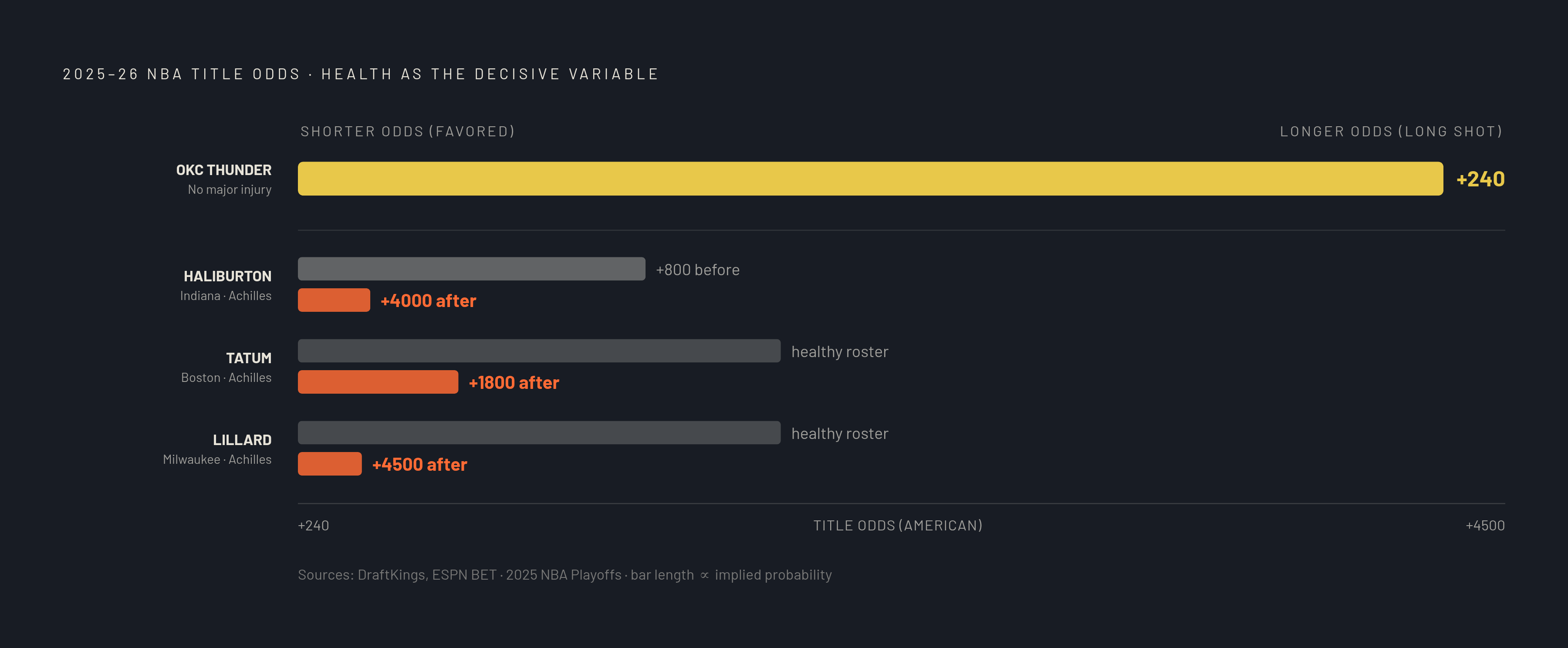
Nothing demonstrates the reach of injury news into futures pricing quite like what happened across the 2025 NBA Playoffs blog.sportscommand.ai. Three elite players, Damian Lillard, Jayson Tatum, and Tyrese Haliburton, each suffered a non-contact Achilles tendon rupture that postseason blog.sportscommand.ai.
He exited Game 7 of the NBA Finals in the first quarter with what was confirmed as a torn right Achilles tendon. Before Game 7 tipped off, Indiana had sat at +800 to win it all si.com.
Jayson Tatum's Achilles injury happened earlier in the postseason, during the Eastern Conference semifinals against the Knicks, and he is expected to miss most if not all of the following season. About a week after the injury, ESPN BET opened its next-season title odds with Boston at +1800, a substantial drop from where a healthy roster built around Tatum would have priced si.com.
Damian Lillard's injury came earlier still, in Game 4 of Milwaukee's first-round series against Indiana in April. The team confirmed his health would take priority over any short-term return, and Lillard will likely miss the upcoming season, targeting a return for 2026-27. Milwaukee's title odds fell to +4500 si.com.
Set that against the team that suffered no such loss. That contrast is the clearest evidence available that futures markets treat player health not as a footnote but as a primary input, weighted right alongside roster talent and recent performance. Futures impact: Pacers fell from 10-1 to 40-1 at ESPN BET after the injury espn.com. OKC Thunder, 2025 Finals winners, unaffected by major injury, opened as the +240 favorite at DraftKings Sportsbook for the 2025–26 title, a contrast that illustrates the futures market pricing health as a primary input blog.sportscommand.ai si.com. SOURCE PAGES: what the pages behind the outline's links say.