Steam Moves and Syndicate Betting Behavior
Syndicates engineer fake steam moves to manipulate odds and trap recreational bettors.
U.S. sports betting handle grew from $13 billion in 2019 to $167 billion in 2025, and that growth pulled in professional operations with the capital and the modeling firepower to move a line at dozens of sportsbooks within seconds of each other. The industry calls this a steam move. Most bettors read a fast line change as proof that something smart is happening behind it, and that instinct is wrong more often than it's right. Understanding how syndicates build a steam move, and how easily they can fake one, is the only real way to separate the signal from the trap.
What a steam move is, and what disqualifies something from the definition
A steam move is a sudden, sizable shift in a betting line, usually 1 to 2 points against the spread or 0.25 to 0.5 goals in soccer markets, that shows up across multiple sportsbooks at nearly the same time. That simultaneity is the whole definition, not a detail attached to it. If one sportsbook moves its number and the rest of the market sits still, that's a single risk management desk deciding it doesn't like its own exposure. That happens constantly, and it means nothing beyond that one book's internal betting patterns.
The term borrows its imagery from a steamroller, since sharp money hits the market, a book reacts fast to protect itself, and the adjustment rolls outward across the industry the way a steamroller flattens whatever sits in its path. Speed is what separates it from ordinary drift. A line moving because the public piles onto a popular team over a Sunday afternoon is a slow bleed accumulated across hours. Steam happens in minutes, sometimes less. If that compression is stripped away, a bettor is just watching public sentiment do what it always does, gradually and on schedule. Treating a slow drift as steam is the first mistake, and it's a common one.
The mechanics of how syndicates generate steam simultaneously
Making steam costs money. Sportsbooks that cater to sharp action, the kind with limits well above what a typical bettor could ever wager, won't move a number for a bet that doesn't threaten their risk model. Syndicates clear that bar on purpose, and they clear it at several books at once, racing to lock in the best price before any single book has time to adjust. The simultaneity is the strategy. It's the strategy.
Sharp-facing books like Pinnacle, Bookmaker, and CRIS tend to move first. Once one of them adjusts, other operators start watching and copy the move within minutes, sometimes seconds, because no book wants to be the last one on the board still offering a price that's already been picked apart elsewhere. That defensive posture, replicated across the industry almost instantly, is what turns a single sharp bet into a market-wide event. The public rarely sees the original wager. It only sees the aftershock.
Who syndicates are and why they can move markets
Professional bettors and syndicates make up a small slice of everyone placing wagers, yet they account for the majority of line moves that matter at major sportsbooks. That's an outsized amount of force coming from a tiny population, and the mechanism behind it comes down to skill measured against a brutal, unforgiving threshold. Break-even at standard -110 odds is 52.4%. A bettor who wins 55% or better clears that bar by a margin that looks modest on paper but compounds into a durable edge across thousands of bets.
Syndicates aren't a few sharp guys trading tips in a group chat, and treating them that way is how recreational bettors underestimate what they're up against. They run pooled capital, statistical modelers building proprietary projections, staff monitoring line movement in real time, and proxy bettors, known in the industry as beards, who place wagers under different names to hide the group's true position from the books they're betting against. The comparison to a hedge fund holds up: some syndicates run models that update continuously and have members putting in well over full workweeks hunting for mispriced numbers. The whole operation is built around finding the same kind of small, repeatable edge a market maker looks for in any other asset class, and exploiting it before the price corrects.
Advanced syndicate tactics that make steam misleading: the head fake and the buy-back
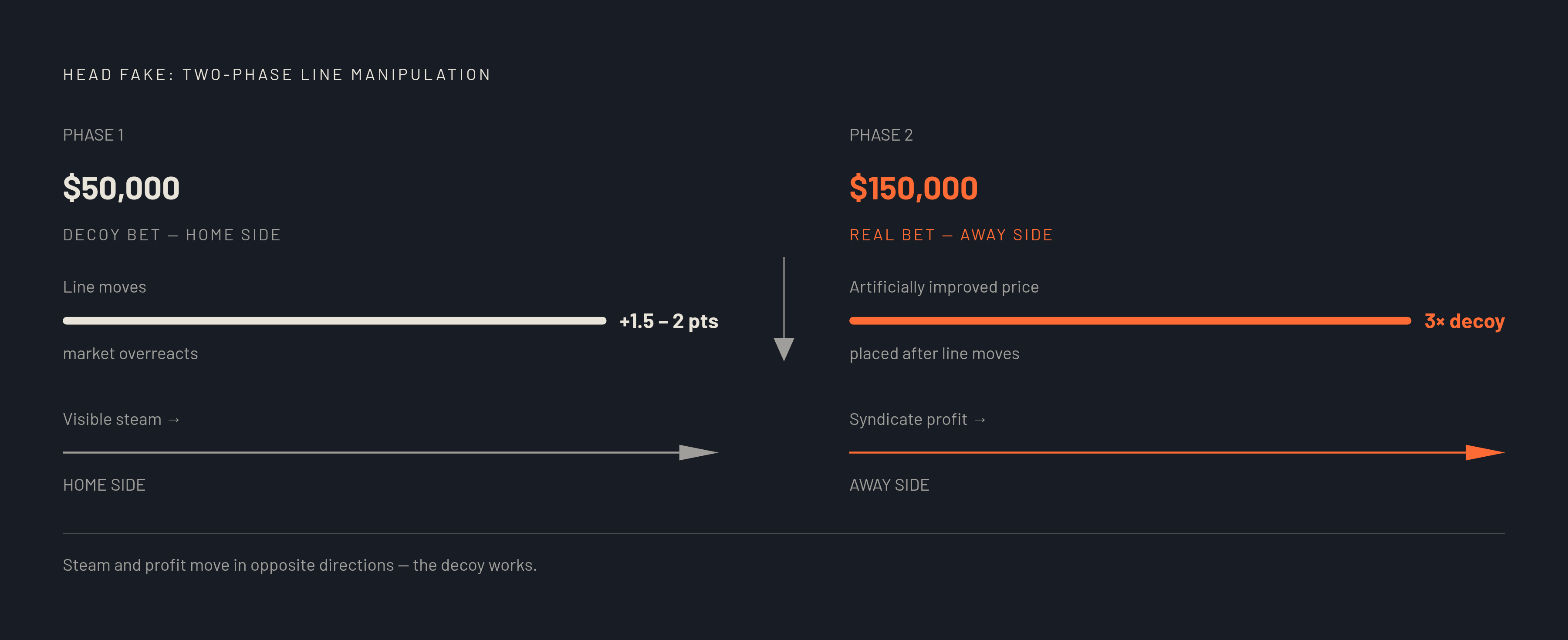
Not every steam move reflects where a syndicate actually wants its money, and assuming otherwise is where most recreational bettors get burned. A group might favor one side of a spread, but instead of betting that side outright, it first places a sharp wager on the other side to trigger an overreaction from the books, and only then does the syndicate come in with real size on the side it always wanted, now getting extra value from the artificially moved number. The visible steam moves one direction while the syndicate's actual position moves the other.
Billy Walters, one of the most well-documented professional bettors in the sport's history, ran versions of this play for years, a deliberate pattern that manufactured profit rather than incidental gain: a $50,000 wager on the home side would trigger an overreaction from the market, and once the number moved, his team would come back with $150,000 on the side they'd wanted from the start, capturing a swing of 1.5 to 2 points. It's a deliberate mechanism for manufacturing inefficiency and then harvesting it. It's a deliberate mechanism for manufacturing inefficiency and then harvesting it.
The buy-back runs the same trick in reverse. After a line moves hard in one direction, sharp money sometimes returns on the other side once the new number itself becomes attractive, creating a second steam move that whipsaws any recreational bettor who chased the first one and watched the market reverse against them. Beards spreading bets across dozens of books make the picture murkier still, and proxy networks of this kind are a well-documented feature of how professional syndicates operate against soft lines. The direction a line first moves is not reliable evidence of where the smart money actually sits. Steam gets engineered as misdirection just as often as it reflects a genuine position, and treating the first move as the true signal is the single costliest habit a recreational bettor can pick up.
How steam relates to reverse line movement and ticket/handle splits
Steam has a close cousin called reverse line movement, or RLM, and the two get confused often enough to warrant separating cleanly. RLM describes a line moving against the direction of public betting: the crowd piles onto one side, and the number moves the other way anyway. Steam describes something narrower, a sudden, coordinated shift across the market compressed into minutes rather than hours. A game can show one, the other, both, or neither, though in practice steam is often just RLM running at high speed. Both point at the same underlying fact, that real money moved a number the public wasn't backing, but steam shows it live while RLM usually gets reconstructed after the fact from closing numbers.
A separate confirmation tool comes from comparing ticket counts to handle. If 20% of bet tickets account for 80% of the total money wagered on a game, that split is a strong signal that professional money is involved, since a small number of large bets are outweighing a much larger number of small ones. One instructive real-world case: the Braves drew 62% of bet tickets on the run line but only 39% of the actual money, while the Athletics pulled just 38% of tickets yet 61% of the handle. The sharp money was sitting exactly where the public wasn't touching, and the ticket count alone would have told the opposite story.
How to interpret a steam move in practice
Before reacting to any line move, check for coordination across multiple books rather than treating a single outlier as proof of anything. Genuine steam requires that coordination, ideally with the move originating at a sharp shop like Pinnacle, Bookmaker, or CRIS before spreading outward. A move that just resembles steam, driven by a wave of public money piling onto a popular team, is a trap for anyone who assumes every fast line change means something sophisticated sits behind it. The tell is where the money concentrates first, not how fast the number moves.
A short checklist separates the two. Did the move start at a sharp book, Pinnacle, Bookmaker, or CRIS, before showing up elsewhere? Does it run counter to the public betting percentage, meaning reverse line movement is visible alongside the steam? Is handle concentrated heavily on one side despite fewer tickets, the 20/80 pattern described above? Is there a plausible news catalyst, an injury, a lineup change, a weather report, that explains the move as information moving through the market rather than a syndicate moving it?
Chasing steam, trying to grab the pre-move number at a book that hasn't adjusted yet, is a real strategy, but it's a narrow one, and most recreational bettors overrate their odds of pulling it off. The value only exists if a bettor can lock in the number before the lagging book catches up, and that window often runs somewhere between 60 and 180 seconds. Pulling it off requires accounts open at multiple sportsbooks at once and some kind of real-time line-tracking setup, since no one refreshes ten tabs by hand fast enough to matter. It also carries a cost most casual bettors never price in upfront: sportsbooks limit or ban accounts that consistently win by chasing steam, so success itself shortens the strategy's shelf life. In most cases, professional syndicates and their own automated systems absorb whatever value is left in that window long before a recreational bettor even reaches for the bet slip.
Timing matters as much as speed. Sharp action tends to concentrate in the first 30 to 90 minutes after a line opens, when the market is least tested and mispricing is most likely. Steam that shows up late, close to kickoff, usually signals the highest conviction behind the move. By then, though, the number of books still offering the old price, and the time left to act on it, has shrunk to almost nothing.