How Sportsbooks Set and Manage Risk on Large Wagers
Sportsbooks profit not by picking winners, but by balancing action on both sides of every bet.
- Written by
- Renata Kowalczyk
- Published
- October 10, 2026
- Reading time
- 10 min read
What this covers
A sportsbook's profit does not depend on picking winners. It depends on pricing both sides of a bet so that balanced action guarantees a return no matter which side wins, and every layer of risk management described in this piece exists to handle the moments when action is not balanced.
How sportsbooks make money before a bet is graded
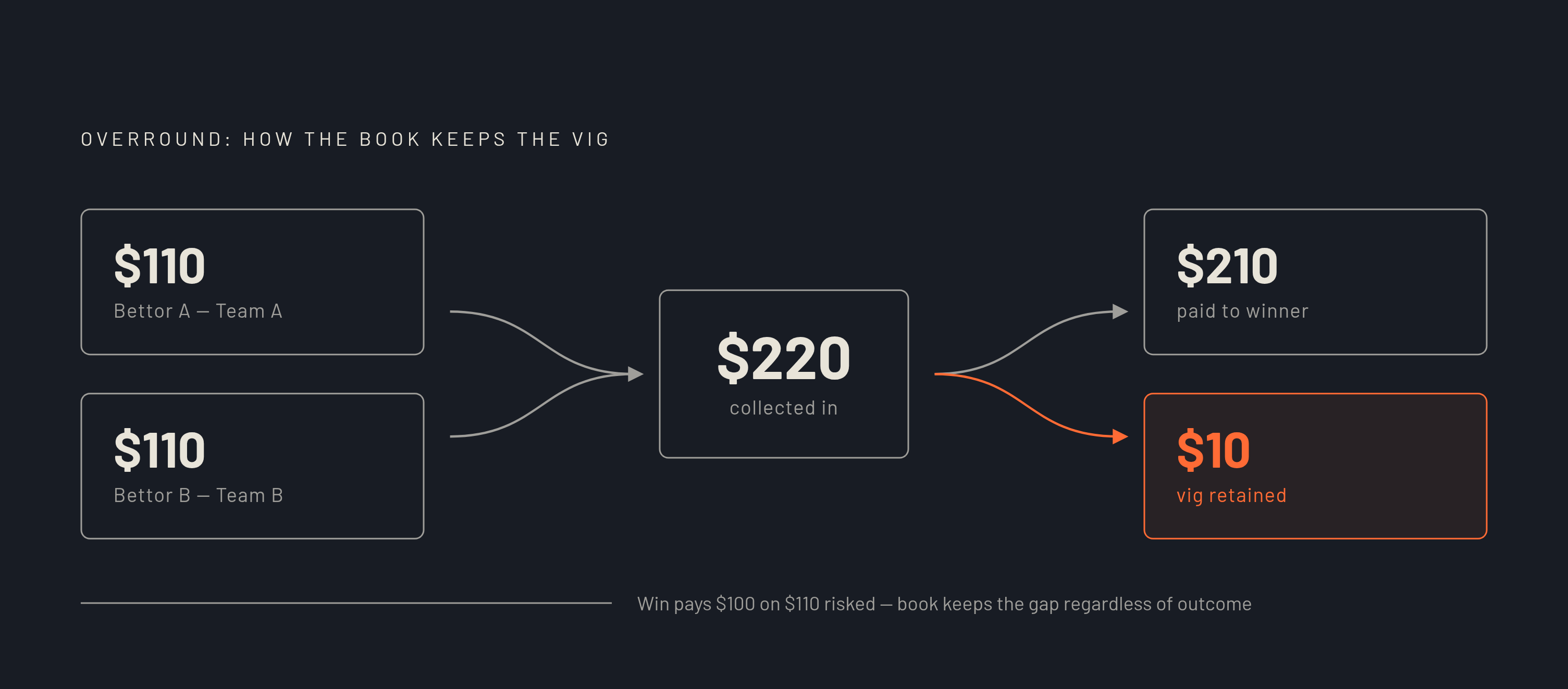
A point spread offers both sides at the same price, and that price is built so a bettor risks more than they stand to win. Lay a standard amount to win a smaller, fixed amount on either side of a game, and if equal money comes in on both sides, the book collects more than it pays out, no matter which team covers. That gap between what's collected and what's paid, known as the overround or the vig, is built into the number before anyone places a bet, so the book's return does not depend on which team wins, only on whether the money on each side stays roughly even. That is the entire premise the rest of this system is built to defend: the margin is automatic only when the book keeps the action balanced, and keeping it balanced turns out to be a constant, active job rather than a one-time setup.
What goes into an opening line
An opening line is a probability turned into a price, and it is posted knowing it will probably need to move. In-play markets add another layer of difficulty, since odds have to recalculate in milliseconds as goals go in, cards get shown, and momentum swings, running on a system that blends base probability, the current state of the match, and the book's live exposure on that market.
Not every book builds its own number from scratch. Market-making books, among them Pinnacle, Circa, and Bookmaker, post the first price in a given market. Retail books like DraftKings, FanDuel, and BetMGM generally don't set that initial line themselves; they follow the market-makers' prices and adjust to match them, usually with some delay. Opening limits, meanwhile, stay low on purpose. The book knows the opening number hasn't been tested yet, and it expects sharp bettors to find the spots where the price is wrong and bet into them. That early betting activity is the mechanism by which a rough opening estimate gets corrected into something closer to fair value.
Real-time exposure tracking as a live liability dashboard
Once a market opens, the question facing a trading desk changes to how much money the book now owes if a given outcome happens. That's exposure tracking: watching, in real time, how much liability has built up on each side of a market, and comparing it to what the book has collected from the other side. That gap between those two numbers is the book's net risk position, and it moves with every bet that lands.
Parlays make this harder. Winning one leg raises the odds of winning the other, concentrating liability on a single outcome. That's why sportsbooks watch parlay combinations closely, cap payouts on correlated legs, and in traditional cross-game parlays generally refuse correlated combinations. Same-game parlay products are the exception: they allow correlated legs, but at odds adjusted downward to account for the added risk. Trading teams also run scenario models ahead of a full slate of games, stress-testing what happens if every favorite wins, adjusting exposure before kickoff.
What large bets signal about lines
A large bet forces the book to react on two fronts at once. The size of the wager might be carrying information, a signal that the current price is wrong, and the book needs to protect itself from further bets on that same side. Professional bettors who build their wagers on rigorous modeling can move a line more than a flood of small public bets, because the book treats the identity of the bettor, not just the size of the stake, as a signal about whether the number is off. When a sharp bettor spots an opening price that doesn't match fair value, the resulting large bet shifts the line in that direction even when total betting volume across the market is low.
If the large majority of tickets back one team but the line moves toward the other side, that's professional money working against the popular side, and traders read that as a more reliable signal of true market opinion than the public betting percentages alone.
There's a hard constraint on how far a line can move at once, though, especially in football: key numbers. Point spreads tend to cluster around certain final-score margins, and 3 and 7 are the most common. They're holding both sides at different prices, and if the game lands with the favorite winning by exactly 4, 5, or 6 points, both bets win. The book loses on both tickets at once, so oddsmakers try to avoid that scenario by moving a number gradually, or holding it in place and limiting action, to keep it from crossing a key number freely.
The gap between where a line opened and where it closed, known as closing line value, becomes the long-term record of who was right. A bettor who consistently gets better prices than the closing number is demonstrating real, repeatable skill at finding mispriced markets, so books track it closely when deciding who to limit.
Layoff strategies and the limits of external hedging
Moving the line is the book's first response to lopsided action, but it doesn't always work fast enough or draw enough counter-betting to fix the imbalance. When that happens, the book looks outside its own market to offload the risk, a practice called laying off. The mechanic is simple: the book places its own counter-bet on the side it's overexposed to, either with another bookmaker or on a betting exchange, locking in its margin regardless of how the game turns out.
Public exchanges are expensive places to do this at scale. That price slippage, combined with the exchange's own commission on winning positions, can eat through the margin the book was trying to protect. A book that accepted a retail bet with a standard built-in margin and then tries to hedge that exposure on a public exchange at a tighter price can end up handing back the entire edge it priced in to begin with.
That's the reason the sportsbook industry has built private alternatives instead of relying on public markets for large hedges. Private risk pools, internal netting arrangements between affiliated books, and centralized B2B clearinghouses let operators offset liability against one another without broadcasting the position to outside traders. At that scale, manual trading isn't a realistic option, since even small pricing or risk-management errors across thousands of simultaneous markets can produce large financial losses.
Bet acceptance rules and account-level limits as the first line of risk control
Betting limits look, from the customer's side, like a single number posted next to a market. In practice, they operate on several levels at once, tuned to what the book believes about a specific account's likely edge. The maximum bet posted on an NFL spread is a public figure, but the same system can quietly cap a flagged account at a fraction of that number without ever changing the number everyone else sees. It can also refuse a large bet on a player prop while accepting a much bigger bet from the same account on the game's moneyline, because those two markets carry very different margins and very different risk to the book.
Limits can be soft, a lower maximum stake applied to an account, or hard, restrictions on specific markets, a suspension, or an outright account closure. The signal books use to decide who gets limited is closing line value: an account that consistently buys in at a better price than where the line ends up closing is showing that its bets carry information the book hasn't priced in yet, and that's a direct threat to the book's margin on every bet that account places.
At a Massachusetts Gaming Commission roundtable on the practice, BetMGM's senior director of compliance, Sarah Brennan, said only a small share of the operator's Massachusetts customers had limits imposed on their accounts. Altenar sales manager Matthew Ferrara, speaking to SBC Americas, laid out two separate reasons operators apply limits: containing sharp bettors who hold a real edge over the book, and restricting customers who are losing heavily and may be at risk of problem gambling. The same tool, in other words, serves two different functions, one about protecting margin and one about compliance. Ferrara also warned that limiting applied too aggressively "is killing business for a lot of operators and is pushing players into the black market," where no such limits exist.
Not everyone accepts the responsible-gambling framing at face value. Joe Brennan of Prime Sports has argued that describing limits as a welfare measure is misleading, since in his view they function primarily as a profit-protection tool aimed at skilled bettors. Operators counter that limits are a necessary control against betting patterns that could expose the book to losses it cannot absorb. Both positions describe the same mechanism; they disagree about which purpose it primarily serves.
Sharp books and retail books manage risk in structurally opposite ways
The same sharp bettor who threatens one type of sportsbook is the reason another type of sportsbook can function at all, because each business makes its money differently. A sharp bettor who wins consistently is pulling money directly out of the pool that model depends on. Those accounts get flagged and limited quickly once their closing line value becomes clear.
Market-making books like Pinnacle run on much thinner margins, close to 2%, and that model only works with high volume and prices that are accurate. These books actively want sharp action rather than trying to keep it out, because sharp bets are what corrects a line that's slightly off, making the price more accurate and the thin-margin business sustainable over the long run. As a result, the same account facing a severely reduced limit at a retail sportsbook can often bet at full posted limits, indefinitely, at a market-making book, because that book's entire pricing model is built to take that kind of bet and use it.
AI, automation, and the speed and granularity of risk management
Every layer described so far now runs, at least in part, on machine learning, and automation has compressed the time available to respond to risk from minutes down to milliseconds. Human traders cannot track thousands of live markets and adjust prices fast enough on their own to keep pace with in-play betting volume. Algorithmic models scan large datasets, spot developing patterns, and adjust odds in milliseconds, which both sharpens pricing accuracy and keeps exposure from building up unnoticed between manual checks.
AI now touches nearly every part of sportsbook operations: pricing and trading models driven by machine learning, automated systems that flag accounts for limiting, real-time behavioral profiling used to personalize offers and promotions, models that predict customer churn and lifetime value, and scoring systems built to catch fraud and low-quality affiliate traffic.
That same behavioral profiling, built to manage the book's risk, is now drawing legal scrutiny aimed at the harm it may cause customers. A lawsuit filed in July 2026 against one operator alleged that gambling addiction problems were the result of deliberate algorithm design. State legislatures across the US are now moving to regulate AI-driven personalization and addictive design features in sports betting apps, adding a compliance layer to the risk-management stack that didn't exist a few years ago.
What the full system protects against
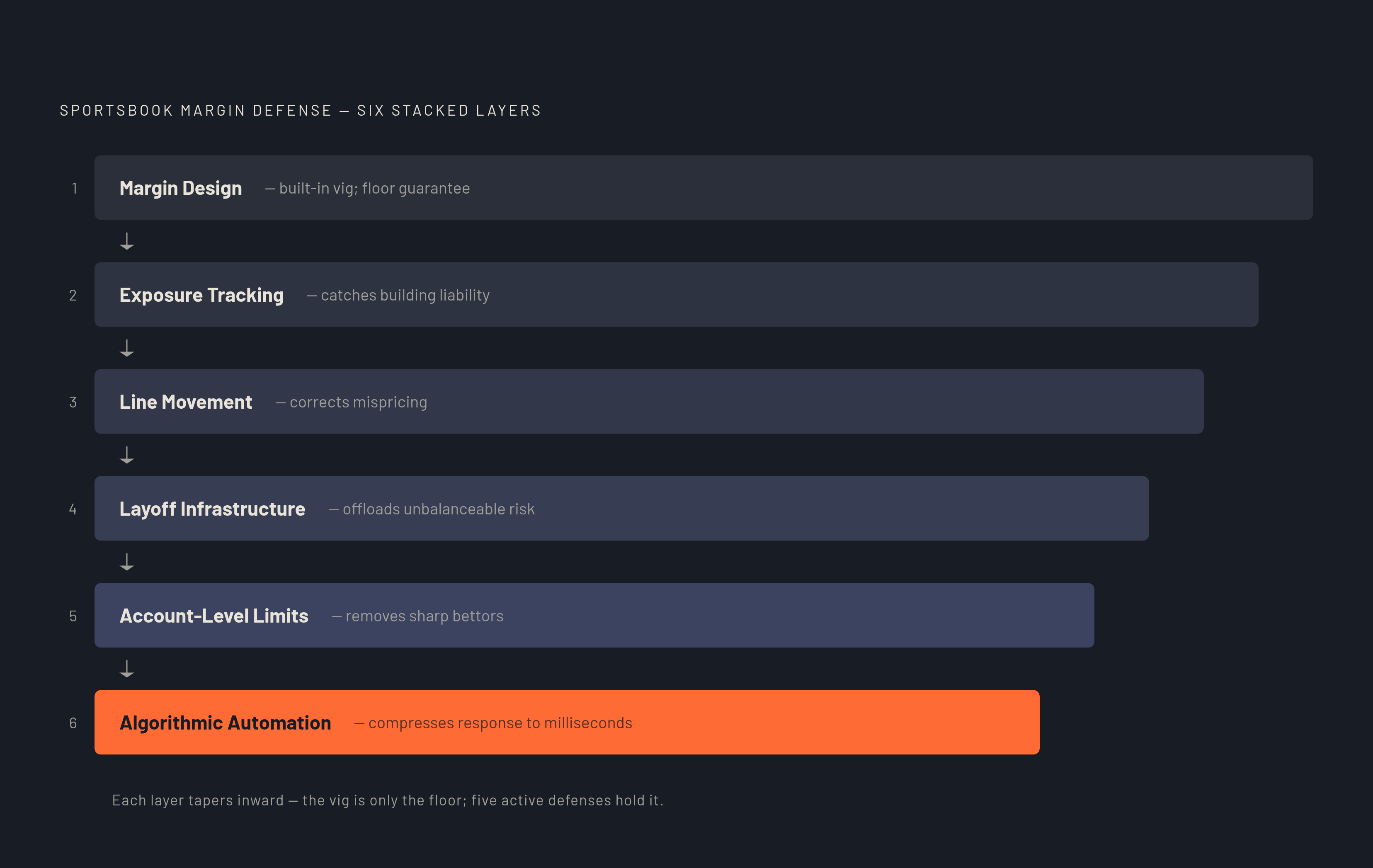
Put the layers together, margin design, exposure tracking, line movement, layoff infrastructure, account limits, and algorithmic automation, and a clear picture emerges: the vig is the floor of a structure that takes constant, active work to hold in place. The margin only produces a guaranteed return when action stays balanced, and balanced action is the exception the system has to manufacture, not the default condition it can assume.
Each layer in this stack exists to catch a different way that balance can break down. Exposure tracking catches liability building up before it grows large enough to threaten the margin. Line movement corrects mispricing in real time and discourages further bets piling onto the exposed side. Layoff infrastructure offloads liability the book can't rebalance through its own market. Account-level limits remove or restrict the bettors most likely to exploit whatever mispricing is left. None of this runs on autopilot, even with the margin volatility that figure alone implies: US sportsbooks posted a record 12.4% hold in June 2025, a number that can swing sharply in the other direction when favorites win consistently and squeeze margins across an entire slate of games.
Limits on winning bettors exist because the retail business model depends on recreational losses to cover its margin, and that margin leaves little room to absorb bettors who win on purpose. The newest addition to this system, regulatory scrutiny of AI-driven personalization and product liability claims tied to algorithmic design, means the risks these books manage are no longer confined to the balance sheet. They now extend into legal and reputational territory that the rest of the stack was never built to handle.