How Event Contract Prices Are Set at Launch
Markets face their hardest test on day one, before trading reveals what anyone actually thinks.

Event contracts pay $1 if a thing happens, $0 if it doesn't, so the price between $0.01 and $0.99 is a probability. A contract at $0.73 says the market thinks there's a 73% chance of a YES resolution, full stop; a stock price just quotes a number nobody fully agrees on for reasons that have nothing to do with probability. This piece is about the one moment that number is hardest to trust: the instant a market opens, before anyone has traded it, when the price has to come from somewhere and that somewhere is usually a guess wearing a decimal point. Everything below traces how that opening guess gets made, how it gets corrected, and where it quietly lies to you.
Why the launch moment is the hardest point to price
Every market has a birthday, and it's the single worst day to ask that market anything.
At launch there's no trade history, no order flow, nothing for a new trader to lean against. Whatever sets the first price, a formula or a human posting a bid, has to answer a question nobody has answered yet. That's the cold-start problem. It shows up anywhere a system needs participation to generate signal but needs signal to attract participation in the first place. Zero traders produce zero information, and nobody shows up without a starting price to react to, agree with, or bet against. The two conditions depend on each other, which is exactly the kind of setup that never resolves itself cleanly.
Thin volume makes things worse. In the first hours after launch, one large order can shove the price around before anyone shows up to lean the other way; that's structural, true of any market with few participants, and it's why the launch window deserves more scrutiny than the settled middle of a market's life. Judge a prediction market by its day-one price and there's a decent chance the only thing being measured is how few people had logged on yet.
The 50/50 default under the Logarithmic Market Scoring Rule
Most fixes for the cold-start problem start at the midpoint and let trading sort out the rest. Worth saying plainly: that starting point is a placeholder, and treating it as a prediction is the first mistake a new reader of these markets tends to make.
That's the logic behind the Logarithmic Market Scoring Rule, or LMSR, the mechanism underneath a large share of automated prediction markets. Under LMSR, the market maker's inventory starts at zero shares outstanding for every outcome, and zero shares outstanding maps mechanically to a $0.50 price on both YES and NO. Read that as a coin-flip forecast about the world and the mechanism has already fooled someone. The number is closer to a blank page than an opinion.
What happens after the first trade is governed by a parameter called b, the liquidity parameter, and picking it is a real design decision, not a rounding error. A high b keeps the price stable even after a decent-sized trade, which sounds safe until it's slow to reflect anything a trader actually knows. A low b lets each trade throw the price around more violently: responsive, but chaotic-looking before enough volume shows up to smooth it out. That tension bites hardest exactly when volume is lowest, meaning right at launch, meaning right when getting it wrong is cheapest to notice and hardest to fix.
LMSR earned its dominance for one specific reason worth naming directly: it caps the market maker's loss no matter how trading goes, and it guarantees continuous liquidity, so a trader can always execute at some price without waiting on a counterparty. No matching required. That guarantee is what let early prediction markets exist at all, back before any of them had a user base large enough to run a real order book.
Why major platforms moved away from pure AMMs toward order books
LMSR solved the cold-start problem and quietly created a capital problem in its place. Capital problems are usually the ones that actually kill a business model, and this is the section where that bill comes due.
To cover every possible outcome, including the ones sitting at 99% unlikely, the market maker has to lock up collateral across the entire range. Most of that capital just sits there, waiting on an outcome that statistically will not occur. Large trades make it worse: every purchase drags the price along the underlying cost curve, so a trader buying a big position pays progressively worse prices as the order fills. That's slippage, baked into the formula itself, not a bug in any one implementation of it.
Platforms including Polymarket moved away from pure AMM designs toward continuous limit order books, or CLOBs, the same basic structure that runs stock exchanges. A CLOB has no mechanical starting price baked into a formula; the market doesn't open until somebody posts a bid and somebody else posts an ask, and whatever numbers those two orders carry becomes the opening price, for better or worse. Buyers and sellers get matched peer-to-peer, order by order, with no algorithmic curve smoothing anything over in the background.
Here's the trade nobody gets to skip: CLOBs deliver tighter spreads and sharper price discovery once real participants show up, but they need a critical mass of those participants just to function at all. The cold-start problem doesn't disappear under a CLOB. It changes shape and shows back up at the exact same launch moment, wearing a different coat.
How exchanges and market makers seed opening prices on order-book platforms
Somebody has to go first, and on a CLOB, that somebody is usually the exchange itself, or a professional market-making firm brought in specifically to keep a new market from opening onto a blank order book and an awkward silence.
Some platforms act as market maker of last resort, posting their own bids and asks to seed liquidity before outside traders arrive. That first quote isn't pulled from thin air. Base rates and historical priors carry a lot of the weight: how often has this type of event happened before, under similar conditions, as far back as the record goes? Reference markets carry more of it, liquid external venues like futures, options, or polling aggregators that already price a closely related risk, letting the opening price anchor through something close to arbitrage against a market that already trades.
Resolution source specification plays a quieter role that's easy to underrate. Kalshi contracts resolve against a named, verifiable source, a specific government data release or an official election call, and the tighter that rule is written, the more precisely the launch price can be calibrated against whatever external probability already exists for that exact outcome. For genuinely new categories of event, ones with no liquid reference market anywhere nearby, pricing falls back on the market maker's own internal models, built from whatever inputs are on hand.
Call the opening quote what it actually is: an informed estimate, built from priors, analogous markets, and, in the newest categories, educated guesswork dressed up in decimal points. Real price discovery starts only after that number goes up on the board and other traders get a chance to disagree with it.
How prices move from the opening anchor toward a market consensus
Under an AMM, price movement is purely mechanical. Buying YES tokens shrinks their supply in the liquidity pool, which pushes the algorithmic price up; selling reverses it. No judgment involved, just a formula reacting to inventory.
Under a CLOB, movement comes from order flow instead, and it looks less like a formula and more like a running argument between everyone who has an opinion and money riding on it. Liquidity decides how orderly that argument looks from the outside: more of it tightens the spread between buy and sell prices and keeps things stable, less of it means bigger jumps and wider gaps. That's exactly why an early-stage market can look wildly volatile even when the underlying probability of the event hasn't moved an inch.
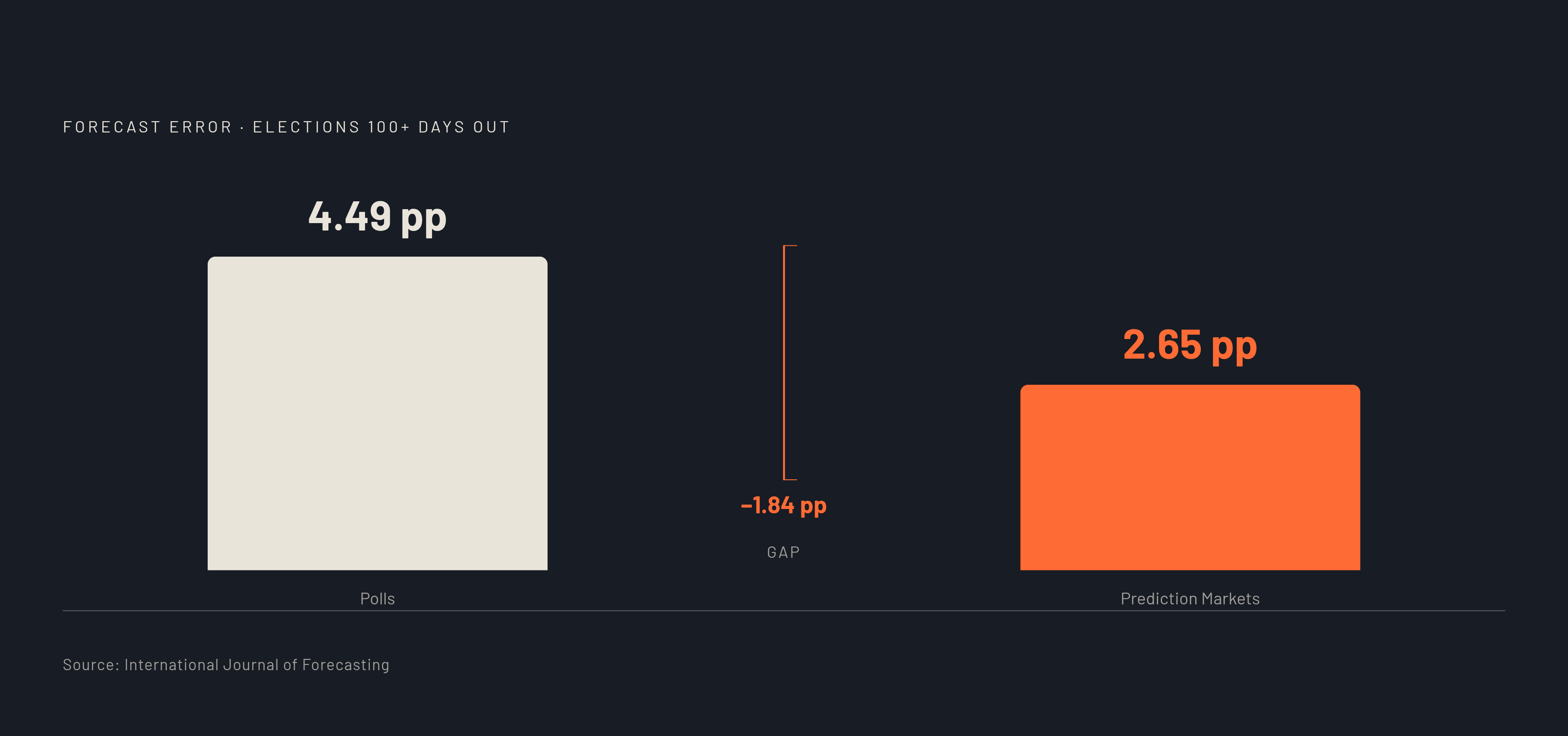
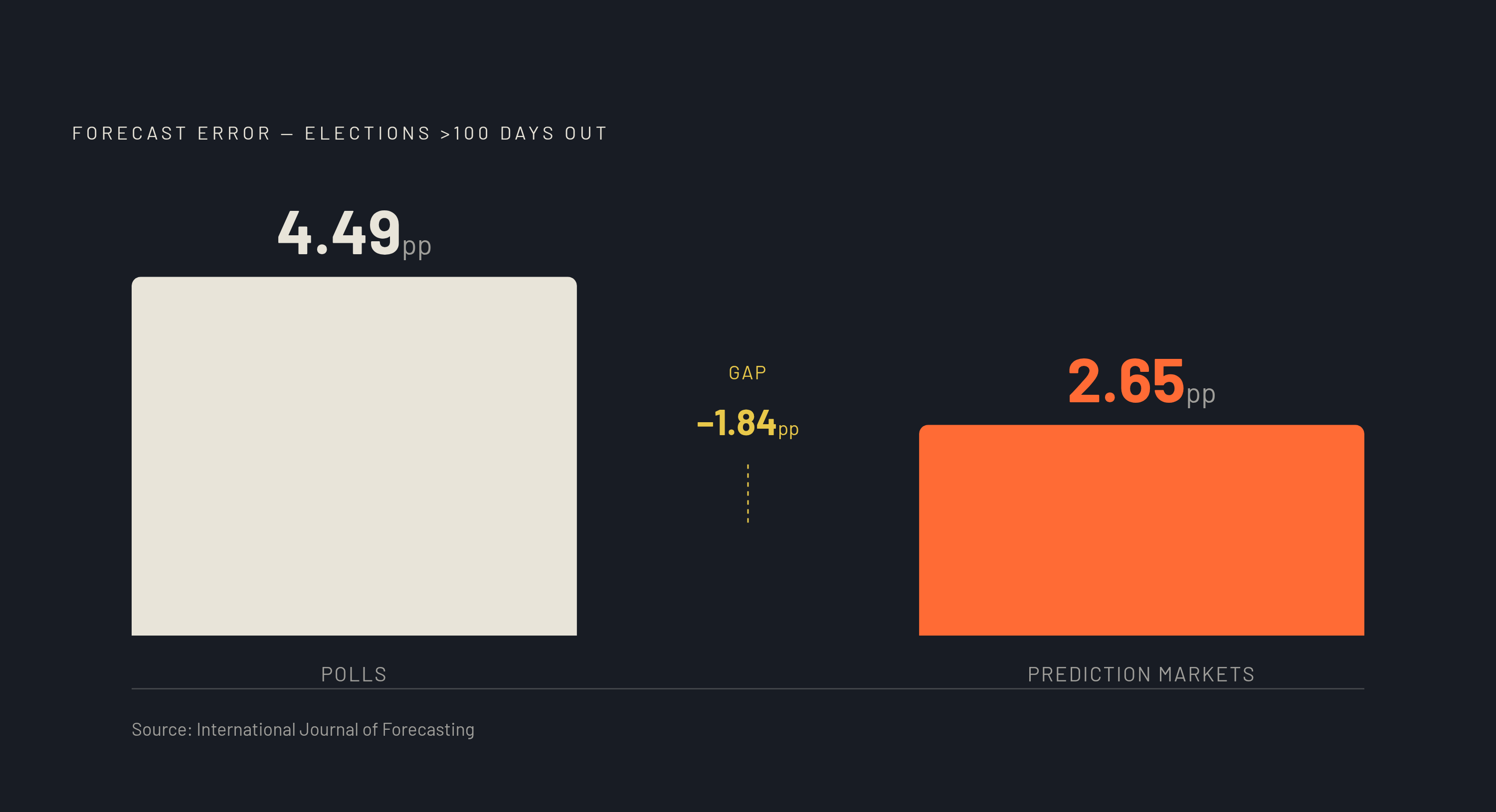
New information does the rest of the work: a central bank statement, a fresh batch of polling, a data release, breaking news that shifts the odds of the resolution condition being met. One figure worth sitting with, because it carries a date and a source behind it: a study in the International Journal of Forecasting found that for dates more than 100 days out from an election, average poll error ran to 4.49 percentage points, against 2.65 points for markets over the same stretch. That gap is the whole argument for prediction markets in one line, and it deserves to be taken seriously rather than treated as a fun fact. Money behind a belief compresses error better than a survey does, at least once enough of it shows up to matter.
That last clause carries the weight of the sentence. Polymarket's 2024 presidential market drew heavy volume and drew attention for its forecasts; down-ballot markets on the same platform, running the identical mechanism, fared distinctly worse. Same formula, same company, wildly different results, because the mechanism only works in direct proportion to how many people bother to show up and run it.
Distortions that can make an opening price misleading
A YES contract at $0.62 tells a reader the market thinks there's roughly a 62% chance the event happens. Taking that number at face value means ignoring the several ways it bends before it ever reaches a screen, and this is the section where that gets named plainly rather than hedged around.
Fees and spreads wedge themselves between the traded price and whatever "true" probability sits underneath it. A trader isn't just buying information, they're paying a toll to reach it. Wash trading does uglier damage: a Fortune investigation, citing analysis from Chaos Labs and Inca Digital, found wash trading accounted for as much as roughly a third of volume on Polymarket's presidential market, meaning a meaningful chunk of that activity was theater, not signal. Thin-market noise piles on in low-volume conditions, where one sizable order can shove a price around before any offsetting flow shows up to correct it, so what's on display reflects one trader's bet rather than any real consensus. Trader bias closes it out: the plain human habit of overweighting a preferred outcome and underweighting an uncomfortable one, tilting early prices away from anything resembling a calibrated estimate.
All four bite hardest exactly at launch, when volume is thinnest and a price is at its most exposed. Knowing how the mechanism works doesn't excuse the follow-up question: does this particular market have enough real participation behind it for the price to mean what it claims to mean? Skip that question and the price is just a number with good posture.
What the regulatory framework permits and constrains at launch
Event contracts sit under CFTC oversight, and exchanges have to certify that a new product complies with the Commodity Exchange Act before launch. That certification doesn't require advance CFTC approval. Registered exchanges self-certify, which hands them real latitude in how a new market gets structured and seeded, and shortens the gap between an idea and a live, tradable contract considerably.
The legal ground shifted in September 2024, when a federal district court found the CFTC had erred in treating political event contracts as prohibited gaming, and the CFTC dropped its appeal in 2025. Practically, that widened the category of events for which regulated launch pricing works in the United States, stretching it out of the familiar territory of economic indicators and weather thresholds and into politics and sports.
One requirement deserves to be singled out rather than filed alongside the rest: every contract must name a specific, verifiable resolution source in advance, a government data release or an official election call. That's a pricing feature, not paperwork, because it's exactly what lets a market maker calibrate a launch price against an external probability with any real confidence. A vague resolution condition makes precise pricing at launch close to impossible, no matter how good the underlying model is; write the rule loosely and the price on day one is close to meaningless regardless of how carefully everything else was built.
The scale involved gives all of this some weight. By 2025, per the Keyrock and Dune Analytics 2025 Prediction Markets Report, the industry had recorded over $44 billion in total notional trading volume, with monthly active users topping 600,000. At that size, the mechanics of an opening price stop being a technical footnote. They're the first few seconds of a process real money rides on, starting the moment the first bid and ask actually hit the board.