Cross-Sport Correlation in Event Contract Pricing
Cross-sport parlays cost more than their legs imply, and market structure is the culprit.

- Written by
- Darnell Boateng
- Updated
- November 9, 2026
- Reading time
- 10 min read
- Sources cited
- 8 sources ↓
What this covers
- Event contract markets and why sports dominate them
- How a contract price is supposed to encode probability, and the conditions under which it does
- Same-game versus cross-game correlation: why the distinction changes everything about parlay pricing
- What happens to cross-sport parlay prices on prediction markets
Event contract prices move in step with each other across sports leagues that share no fans, no schedules, and no statistical connection, and the reason has nothing to do with the games themselves. It comes down to how these markets are built, quoted, and hedged. Once you understand the mechanics behind a single contract price, the correlations between, say, an NBA moneyline and an NFL spread stop looking like coincidence and start looking like a byproduct of market structure.
Event contract markets and why sports dominate them
An event contract is about as simple a financial instrument as exists: a binary Yes or No position on whether something happens, settling at full value if the trader is right and at zero if not.
Sports have taken over this category almost entirely. As of February 2026, roughly 87% of everything traded on Kalshi over the prior year was tied to a sporting event. By May, sports contracts still made up the dominant share of the platform's monthly volume. Polymarket's sports share sits lower as a percentage of its total activity, but sports remain its single largest category by a wide margin, accounting for well over a third of the prior year's volume.
The structural detail that matters most here is the peer-to-peer design. There's no house setting odds and skimming a margin. Prices move purely because traders are buying and selling against each other, and the resulting price reflects consensus, not a bookmaker's cut. That absence of a built-in edge makes the probability interpretation of these prices theoretically clean, so any deviation from clean pricing, especially across sports that share no logical connection, calls for investigation. Key platforms in this ecosystem (Kalshi, Polymarket, OG (by Crypto.com), and CME) span regulated CFTC-overseen exchanges and crypto-native and CFTC-regulated platforms.
How a contract price is supposed to encode probability, and the conditions under which it does
No adjustment, no vig, no hidden margin baked into the number. Because pricing happens through open trading rather than a bookmaker setting a line, the price-as-probability read is more direct here than it is at a traditional sportsbook.
But that identity holds only under certain conditions, and recent research spells out exactly where it starts to break. A study by Moshrefi (arXiv:2607.14430), built on 23 million moneyline trades across major sport leagues on Kalshi, found that calibration, meaning how closely quoted prices match the actual frequency with which those outcomes occur, shifts in a predictable pattern tied to time-to-expiry. In the middle of a contract's life, prices sit close to where perfect calibration would put them. As expiry closes in, though, that calibration degrades sharply, and late-life prices stop functioning as reliable probability estimates.
A single-leg contract priced mid-life behaves like a probability. That same contract, minutes from resolution, does not. Combining legs from different sports into a single product makes this the first thing to check before assuming the joint price means anything at all.
Same-game versus cross-game correlation: why the distinction changes everything about parlay pricing
Same-game parlays combine legs from a single event, where the outcomes are tangled together by construction. A quarterback's passing yards and the game total move together, they're pulling on the same thread. Sportsbooks have handled this for years by applying a correlation premium, shaving the payout down below what a naive multiplication of the individual odds would suggest, standard practice that nobody in the industry disputes. That's standard practice, and nobody in the industry disputes it.
Cross-game parlays are a different animal entirely. When the legs come from separate games, or separate sports altogether, there's no structural relationship linking them. An NBA outcome tells you nothing about a simultaneous NFL outcome. Theoretically, then, a parlay built from independent legs should price at exactly the product of its component probabilities, no premium required.
That's what makes cross-sport analysis interesting. If each leg prices correctly as a standalone probability, the joint price of the parlay should be arithmetically predictable, just multiply the two numbers together. Any gap between that arithmetic and what the market actually charges is a signal, not noise, and it's the signal the rest of this piece is built around.
What happens to cross-sport parlay prices on prediction markets
Parlay volume has exploded, both in traditional sportsbooks and on exchanges. Traditional books saw parlays account for roughly 27% of all money wagered across Illinois, New Jersey, and Colorado through October 2024. Kalshi's own trajectory tells a similar story: same-game parlay positions launched in late September 2025, multi-event Combos followed in December, and by April 2026 parlays had grown from a negligible share to roughly 22% of total exchange volume. That scale is what makes the mispricing consequential rather than academic.
Moshrefi's research found that cross-game parlays are systematically overpriced relative to what the product of their individual leg prices would predict, and the size of that overpricing grows as more legs get added. The overpricing appears even when every leg is drawn from the exact TTE window where individual calibration is close to flawless. That single fact eliminates the most obvious explanation. If the legs themselves are well-calibrated, the earlier time-to-expiry issue can't be what's driving the gap. And because these are cross-game legs by definition, there's no correlation premium to invoke either, the legs are independent, full stop. What's left is a markup that appears uniformly across the calibration curve, shifting the whole thing below the diagonal rather than distorting it in a probability-weighted way, which points to something closer to an added fee than a behavioral quirk.
Condition on both time-to-expiry and product type before trusting a number as an input. A cross-sport parlay price is not the product of its legs' probabilities, and treating it as such will misprice every position built on that assumption.
The market-making challenge that creates cross-sport pricing gaps
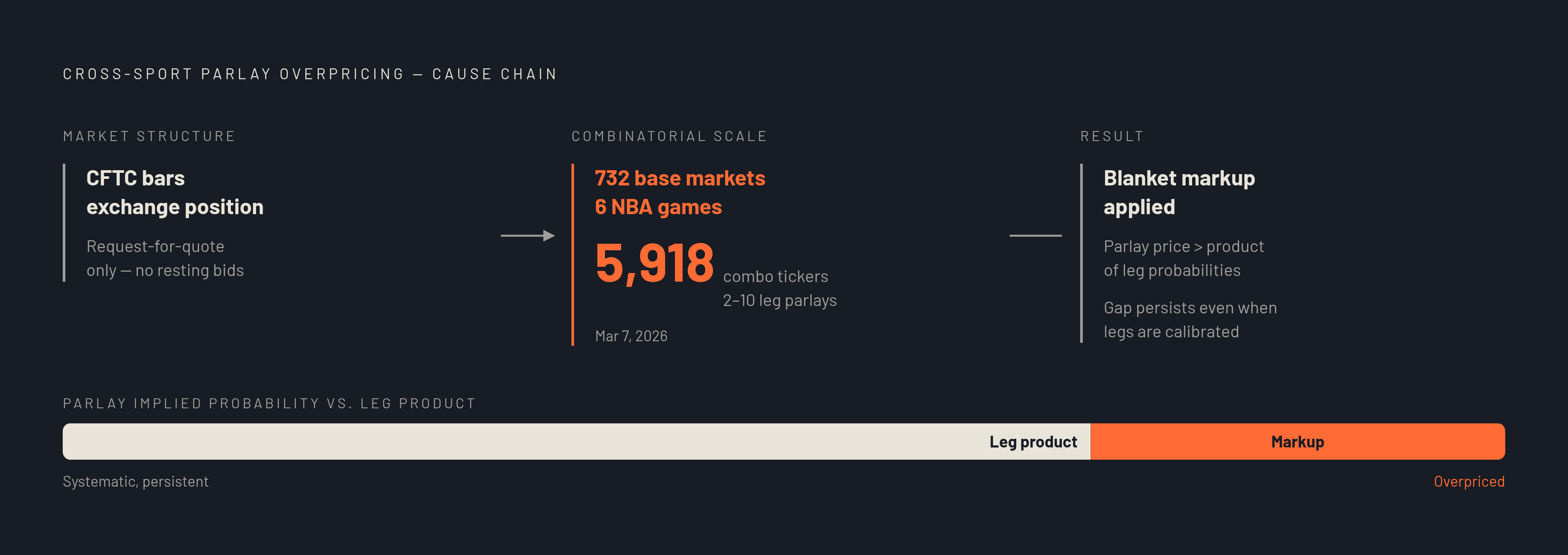
The overpricing has a structural cause, and it starts with a regulatory constraint that's easy to overlook. Federal rules prohibit these exchanges from taking a side of any trade themselves. Both Kalshi and Polymarket route parlay execution through a request-for-quote model, where outside market makers step in to take the opposing position. Neither platform runs its own internal pricing engine over the full combinatorial space of possible parlays.
That combinatorial space is larger than it sounds. Researchers testing Kalshi's NBA slate on a single day, March 7, 2026, counted 732 base markets across six games, which generated 5,918 listed combo tickers spanning two-leg through ten-leg parlays. That's the scale of the pricing challenge facing anyone trying to quote these products in real time.
One proposed answer comes from ParlayMarket (arXiv:2603.22596, Rana et al., 2026), which builds a shared, learned representation of the joint outcome distribution, letting a market maker quote automatically across the entire combinatorial family while keeping aggregate loss under control, using the flow of parlay orders itself as a signal for how legs actually depend on each other. The existence of that research is itself telling: it means the industry recognizes this as an unsolved problem worth engineering around.
Until tools like that see wider use, market makers are stuck pricing an intractable combinatorial problem the blunt way, by tacking on a conservative markup that favors the house side of the quote. The overpricing Moshrefi documents becomes straightforward once you see it this way. It's the price the market charges for the uncertainty market makers can't yet model away.
How the same event prices differently across competing platforms
Cross-sport correlation isn't the only place this appears. The same event, priced on two different platforms at the same time, ought to converge on the same number if both markets are doing their job. Krause (SSRN:6861841, June 2026) tested this directly, tracking identical binary contracts trading simultaneously on Kalshi and Polymarket, same event, same resolution criteria.
Despite identical underlying events, correlation between probability levels came out to just 0.55, and daily changes correlated at only 0.22, so the two markets frequently told meaningfully different stories about the same event. Spreads between platforms reached as wide as 26.1 percentage points in some observed cases. That's not rounding error, that's two markets disagreeing meaningfully about the odds of the same coin flip.
The payoff of that disagreement is what matters. A mean-reversion strategy, entering a position once the spread crossed a set threshold and exiting once it closed back to zero, won on every observed trade between January and May 2026, averaging a 15.6% net return per trade over a mean holding period of 5.9 days. Platform divergence, in other words, isn't just noise to be ignored, it's a structural gap wide enough to trade.
For cross-sport analysis specifically, this compounds the difficulty described earlier. Combining a leg from one platform with a leg from another means a trader isn't just multiplying two probabilities together, they're stacking two separate pricing regimes on top of each other. The implied joint probability stops being a simple product the moment the legs come from markets that don't agree with each other in the first place.
Live-game price dislocations and the speed at which cross-sport arbitrage closes
Everything discussed so far describes a structural, slow-moving markup. Live trading tells a different story, one about speed rather than persistent bias. A high-frequency study of Polymarket's NBA markets pulled tens of millions of limit order book snapshots from 173 games played between February 4 and March 4, 2026.
Out of the combinatorial market states the researchers evaluated, 523 candidate arbitrage episodes appeared. After stripping out artifacts caused by games ending, 290 active, executable episodes remained, a median of exactly 2.00 per game. Almost all of that action clustered around live play. The pre-game phase yielded only a handful of episodes, while in-game trading generated 279 active episodes, driven by live scoring events that create rapid win-probability shifts and brief cross-market dislocations. NBA volume on Polymarket grew substantially between 2024 and 2025, and that liquidity is precisely what lets the order book snap back into line so quickly.
That speed matters for anyone thinking about acting on cross-sport signals. The parlay markup and the platform divergence documented above are slow enough and persistent enough that a patient trader can act on them. Live in-game dislocations are not that. They close in the time it takes a human to read a screen and click a button. Capturing them realistically requires automated, low-latency infrastructure that most participants simply don't have. Two different kinds of edge exist here, one open to anyone paying attention, the other reserved for whoever's fastest.
Behavioral distortions that ripple through cross-sport pricing
Before any of this gets to the parlay stage, individual contract prices already carry a bias baked in. Research on Polymarket contracts (arXiv:2609.12878) documented a favorite-longshot bias, a tendency to overprice unlikely outcomes and underprice likely ones, consistent with the long-established Snowberg and Wolfers work from 2010 and the older prospect theory framework from Tversky and Kahneman.
This matters more once legs get combined. A cross-sport parlay pairing a longshot from one sport with a favorite from another is stacking two distortions pointing in opposite directions, and which one wins out depends entirely on the specific legs involved, not on any general rule that can be applied across the board. There's no shortcut here, each leg has to be checked on its own terms.
It gets messier once TTE is factored back in. Behavioral distortion may be stronger in the late-life phase, precisely where calibration is already degraded. Leg prices drawn from different stages of their trading life aren't comparable on a like-for-like basis. Anyone trying to read a cross-sport price as a clean signal has to account for three separate forces at once: how far each leg is from expiry, whether it sits on the favorite or longshot side of the bias, and which platform it's quoted on.
The regulatory uncertainty that shapes which pricing signals are stable
None of this sits on stable ground, and that instability is worth taking seriously rather than treating as background noise. Prediction markets operate under federal CFTC oversight rather than the state-by-state licensing regime that governs traditional sportsbooks, giving these products different tax treatment (1099-B rather than W-2G) and broader geographic reach, a genuine structural advantage. That's a genuine structural advantage.
But federal oversight itself is in flux. The CFTC withdrew its June 2024 proposed rulemaking and its September 2025 staff advisory in February 2026, then turned around in March and issued a new advisory requiring exchanges to keep contracts from being "readily susceptible to manipulation" and to run real-time monitoring, alongside an advance notice of proposed rulemaking asking the industry to weigh in. That's three regulatory postures in under a year.
State-level friction compounds it. Several states have sent Kalshi cease-and-desist letters over sports contracts they consider unlicensed gambling, and Kalshi is now fighting litigation across more than a dozen states. A recent Ninth Circuit ruling against Kalshi's sports contracts in Nevada directly contradicts an earlier Third Circuit decision, which puts the question on a plausible track toward the Supreme Court. Regulators have even flagged that firms should be ready for the possibility of "termination of sports-related event contract positions" tied to how this litigation shakes out.
That discontinuity risk belongs in any analysis of these pricing patterns. A product or an entire platform can become unavailable in a given state mid-position, and a pricing pattern documented under today's rules may simply not survive a rule change. The request-based structure behind parlay pricing described earlier exists in part because of what CFTC-regulated exchanges are and aren't permitted to do directly. KPMG's analysis of the tax treatment of sports event contracts makes a similar point from the operator's side, flagging the volatility of the regulatory landscape as a real cost that operators and investors both have to price in. Any trader reading cross-sport correlation as a stable, permanent feature of these markets is missing that the rules generating the correlation could shift under them without much warning.
Methodology & sources
- Prices, Probabilities, and Parlays: Systematic Bias in Sports Prediction Markets
Described how Kalshi and Polymarket route parlay execution through request-for-quote market makers.
- [2607.14430] Prices, Probabilities, and Parlays: Systematic Bias in Sports Prediction Markets
Abstract of the Moshrefi study, with the 23 million moneyline trades behind the calibration and parlay overpricing findings.
- Prediction Markets: Policy Issues for Congress | Congress.gov | Library of Congress
Provided the share of Kalshi volume tied to sports and background on federal policy issues.
- Taxation of Sports Event Contracts
Supplied the tax treatment of sports event contracts and the point that regulatory volatility is a cost operators must price in.
- Systematic Bias in Sports Prediction Markets
Provided the Moshrefi study findings on calibration by time-to-expiry and systematic overpricing of cross-game parlays.
- Same-Game Parlays: The Mathematics of Correlation | Wizard of Odds
Covered the mathematics of correlation in same-game parlays and why independent legs should price as a simple product.
- Sports and Gaming Law in the First Half of 2026
Informed the account of ongoing state litigation and conflicting circuit court rulings over sports event contracts.
- Prediction Markets at a Crossroads: The Continued Jurisdictional Battle Over Event Contracts | Insights | Holland & Knight
Covered the jurisdictional fight between federal and state regulators over sports event contracts.