Tax Treatment of Betting Exchange Winnings in the US
The IRS hasn't ruled on exchange winnings.

- Written by
- Mei-Ling Tso
- Published
- October 7, 2026
- Reading time
- 9 min read
- Sources cited
- 7 sources ↓
What this covers
Every dollar won on a betting exchange or prediction market is taxable income, and that part of the law is not in dispute. The IRS treats gambling winnings as fully taxable under existing rules, and that treatment applies whether the money came from a slot machine, a poker tournament, a sportsbook, or a contract traded on an exchange like Kalshi or Polymarket. No platform, no bet size, and no missing tax form changes that baseline fact. A trader who never receives a 1099 or a W-2G still owes tax on the gain, because the reporting form controls what the IRS gets told, not what the law requires the filer to report. What remains unresolved is which of three competing tax frameworks governs that income, and the choice between them changes the rate paid, what losses can offset, whether self-employment tax applies, and whether the new 90% loss cap under recent tax legislation even reaches a given return. As of October 2026, the IRS has issued no guidance specific to prediction markets or betting exchanges, so every filer in this space is making a classification judgment without a rulebook to point to.
The three frameworks that could apply to exchange winnings
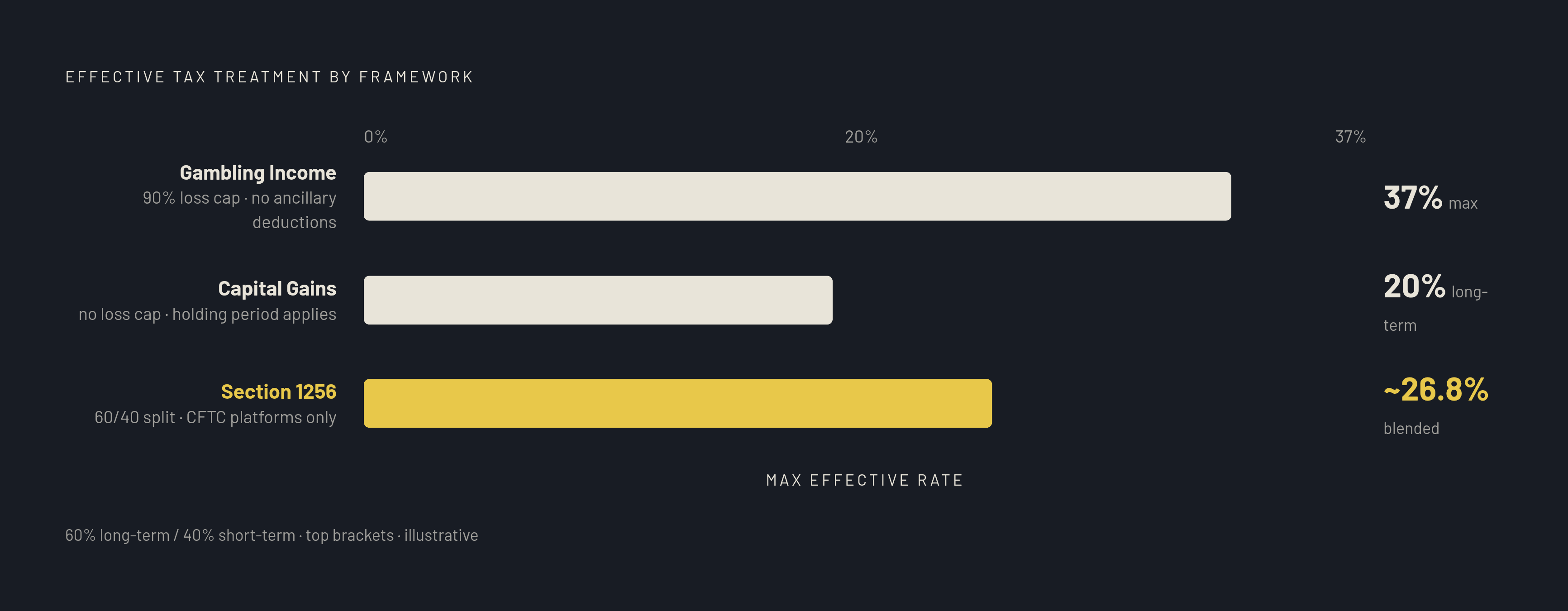
Three distinct characterizations compete for betting exchange winnings, and each one leaves you with a different tax bill, a different set of forms, and a different exposure to the new loss limits.
The most conservative path treats exchange winnings the same as any other gambling income. So winnings go on Schedule 1 of Form 1040 and get taxed as ordinary income, and if you're a high earner, the top marginal rates apply directly to gross winnings, not net profit. Losses can only offset winnings dollar for dollar up to the amount won, and starting in 2026 that offset is capped further still by the OBBBA, a change covered in the next section. Casual bettors filing under this framework also cannot deduct the ancillary costs of trading, so a subscription to a data service or the cost of research tools used to inform a position doesn't reduce taxable income the way a business expense would. Tax law attorneys at the Tax Law Center at NYU Law argue the same position, concluding that sports-event contracts function as wagers and should be taxed under the same federal rules that apply to sports gambling generally.
A second framework puts exchange contracts in the same bucket as stocks and bonds, treating them as capital assets. Under capital gains treatment, a position held for one year or less is taxed at short-term rates, which mirror ordinary income rates, while longer holding periods would qualify for the lower long-term capital gains rate, if the position is ever held that long given how most prediction market contracts resolve. Losses under this framework first offset capital gains of the same type before touching other income, a materially different mechanics from the gambling framework's win-capped deduction. Platforms like Polymarket have pointed users toward this treatment, framing their contracts as investment positions.
A third framework applies if the contract trades on a CFTC-regulated exchange: it invokes Section 1256 of the Internal Revenue Code, which splits gains into a blend weighted toward long-term treatment, with the remainder treated as short-term, no matter how long you actually held the position. This treatment is the most favorable of the three for an active trader, since it taxes a portion of every gain at the lower long-term rate even on contracts held for a single day. The argument for applying Section 1256 to exchange contracts rests entirely on the platform's regulatory status as a designated contract market, which is a serious qualification, not a loophole: a contract traded on an unregulated or differently regulated platform has a much weaker claim to this treatment, and the IRS has not confirmed that Section 1256 applies to event contracts in any public guidance. A filer who takes this position is making an aggressive read of a provision written for futures and options, applied to a product the agency has not yet addressed by name.
How the OBBBA changed the stakes for anyone filing under the gambling framework
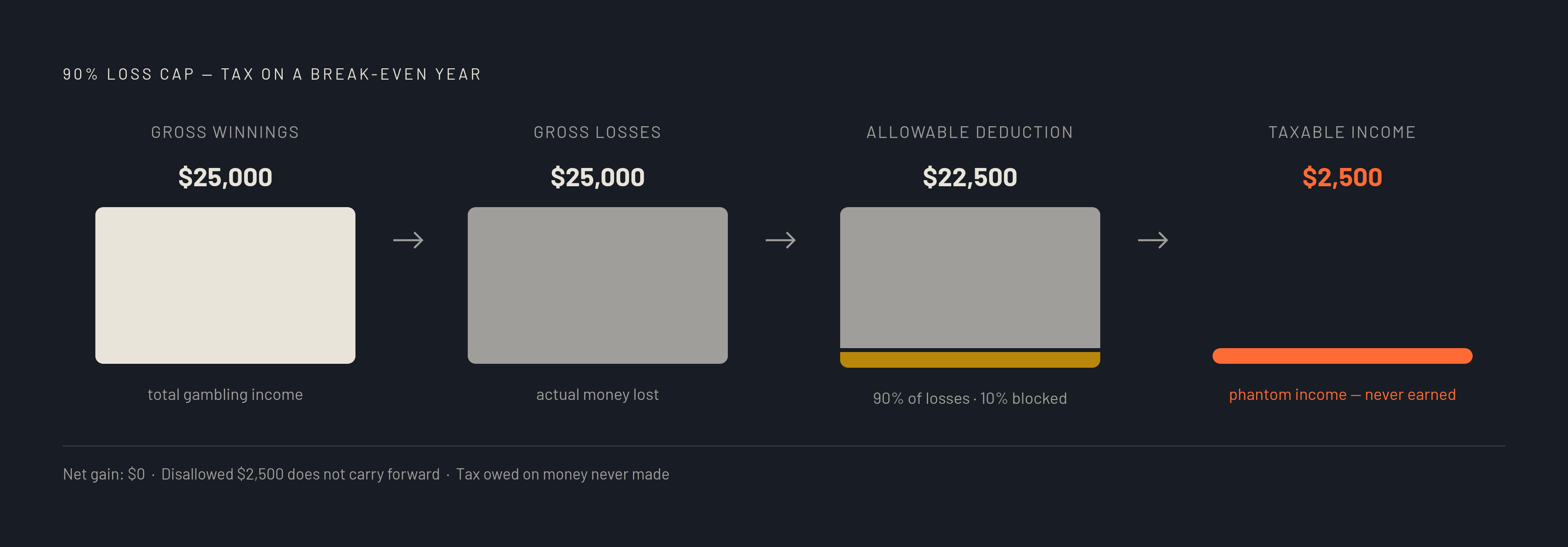
Recent tax legislation introduced a 90% cap on gambling loss deductions, and that single change makes correctly classifying winnings far more consequential for anyone filing under the ordinary gambling income framework than it was in prior years. The mechanics produce what's become known as phantom income: a bettor who wins $25,000 and loses $25,000 across the year, breaking exactly even, can deduct only 90% of those losses, or $22,500, leaving $2,500 of taxable income despite no actual profit. The disallowed portion does not carry forward to a future year and cannot be applied against other income on the current return. It is simply gone, taxed as if it were real gain when the bettor's net position for the year was zero.
The Joint Committee on Taxation estimated this provision would raise substantial federal revenue over the next decade, with a significant share of that revenue coming from high-wealth professional gamblers. That detail matters because the cap does not carve out an exception for professionals. Filers who report gambling activity on Schedule C and pay self-employment tax on it remain fully subject to the 90% limitation, and the OBBBA goes further by bundling wagering losses together with ordinary business expenses, tournament fees, travel, lodging, and similar costs, and subjecting that entire combined total to the same cap. Before this change, you could deduct a professional gambler's business expenses in full as ordinary business costs, kept separate from the win-loss accounting that governed the wagering itself. Folding those expenses into the capped category is a meaningfully worse outcome for anyone who trades or bets as a full-time activity.
A separate change runs alongside the loss cap: for calendar years after 2025, the minimum threshold that triggers a W-2G reporting form will adjust annually for inflation. The IRS has not released guidance interpreting how that adjustment applies to specific categories of gambling activity, so its effect on exchange-style contracts in particular remains unclear.
Political pressure to reverse the 90% cap exists, but no fix has become law. President Trump remarked in early December 2025 that he would "think about" repealing income taxes on gambling winnings. Rep. Jason Smith, chairman of the House Ways and Means Committee, has called the provision a "mistake." Rep. A repeal provision cleared the House Ways and Means Committee in September 2026, but it has not received a floor vote in either chamber. Filers need to plan around the law as it currently stands: the 90% cap applies. They should watch for any amendment that might pass before the April 15 filing deadline without assuming one will arrive in time to change this year's return.
How platform structure, Kalshi vs. Polymarket vs. others, determines which framework is most defensible
Which of the three frameworks a bettor can defensibly claim depends heavily on the regulatory status of the platform where the contract was traded.
Kalshi operates as a CFTC-regulated designated contract market, and that status lets contracts traded on it be treated as Section 1256 contracts, so you get the favorable 60/40 long-term/short-term split. That advantage comes with a recordkeeping cost: Kalshi does not issue a 1099-B that covers event-contract trading proceeds or cost basis, so the burden of calculating gains and losses for tax purposes falls entirely on the trader, with no form to lean on for the underlying math.
Polymarket has said it understands the IRS to treat its positions as investment contracts, so it points its users toward capital-gains treatment. Polymarket issues no tax form at all for trading gains, so, as with Kalshi, you carry the full weight of tracking basis and computing gain or loss yourself.
A wider field of platforms has entered prediction markets more recently, including Robinhood, Interactive Brokers, Coinbase, Crypto.com, DraftKings, FanDuel under Flutter Entertainment, and Fanatics. Robinhood has called prediction markets its fastest-growing product line by revenue, and millions of customers have traded contracts since launch. Robinhood issues an annual statement for this activity, but its own fine print states that the statement is not a tax form, a distinction that matters for anyone who assumes the document is sufficient for filing. None of these platforms has had its regulatory classification publicly addressed by the IRS, and each may end up treated differently depending on how it is structured and regulated.
State governments are now entering this fight directly, adding a layer of conflict on top of the unresolved federal picture. Kentucky enacted a substantial excise tax on prediction market operators through House Bill 757 in April 2026, with an effective date of January 2027. The CFTC has sued Kentucky, arguing federal preemption of the state's approach, and a separate coalition including Kalshi, Crypto.com, and Polymarket has filed its own legal challenge. These fights remain contested and unresolved, but they signal that at least some states are prepared to treat exchange contracts as gambling for their own purposes, a posture that, if it survives litigation, would strengthen the case for the ordinary gambling income framework for bettors in those jurisdictions.
State Residence and the Total Tax Bill
State tax treatment of gambling winnings runs on its own track, separate from whatever federal framework applies, so two bettors with identical federal filings can end up owing very different total amounts just based on where they live. Some states deny any deduction for gambling losses at all, which stacks a second layer of phantom income exposure directly on top of the federal 90% cap: a bettor who breaks exactly even for the year in Illinois or Kansas still owes state income tax on the full gross amount won, with no offset for the losses that brought the net result to zero. Other states draw a line between online betting and in-person betting for tax purposes, a distinction that doesn't map cleanly onto exchange platforms, which are neither traditional online sportsbooks nor physical venues, and how that distinction applies to exchange contracts has not been settled in most states. The state-level picture is a second, independent variable that every filer has to account for based on their own residency.
Filing Guidance for the 2026 Tax Year
The practical reality for the 2026 tax year is that no filer can wait for the IRS to resolve this before filing, because nothing suggests guidance is coming before the April 15 deadline. The starting point for every filer is the same regardless of which framework eventually proves correct: every dollar of exchange winnings gets reported, with or without a tax form from the platform, and the absence of a 1099 or W-2G is never grounds for leaving income off a return.
From there, the choice of framework should track the platform and the nature of the trading activity as closely as possible. A bettor trading contracts on a CFTC-regulated designated contract market like Kalshi has the strongest documented basis for claiming Section 1256 treatment, but should keep complete records of every position's open and close dates and proceeds, since the platform itself will not generate a 1099-B covering that detail. A trader on a platform that frames its own contracts as investment positions, as Polymarket does, has a reasonable basis for capital gains treatment but carries the same recordkeeping burden, with no tax form issued. A bettor who trades casually, without a clear capital-markets framing from the platform, and whose activity resembles traditional sports wagering more than securities trading has the most defensible position filing under the ordinary gambling income framework, understanding that losses are capped at 90% of winnings under current law.
Anyone filing as a professional, on Schedule C, needs to account for the fact that the 90% cap now reaches both wagering losses and ordinary business expenses, a combination that was not capped together before the OBBBA. Every filer, no matter the framework, should check their state's specific treatment of gambling losses, because a state that denies any loss offset can turn a break-even year into a real tax liability even when the federal return shows none. Political efforts to repeal the 90% cap remain stalled in the legislature despite a committee vote in September 2026, so filers should prepare returns under the law as it exists now and adjust only if an amendment actually passes before the filing deadline. Working with a CPA familiar with gambling and digital-asset tax issues is the most reliable way to choose a defensible position among the three frameworks and to document that choice in case the IRS eventually issues guidance that favors a different one.
Methodology & sources
- Gambling & Sports Betting Tax CPA
Provided the specific $25,000 win/$25,000 loss example used to illustrate the phantom income problem created by the OBBBA's 90% loss cap.
- Instructions for Forms W-2G and 5754 (01/2026)
Sourced the detail about W-2G reporting thresholds adjusting annually for inflation for calendar years after 2025.
- IRS silence on prediction market winnings to cause confusion as World Cup begins
Supported the article's central premise that the IRS has issued no guidance specific to prediction markets, leaving filers without a clear rulebook.
- Gambling Loss Deductions Narrow Under the OBBBA Starting in 2026
Provided details on the OBBBA's treatment of professional gamblers, including how business expenses are now bundled with wagering losses under the 90% cap.
- Major Changes to Gambling Loss Deductions Under the OBBBA: What Taxpayers Need to Know
Supplied information on how the OBBBA's 90% cap applies to professional gamblers filing on Schedule C and the disallowance of the carry-forward provision.
- New Gambling Loss Deduction Rules: How the One Big Beautiful Bill Act Impacts Your Taxes - Landmark CPAs
Informed the article's explanation of the mechanics of the 90% gambling loss cap and its effect on casual and professional bettors alike.
- The One Big Beautiful Bill Act Creates Unequal Tax Treatment for Gambling Losses
Provided the Tax Foundation's analysis of unequal treatment under the OBBBA, including the Joint Committee on Taxation's revenue estimate for the loss cap provision.