Polymarket Legal Status for US Users
Two platforms share the name, but only Polymarket US is legal for American traders—for now.
- Written by
- Renata Kowalczyk
- Published
- October 4, 2026
- Reading time
- 8 min read
- Sources cited
- 2 sources ↓
What this covers
Polymarket is federally legal for US users, but only through one specific product: Polymarket US. That legality comes bundled with state-level caveats, a rolling set of access restrictions, and a constitutional fight over jurisdiction that is still being argued in federal court, which makes "legal" a far more conditional word here than it looks at first glance.
How Polymarket split into two distinct products
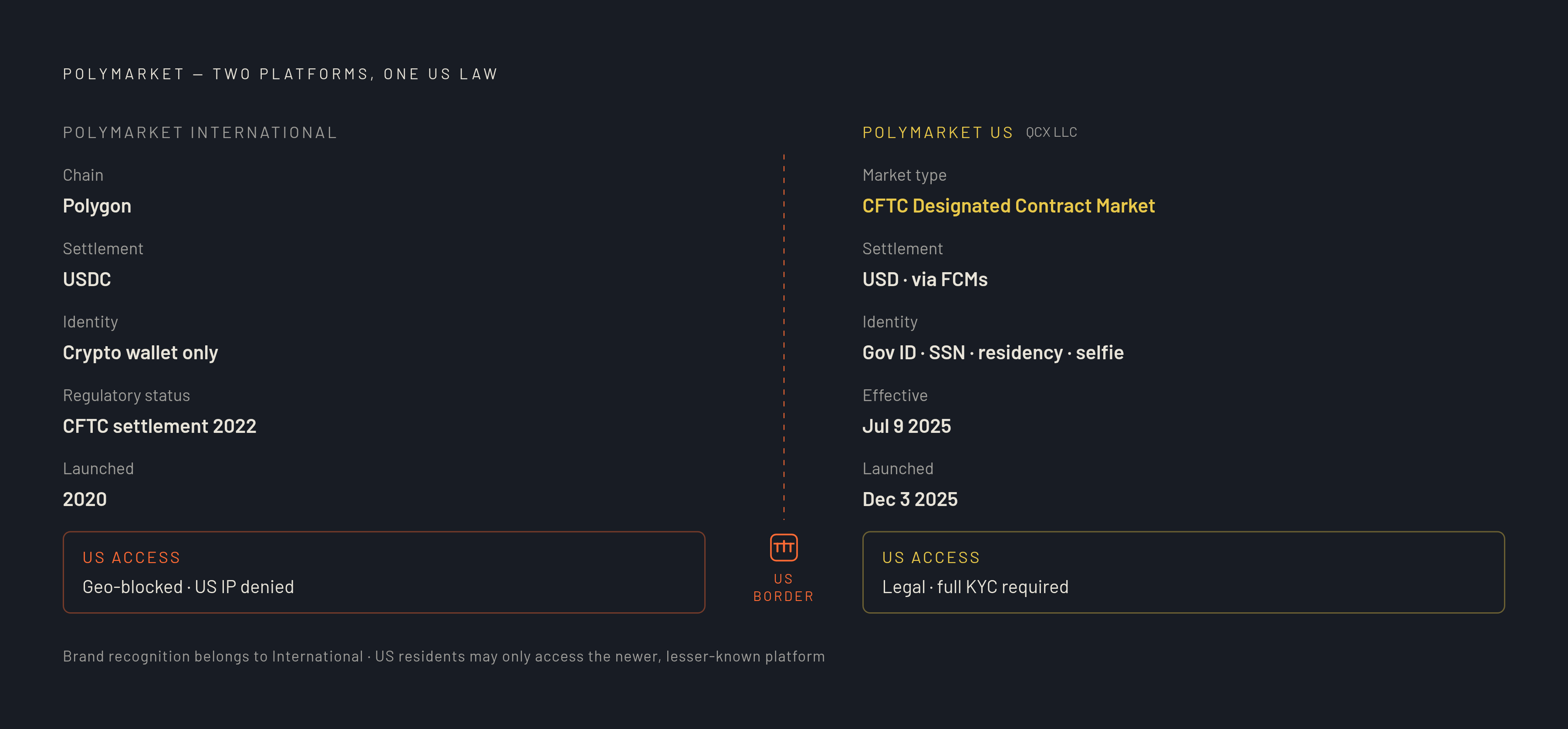
Two products now share the Polymarket name, and mixing them up is the single most common error a new US user makes. The original international exchange runs on Polygon, it settles trades in USDC, and it lists event contracts on everything from elections to sports to macroeconomic releases. That platform has been geoblocked for US IP addresses since a 2022 CFTC settlement, and it remains off-limits to anyone trading from inside the country. Polymarket US is a different venue entirely: it's operated by QCX LLC, it's regulated by the CFTC, and it launched on December 3, 2025 as the only Polymarket product US residents can lawfully use.
The brand recognition built around Polymarket, the viral election markets of 2024, the large trading volumes, the broad catalog of international contracts, belongs almost entirely to the platform US residents still can't touch. Polymarket US carries the name forward, but it runs on a compliance structure built from scratch for US law.
Polymarket US's Compliance Framework and User Experience
Signing up for Polymarket US looks nothing like the old crypto-native workflow. New users go through full identity verification: a government-issued ID, a Social Security number, proof of residency, and a live selfie match. None of that was required on the international platform, where a crypto wallet was enough to start trading.
The mechanics of trading have changed just as much as the onboarding. Users can no longer trade straight from a crypto wallet. Orders now route through approved Futures Commission Merchants, and accounts settle in US dollars rather than USDC. Polymarket US now sits in the same settlement and clearing structure that governs traditional futures and options markets, apart from the peer-to-peer crypto rails the international site still runs on.
The federal approval that made Polymarket US possible and what it grants
The relaunch rests on one specific status: Polymarket US, operating under QCX LLC, holds designation as a Designated Contract Market, the CFTC's formal category for a regulated derivatives exchange. CFTC records list QCX LLC d/b/a Polymarket US as designated effective July 9, 2025, and the Bitcoin Magazine coverage of the December 3, 2025 launch described the product as following CFTC approval. DCM status lets Polymarket US onboard US brokerages and retail customers directly, matching trades peer-to-peer on the exchange and clearing them through registered FCMs using the same infrastructure that underpins conventional futures markets. You get a real federal green light here, but it's a green light to operate as a derivatives exchange under CFTC oversight. But it does not, by itself, settle how fifty separate state gambling regimes will treat the contracts traded on that exchange.
Why federal approval sharpened the conflict with state regulators
Federal approval gave Polymarket a legal foundation in Washington, but it also gave state regulators a live, operating target they could challenge in court. The result has been an accelerating argument over which level of government actually controls prediction markets.
The CFTC's position holds that it has exclusive authority to regulate prediction markets under the Commodity Exchange Act, and that this authority preempts state gambling enforcement through the Supremacy Clause. States have moved in the opposite direction, treating prediction market contracts as a form of illegal gambling subject to their own licensing and enforcement regimes, and their consumer-protection argument, that unlicensed betting products deserve the same scrutiny as any other wagering market, is a substantive one rather than a procedural objection.
The record of state action already runs long. In Massachusetts, the Attorney General secured a court-ordered preliminary injunction against Kalshi halting its sports event contracts, and the state Gaming Commission warned its licensed sportsbooks against offering prediction market products; Polymarket responded by filing a preemptive federal lawsuit against Massachusetts to stop state regulators from blocking its operations there. Arizona filed the first criminal charges brought against a major prediction market platform, Kalshi, in March 2026, and its Department of Gaming issued a cease-and-desist order to Polymarket as well; federal authorities, the DOJ and the CFTC, then sued Arizona, along with Connecticut and Illinois, to block state prosecution of prediction market operators. In Nevada, the Gaming Control Board filed civil enforcement actions against several prediction market platforms, including Polymarket and Kalshi, arguing that their sports event contracts amount to unlicensed wagering under state law; Polymarket has since geo-blocked Nevada residents in response. Minnesota went furthest of all, becoming the first state to ban prediction markets outright, in May 2026. And in April 2026, the CFTC itself sued Connecticut, Arizona, and Illinois, arguing that prediction markets fall under exclusive federal jurisdiction and that those states' cease-and-desist orders are preempted.
Where US users can and cannot access Polymarket
As of October 2026, Polymarket US is open across a broad majority of states, though that footprint is not fixed and will keep shifting as litigation plays out in multiple circuits at once. The platform lists itself as available across most states nationwide. Several of those states appear on that availability list even as they sit at the center of active legal challenges, and users in New York, New Jersey, Connecticut, and Tennessee in particular should expect access that could narrow or change depending on how those cases resolve. Nevada stands apart from the rest: Polymarket has geo-blocked Nevada residents directly in response to the state Gaming Control Board's enforcement action, so access there is already closed rather than merely contested. None of this is a fixed map. The list of available states has moved as litigation has proceeded through 2026, and it will likely keep moving, so a user's best move before funding an account is to check polymarket.us/tos and the relevant state gaming commission's own guidance rather than rely on any snapshot of availability, including this one.
The circuit split that will determine whether federal approval is a genuine shield against state enforcement
Two federal appeals courts have now looked at the same jurisdictional question and reached opposite conclusions, which is the reason "federally legal" cannot yet be read as "legal everywhere." In April 2026, the Third Circuit, ruling in KalshiEX LLC v. Flaherty, found that federal law likely preempts state gambling enforcement against CFTC-registered designated contract markets that offer sports-related event contracts. That ruling affirmed a preliminary injunction rather than deciding the case on its merits, and it binds only Pennsylvania, New Jersey, and Delaware, but it stands as the first appellate ruling to back the CFTC's preemption theory.
Four months later, in August 2026, a Ninth Circuit panel ruled unanimously the other way, holding that Nevada can enforce its own gambling laws against Kalshi's sports-event contracts, while sending the separate question of election contracts back to the district court for further review.
With two circuits now in direct conflict, New Jersey Attorney General Jennifer Davenport filed a petition for certiorari on September 2, 2026, and asked the Supreme Court to resolve the split. The stakes of that eventual ruling are not abstract. If the Court confirms that the CFTC holds exclusive jurisdiction, state gambling mandates would be blocked nationwide, and states could no longer enforce any consumer-protection requirement beyond what the CFTC itself imposes. But if the Court sides with the states instead, the legal structure Polymarket has built its US re-entry around would face a serious structural challenge across large parts of the country, and access could unwind in states well beyond the ones currently in litigation.
The deceptive-marketing allegations and the federal investigation that add a separate layer of legal risk
A second legal track runs alongside the jurisdictional fight, and this one concerns conduct rather than structure. Polymarket faces allegations about how it marketed itself to US users during the period when they were officially barred from trading on the platform. A Wall Street Journal investigation described a systematic campaign that used replica versions of the trading platform to stage fake bets and fabricated winnings, representing trades that would have produced losses had they actually been placed on the live exchange.
That reporting drew a response from federal lawmakers. In a letter dated June 25 addressed to CFTC Chairman Michael S. Selig, Senators John Curtis (R-Utah) and Adam Schiff (D-Calif.) asked the agency to say publicly whether it is investigating the conduct the Journal described, and whether that conduct violates federal law or CFTC regulations. A person familiar with the inquiry told CNBC that the CFTC has an extensive, ongoing investigation into Polymarket.
None of this has produced a formal finding of wrongdoing, so the allegations still stand as allegations, not settled fact. The risk they represent sits apart from the question of whether Polymarket US is a properly structured, federally sanctioned exchange. A platform can hold valid CFTC designation and still face enforcement consequences tied to how it built its user base in the first place, and those two outcomes would not cancel each other out.
What still remains unsettled before trading
Three separate threads are still unresolved, and a user's actual legal footing depends on how all three play out, not just one. The jurisdictional fight between the CFTC and the states has not been settled by any single ruling. The Third Circuit and Ninth Circuit disagree, and the Supreme Court has not yet decided whether to take up New Jersey's petition, let alone how it would rule. The state-by-state access map is a snapshot from October 2026, not a fixed boundary, and it will keep shifting as more states pass legislation, file enforcement actions, or lose in court.
Given all three, a US resident considering Polymarket US should treat the CFTC's DCM designation as a real but partial answer, not a complete one. Confirming current state availability directly through polymarket.us/tos, rather than relying on any article's state list, is the only way to know whether an account can legally be opened from a given address today. Checking a state's own gaming commission or attorney general's office for recent action is worth doing as well, since several of the states currently listed as available are also the subject of active litigation that could change that status with little warning. And keeping the marketing investigation in view matters for a different reason: it's a reminder that a platform's regulatory status and its legal exposure are not the same question, and that the second one is still being written.
Methodology & sources
- CFTC LETTER NO. 25-48 NO-ACTION DECEMBER 11, 2025
Cited as the federal regulatory reference anchoring the discussion of CFTC designation and its limits relative to separate enforcement exposure.
- Industry Filings: Designated Contract Markets (DCM) Filing
Provided the official CFTC record confirming QCX LLC d/b/a Polymarket US as a Designated Contract Market effective July 9, 2025.