European Betting Exchange Regulation vs US Event Contract Rules
How Europe's fragmented gambling licenses differ from US commodities rules for the same product.

- Written by
- Ignacio Rondon
- Published
- October 9, 2026
- Reading time
- 10 min read
- Sources cited
- 7 sources ↓
What this covers
- Legal architectures for exchange-style event wagering in Europe and the US
- Europe's betting exchange regulation: 27 national licences instead of one
- What the exchange model is permitted to do
- The EU's AML overhaul and ESMA's product classification as a new regulatory layer on national gambling licences
Europe and the United States regulate the same product, exchange-style event wagering, through two legal systems that share almost no common vocabulary. The split exists because each jurisdiction's regulators decided, independently and through its own legal history, which body of law defines the product.
Legal architectures for exchange-style event wagering in Europe and the US
Europe got to peer-to-peer event wagering by way of gambling law. An operator that matches one bettor's stake against another's, rather than taking the other side of the bet itself, is treated as a betting intermediary, and a betting intermediary needs a gambling licence in each country where it wants customers. The United States got to the same product by way of commodities law. An operator that lists a binary outcome contract on a registered exchange is treated as a derivatives venue, and a derivatives venue sits under the Commodity Exchange Act, a federal statute that claims the authority to override state gambling prohibitions wherever it applies. Neither government sat down one day and chose this architecture over some alternative. The outcome is what happens when two long-established legal traditions, one built around consumer protection and licensing territory, the other built around market integrity and federal preemption, each absorb a product that didn't exist in the form regulators were trained to recognize. Because the governing category differs, everything downstream differs with it: who may operate, what capital and compliance obligations attach to that operation, which customers may be served, and which products may lawfully be offered to them.
Europe's betting exchange regulation: 27 national licences instead of one
No EU-wide gambling licence exists. That single fact shapes almost everything else about how exchanges operate on the continent. If an operator wants to run a betting exchange across the EU, it cannot just apply once and get permission everywhere. It must satisfy 27 separate national rulebooks, each written by a different legislature, each enforced by a different regulator, each carrying its own rules on taxation, product permission, and consumer protection. IMGL's European gambling regulation hub lays this out: there is no pan-European gambling regulator and no common standard for what is permitted, taxed, or prohibited. An operator holding a Malta Gaming Authority licence, a Swedish Spelinspektionen licence, and a Dutch KSA licence is operating under three entirely separate legal frameworks that happen to govern the same activity.
This fragmentation is not an oversight the EU intends to fix. Under the EU's foundational treaty, member states can restrict gambling on public interest grounds, and the EU's highest court affirmed this across a line of cases on gambling restrictions. Gambling regulation has been treated as a domain where national sensitivities, from problem-gambling policy to state lottery monopolies, override the usual EU push toward a single market. The instruments that do apply across all 27 states, GDPR, the TFEU's free-movement principles, the Digital Services Act, and the AML package now phasing in, are not gambling laws. They set a perimeter around data handling, advertising conduct, and financial-crime exposure, one that gambling operators share with every other regulated industry. None of them tells an operator whether it may run a betting exchange in a given country. That question is still answered 27 separate times. Licensed in Europe" describes nothing in particular. A licence issued in Malta carries no weight in Germany, France, or the Netherlands, and an operator that wants to serve all four markets must satisfy four distinct sets of regulators, each capable of permitting a product, allowing it with modification, or banning it.
What the exchange model is permitted to do
The clearest way to see what this fragmentation produces is to follow a single product across borders. Betfair is the most useful case because it is the most thoroughly documented betting exchange operating in Europe today, and its licensing structure shows how the same business model can be the regulatory standard in one country and unavailable in the next.
In the UK, the Gambling Commission created a distinct licence category for this product: the Remote Betting Intermediary licence, built specifically for platforms that bring two or more betting parties together online, what the industry calls a betting exchange. That category sits apart from an ordinary sportsbook permission and carries its own obligations: it segregates customer funds from the operator's working capital, and it requires anti-money-laundering compliance and safer-gambling tools such as deposit limits and self-exclusion. Betfair is operated under this structure through two linked entities. PPB Counterparty Services Limited, part of Flutter Entertainment Plc, holds an active UKGC General Betting Standard licence. The Betting Intermediary licence that covers the Betfair Exchange itself is held separately by TSE Malta LP, under account number 39561. The large majority of global Betfair Exchange matched volume runs through UK markets, so the UK is the center of gravity for the entire product category in Europe.
Moving the same product into France, Germany, or the Netherlands changes the picture completely. France's licensing framework does not permit the peer-to-peer exchange model at all, regardless of how an operator structures its compliance. The product treated as the licensed standard in the UK is effectively illegal in three of Europe's other largest gambling markets, because their national rulebooks were written without a category for it.
Betfair's own fee structure shows what it actually costs a successful bettor to operate inside a licensed exchange. The platform applies a tiered Expert Fee calculated on rolling 52-week profit above set thresholds, a mechanism that functions as a de facto tax on the platform's most consistently winning accounts, a detail that distinguishes the exchange model from a conventional sportsbook, where the operator's margin is built into the odds rather than extracted after the fact from the winners.
The regulatory burden inside the UK has also grown heavier over the 2025 to 2026 reform cycle. Remote Gaming Duty has risen substantially, and affordability checks now apply to net deposits above a set monthly threshold, introduced in stages from August 2024 and dropping to a lower threshold from February 2025. If you hold a licence in the most permissive major European market, you are not operating under static rules. So you operate under rules that keep tightening even as the underlying permission to run the exchange model stays in place.
The EU's AML overhaul and ESMA's product classification as a new regulatory layer on national gambling licences
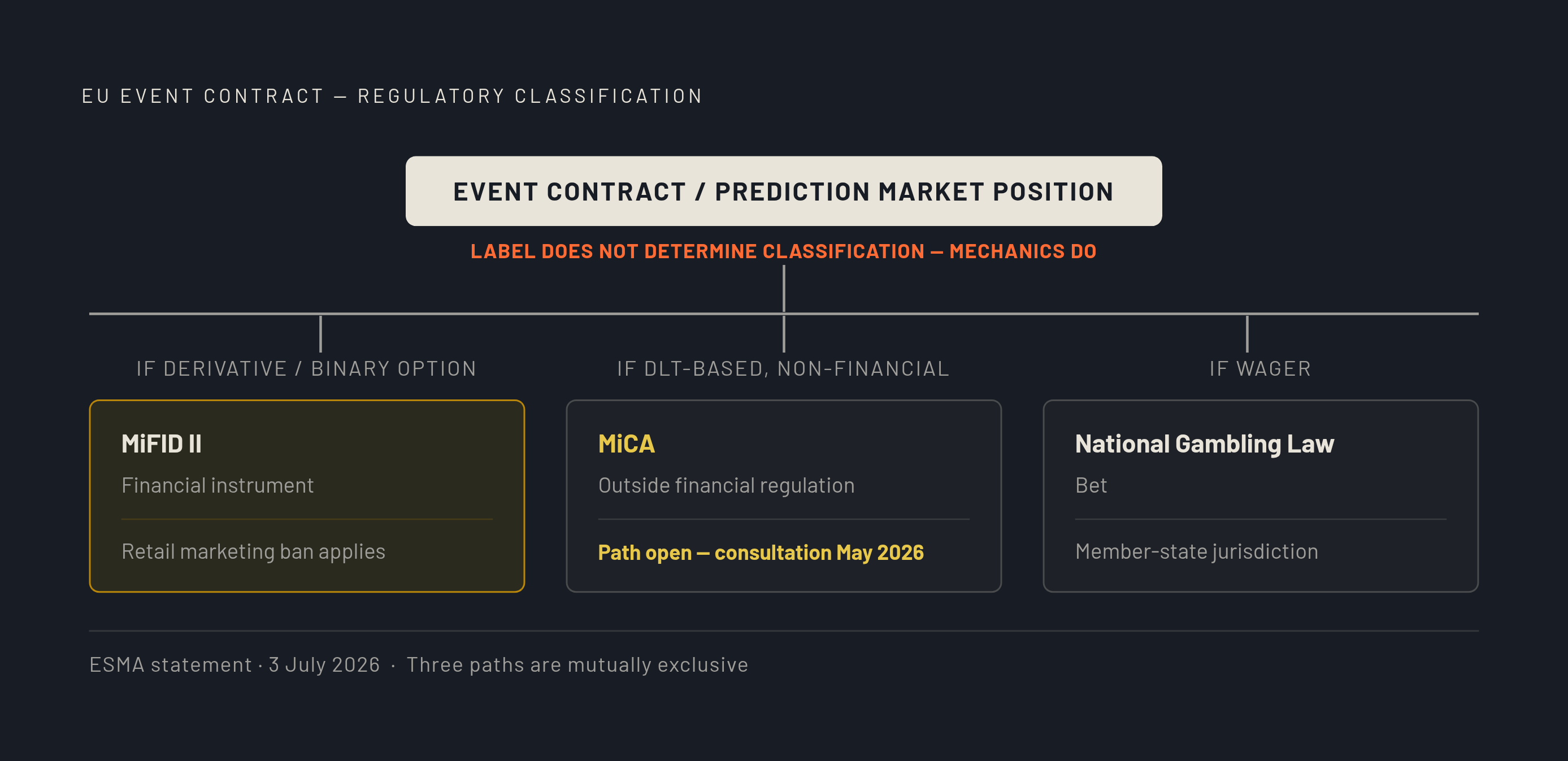
A national gambling licence used to be the final word on whether an exchange could operate. Two EU-level developments are now layering new obligations on top of the licence.
The first is the Anti-Money Laundering Regulation, or AMLR, which is directly applicable law. It requires no national transposition, and it supersedes existing national AML rules from July 10, 2027. The regulation imposes unified customer due diligence thresholds, beneficial ownership transparency requirements, and a single reporting interface to AMLA, the new EU AML supervisor that became operational in 2025 and is headquartered in Frankfurt, across all 27 member states at once. If you already meet strong AML standards in markets like Malta or the Netherlands, this transition asks relatively little of your existing compliance infrastructure. Operators relying on lighter-touch national regimes face a far heavier uplift in tooling and process to meet the same unified bar.
The second development is more disruptive to the exchange model specifically. On July 3, 2026, the EU's securities markets regulator said in a public statement that event contracts qualify as financial instruments if their underlyings fall within Section C(4) to C(10) of Annex I of MiFID II. That classification pulls them into the national prohibitions on marketing, distributing, or selling binary options to retail clients, the same prohibitions that replaced ESMA's original 2018 temporary ban when it expired in July 2019. The consequential part of the statement concerns labeling: the commercial name attached to a product does not exempt it from derivative classification. A contract marketed as an "event contract" or a "prediction market position" can still constitute a MiFID II financial instrument if its underlying mechanics fall within the derivatives categories the directive defines. The regulator sets out three possible regulatory homes for any given event contract: a MiFID II financial instrument, specifically a derivative or binary option; a distributed-ledger-based instrument that falls outside financial regulation and potentially within MiCA instead; or a bet governed by national gambling legislation. Which of the three applies is determined by what the contract actually does, not by what its operator calls it.
The MiCA question remains open. On May 20, 2026, the EU's executive body opened a targeted consultation on the MiCA review, asking whether distributed-ledger-based prediction markets belong inside that rulebook. Until that consultation resolves, platforms with ambitions in the EU retail market face three options, narrowed by ESMA's intervention: restructure their products so they fall outside financial-instrument classification, pursue full MiFID II authorisation, or accept that the EU retail market stays closed to them.
Gibraltar's prediction-market licence: the first attempt to create a purpose-built framework
Gibraltar has taken a different route. Its Gambling Act 2025 does not force prediction markets into an existing gambling category or a financial-instrument category; instead it establishes a standalone prediction-market licence, built as its own regulatory class from the start. It is the first attempt by any European jurisdiction to resolve the ESMA classification dispute by creating a new box rather than deciding which old box the product belongs in.
The timing is not incidental. Gibraltar's framework arrived in the immediate aftermath of ESMA's July 2026 statement, which had effectively closed the EU retail market to event contracts classified as MiFID II instruments. A purpose-built licence, offered from outside the EU's regulatory perimeter, gives operators squeezed out of the MiFID II-governed retail market a jurisdiction built to receive them. Gibraltar's approach shows you can solve the classification dilemma Europe has created for itself by writing new law rather than litigating old law, but only if you sit outside the EU's own regulatory boundary.
The US routing of event contracts through the CFTC: designated contract markets and the preemption claim
This framework starts from a different premise: the product is classified as a derivative, full stop, and the apparatus that governs derivatives governs it. Event contracts must be listed and traded on CFTC-registered designated contract markets, or DCMs, and they must clear through a derivative clearing organisation, the same clearing infrastructure used for commodity futures and financial derivatives generally. A DCM may list an event contract after self-certifying that the contract complies with the Commodity Exchange Act and applicable CFTC rules. Regulatory review happens at the moment of listing, through that self-certification, so there is no separate product-approval process layered on top.
This classification carries a legal claim European gambling law has no equivalent for: preemption. If event contracts qualify as "swaps" under the CEA, the CFTC holds exclusive federal jurisdiction over them, and state gambling laws that would otherwise prohibit the same activity are preempted by federal law. The entire US exchange model rests on that single characterization holding up.
The CFTC's own posture has moved toward accommodating this model. CFTC Chairman Selig described the prior administration's 2024 event contracts proposal as "the prior administration's frolic into merit regulation with an outright prohibition on political contracts ahead of the 2024 presidential election," a description that signals how far the agency's leadership has shifted toward treating event contracts as ordinary market products rather than as a category requiring special restriction. The scale of the resulting market reflects that permissive posture: Federal Register data shows that in one of the largest US prediction markets, the daily average number of event contracts listed for trading increased dramatically over the course of a single year.
The circuit split that leaves the US preemption claim unresolved
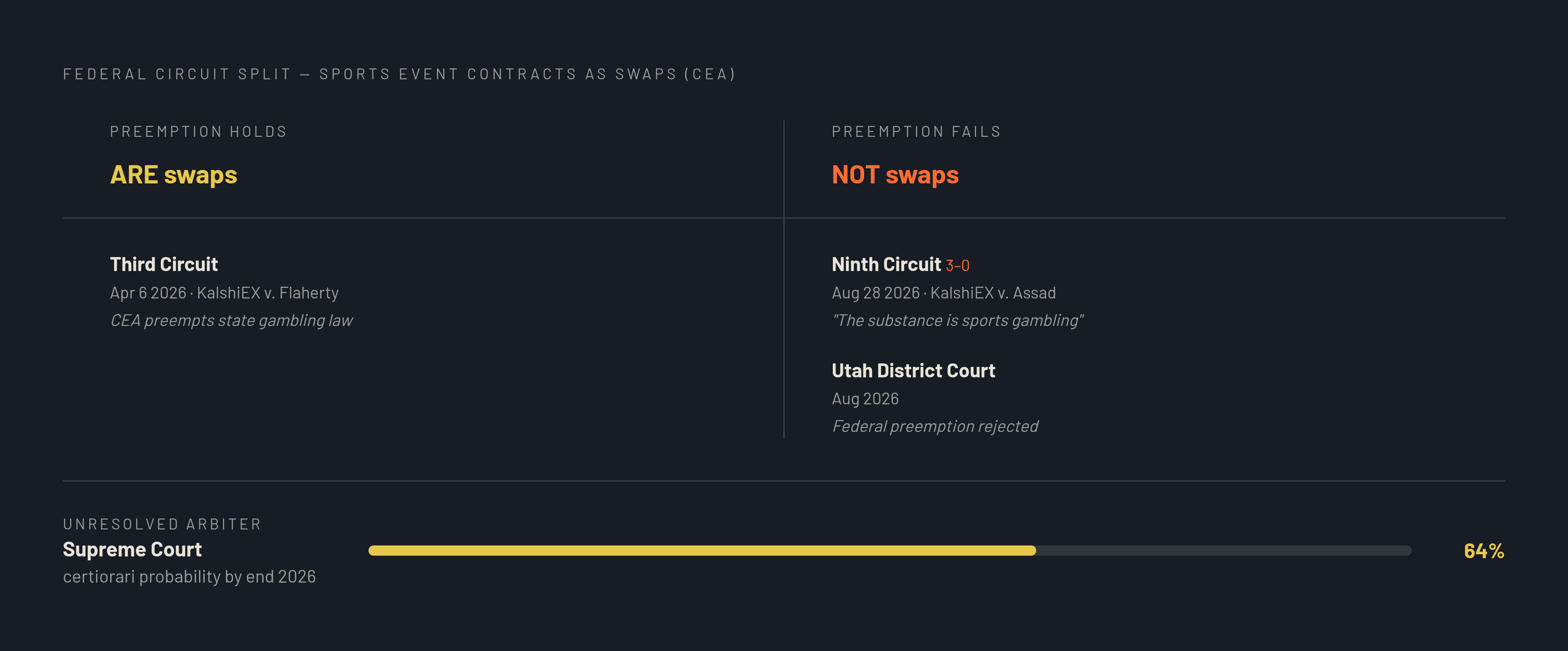
This framework depends on one legal question receiving a consistent answer: are sports event contracts "swaps" under the Commodity Exchange Act. Two federal appellate courts have now answered that question in direct opposition to each other.
On April 6, 2026, a divided panel of the Third Circuit ruled in KalshiEX LLC v. Flaherty that the CEA preempts state gambling laws as applied to sports-related event contracts traded on CFTC-registered DCMs, becoming the first federal appellate court to hold that position.
On August 28, 2026, the Ninth Circuit ruled 3-0 the other way in KalshiEX, LLC v. Assad. The court held that sports event contracts are not "swaps" under the CEA and that federal law does not preempt state gambling regulation, writing that "the sports event contracts were not 'swaps' because they were sports bets" and that "the substance of the sports event contracts offered on Kalshi's DCM is sports gambling, regardless of whether Kalshi calls them swaps."
That reasoning mirrors the approach taken by another regulator overseas almost exactly. What a product does determines which regulatory regime governs it, not what its operator decides to call it. The Ninth Circuit applied that logic to deny federal preemption over state gambling law; ESMA applied the identical logic to pull contracts labeled as "event contracts" back into financial-instrument regulation. Two systems built on opposite premises arrived at the same interpretive method when confronted with a product designed to resist classification.
A third ruling has since widened the gap. In August 2026, the U.S. District Court for the District of Utah granted the state's motion for summary judgment and rejected Kalshi's preemption claim on the merits, so yet another circuit had now ruled against the federal preemption position. A DLA Piper alert described the confirmed circuit split as a strong candidate for Supreme Court review, and a separate Holland & Knight analysis found that prediction market traders assigned a 64 percent probability that the Supreme Court would take up a sports event contract case by the end of 2026.
Until that happens, the legal status of a sports event contract in the United States depends on which federal circuit the operator or the state bringing the challenge happens to sit in. The country does not currently have one federal framework governing this product. It has two, operating at the same time, reaching opposite conclusions about the same contracts.
Methodology & sources
- 10 Takeaways from the CFTC Event Contracts Proposed Rulemaking
Provided the attributed quote from CFTC Chairman Selig characterizing the prior administration's 2024 event contracts proposal.
- Betting on the Future: The risks of prediction market platforms
Cited as the source describing the confirmed circuit split as a strong candidate for Supreme Court review.
- Federal Register :: Prediction Markets; Public Interest Determinations
Provided the Federal Register data on the dramatic increase in daily average event contracts listed for trading in a major US prediction market.
- Navigating the EU's New AML Regulation: Implications for the Gambling Industry
Informed the description of the EU AMLR's unified customer due diligence thresholds and its direct applicability without national transposition.
- EU AMLA and iGaming: Operator Obligations Under the New Anti-Money Laundering Architecture - gamingcompliance.io
Provided detail on AMLA becoming operational in 2025 and being headquartered in Frankfurt, and the unified reporting interface it introduces.
- The EU's approach to prediction markets and event contracts
Informed the analysis of ESMA's three possible regulatory classifications for event contracts and the MiCA review consultation.
- ESMA reminds firms of existing rules and obligations under binary option measures amid growing popularity of prediction markets globally
Provided the substance of ESMA's July 3, 2026 public statement classifying event contracts as potential MiFID II financial instruments and the binary options prohibition framework.