Advertising Restrictions on Sports Betting Operators by State
States are building 39 different rulebooks as public opinion sours on sports betting.
- Written by
- Renata Kowalczyk
- Published
- October 8, 2026
- Reading time
- 10 min read
- Sources cited
- 6 sources ↓
What this covers
Every advertising restriction a sportsbook operator runs into today traces back to one thing: a 2018 Supreme Court ruling. Murphy v. NCAA struck down the Professional and Amateur Sports Protection Act of 1992, the federal law that had kept legal sports wagering confined almost entirely to Nevada for more than two decades. The Court didn't just strike down a ban, it handed the entire regulatory question back to the states, while leaving Congress free to write its own federal framework if it chose to. Congress hasn't done that in any comprehensive way, so when PASPA fell, no federal advertising rulebook existed to take its place. States had to build one from scratch, and they built 39 different versions of it. As of August 2026, legal sports betting operates in 39 states, Washington D.C., and Puerto Rico, each with its own licensing authority, tax structure, and advertising code. Other older federal statutes touching on gambling and wire communications still sit in the background of federal gambling law, but none of them governs what a sportsbook can say in an ad. That job belongs to state gaming commissions, and an operator running campaigns in a dozen states is really running a dozen separate compliance regimes at once.
States are tightening advertising rules now, not at launch
The rules a sportsbook complied with in the early years of legal sports betting look permissive next to what's required in 2026, and that shift tracks a change in public opinion as much as any single piece of legislation. A 2025 survey found that a plurality of U.S. adults now believe legal sports betting is bad for society, up sharply from 2022, when that view was a minority position. Lawmakers drafting advertising bills in 2026 are responding to that shift, not leading it.
The research legislators cite documents the concern directly. Studies on gambling advertising have found that exposure increases gambling attitudes, intentions, and behavior, and that the effect is dose-dependent: more exposure produces more behavioral change, not a flat or diminishing one. The harm from that exposure also isn't spread evenly across the betting population. People already experiencing gambling harm report unplanned spending triggered by direct marketing at a significantly higher rate than people who aren't experiencing harm. The advertising that regulators are targeting lands hardest on the people least equipped to absorb it. A 2025 study in Frontiers in Psychology narrowed that population further: gamblers with greater severity reported a higher perceived impact from gambling ads, and advertising exposure mediated the relationship between impulsivity and gambling severity, as well as between emotion regulation and gambling severity. Young men show up repeatedly in this research as the group most exposed to that pathway.
A separate line of research sharpens the political argument even more. A study tracked more than 9 million bettors through the 2023-2024 NFL season and found that a small share of high-engagement bettors generates most of sportsbook revenue. That's the same population the clinical research flags as most vulnerable to advertising-driven behavior change, and it means the commercial incentive to advertise aggressively points directly at the group lawmakers are trying to protect.
Tax policy has turned out to be its own lever on advertising volume, even without a single word of ad-content restriction. After Illinois moved to a steep progressive tax rate on its largest operators, DraftKings and FanDuel cut back marketing activity in the state substantially. Legislators in other states have taken note: a tax structure can shrink ad spend as effectively as a direct ban, and at lower political cost.
The baseline rules most legal states share
Across nearly every legal market, a common floor has emerged beneath the state-by-state variation, and any operator working in more than one state should treat it as the minimum standard. Nearly every state requires responsible gambling messaging in all advertising materials, bars ads targeting minors or anyone under the legal betting age (21 in most states), requires operators to disclose the actual terms of a promotion rather than just its headline offer, restricts advertising near schools and youth-oriented venues, and bans misleading claims about a bettor's chances of winning.
That convergence isn't coincidental. Most state gaming commissions built their first sportsbook advertising rules by borrowing from casino and lottery frameworks that had already existed for decades, so the industry got a shared starting template even though each legislature adopted it on its own. One detail inside that shared template trips up operators constantly: several states require a specific helpline number, not generic responsible-gambling language, and the required format differs from state to state. If a disclaimer in one national format satisfies one state's gaming commission, it won't automatically satisfy another's, so a compliance team can't build one creative asset and run it everywhere.
State-by-state restrictions that go beyond the baseline
Above that floor, state rules diverge in ways that reach directly into creative production, media buying, promotional design, and affiliate agreements.
New York bars ads targeting anyone under 21 and restricts advertising near schools, so here it just holds to the baseline. It goes further with a law (S1550/A1118, signed by Governor Hochul on October 1, 2024) requiring ads to inform consumers about gambling's harmful effects and display the state's gambling hotline number. A proposed bill, A7962, would go further still, prohibiting advertising that uses terms like "bonus," "no sweat," "bonus bet," or similar language, which would eliminate most of the standard promotional vocabulary the industry currently relies on. That bill hasn't become law. Operators should track it as pending, not current, but it arrives at a moment when New York's tax rate already compresses sportsbook margins so heavily that several operators testified in early 2026 that they can't offer competitive odds or promotions under the current tax burden. Any new ad restriction in New York lands on budgets that are already stretched thin.
Massachusetts bars labeling a promotion "free" when users must risk their own money, requires a problem-gambling message and helpline on all ads, and bars targeting minors or self-excluded individuals. What distinguishes Massachusetts from several other states with comparable rules is active enforcement. The Massachusetts Gaming Commission fined Penn Sports Interactive $25,000 in 2023 over its "Can't Lose Parlay" promotion, finding the ad misleading, and in 2025 it fined four operators, BetMGM, Fanatics, FanDuel, and PENN Sports Interactive, a combined $50,000 over violations that included marketing tied to Belarusian sports and LPGA events and marketing to self-excluded individuals. If a state has rules on the books but no comparable enforcement record, it carries a different practical risk than Massachusetts does.
Maine's market carries a structural feature that shapes advertising compliance directly. Online wagering launched in November 2023 through DraftKings and Caesars Sportsbook, both operating in partnership with the state's Wabanaki tribes. Affiliate and operator advertising in that state has to account for that tribal partnership structure as part of the compliance picture, not as a side note.
New Jersey requires the 1-800-GAMBLER helpline to appear prominently across print, billboard, signage, online, and broadcast advertising. Pending legislation, A 4003, would bar operators from extending promotions or incentives to anyone who has enrolled in responsible gambling tools, which would require operators to cross-reference responsible-gambling enrollment lists against their promotional targeting before every campaign.
Ohio's advertising rule is written specifically to limit the appeal of sports betting to younger bettors, a narrower aim than some of the broader consumer-protection language seen elsewhere.
Pennsylvania has a package of 2026 bills under consideration that would ban push notifications and text solicitations, end credit card funding, set daily deposit limits, and bar promotions for anyone on the state's voluntary self-exclusion list, though none of it is law yet. Pennsylvania's existing tax rate already forces large operators to negotiate affiliate tiers and volume discounts to manage cost, so any one of those proposed restrictions would layer onto a business model that's already under real constraint.
Illinois has no advertising-content ban comparable to New York's or Massachusetts's, but its progressive tax structure has produced the same practical effect, because DraftKings and FanDuel have cut marketing spend in response. Handle growth in Illinois has slowed relative to peer states since the tax increase took effect, and other states' regulators are watching that closely as they weigh tax policy against advertising restriction as two different tools aimed at the same outcome.
Colorado's SB 26-131 as a case study in how advertising legislation moves
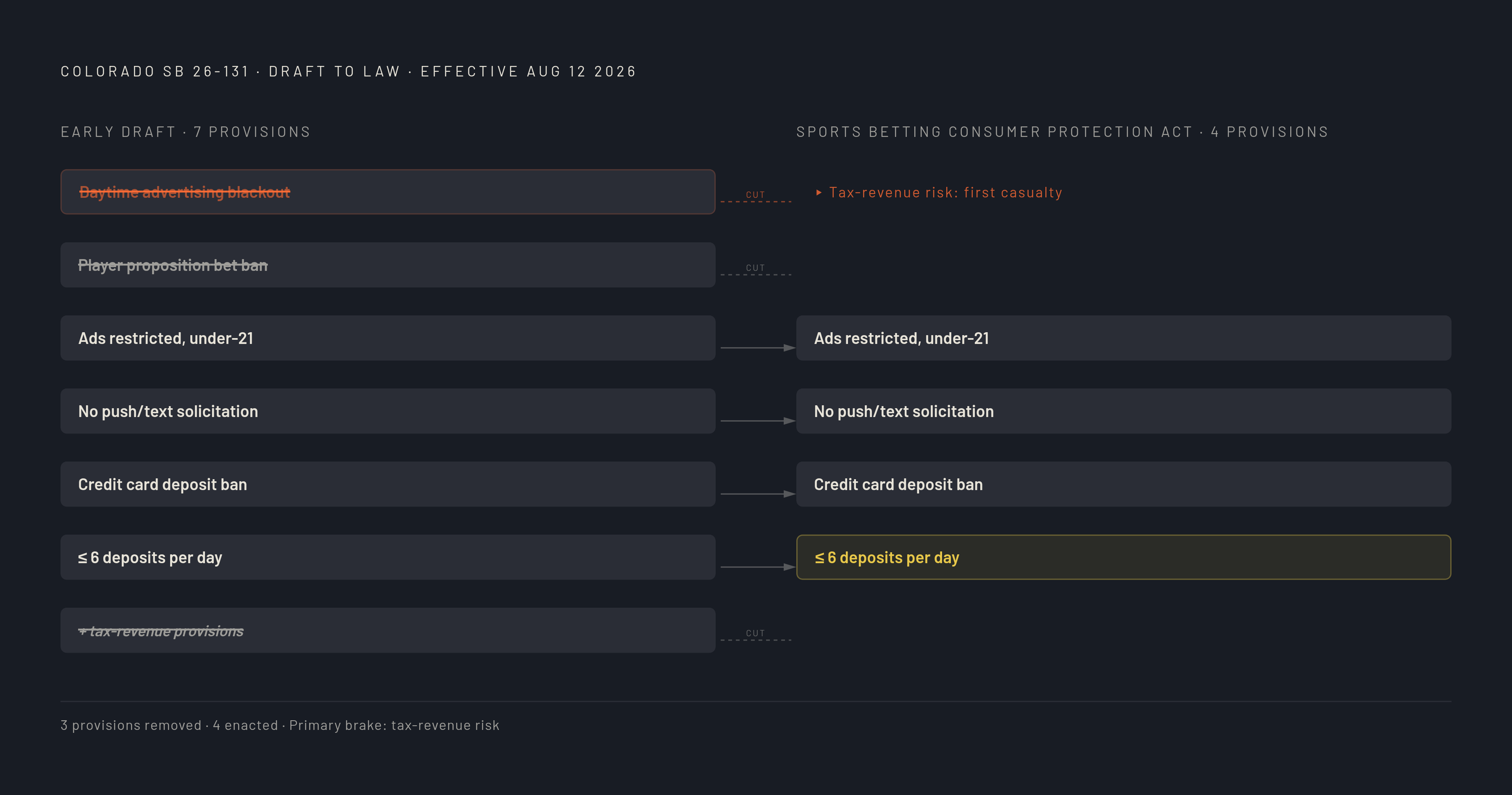
Colorado's SB 26-131 offers the clearest available picture of how an advertising bill moves from an ambitious first draft to an enforceable law, and the arc applies regardless of whether an operator does business in Colorado. Signed and effective August 12, 2026, the bill started out much broader than what ultimately passed. An early version included a daytime advertising blackout; that provision was removed before passage. A proposed ban on player proposition wagers was also removed, after lawmakers raised concerns about its effect on state tax revenue.
What survived, under the Sports Betting Consumer Protection Act, is narrower but still substantial: a ban on credit card deposits, a cap of six daily deposits per person, a prohibition on push notifications or texts that solicit bets, and restrictions on advertising directed at anyone under 21. Violations of certain provisions carry significant per-offense penalties.
The pattern matters more than the specific Colorado provisions do. A broad advertising blackout was the opening bid. Deposit limits and notification bans were the provisions that survived negotiation. Concern over tax revenue functioned as the brake that kept the most sweeping restrictions, the ones that would have cut most directly into operator marketing reach, out of the final bill. Operators in Colorado now have to comply with the law as of August 12, 2026, but operators in every other state should read the Colorado trajectory as a preview. Legislatures elsewhere are likely to start from similarly ambitious language and negotiate down toward something that looks a great deal like what Colorado ended up with: deposit caps, notification bans, and age-targeting restrictions, rather than blanket prohibitions on advertising itself.
The SAFE Bet Act and the federal advertising floor for multi-state operators
The Supporting Affordability and Fairness with Every Bet Act, introduced by Senator Richard Blumenthal and Representative Paul Tonko, would set federal minimum advertising standards for the first time since Murphy v. NCAA put the issue in state hands. Its advertising provisions sit at the center of the bill. One piece targets a practice state rules have barely begun to address: the Act would bar platforms from using AI to track individual bettor behavior or tailor personalized promotions, aiming directly at the algorithmic targeting operators currently use to maximize engagement with high-value bettors.
If you manage compliance across dozens of states, a federal floor can look appealing on paper. It would reduce the need to maintain a separate advertising framework for every state, at least for the provisions the Act covers. That relief would be partial, not complete: state rules that exceed the federal floor, and plenty already do, would remain fully in force on top of it.
The objections to the Act come from serious, credible positions, not fringe resistance. Representative Dina Titus of Nevada called the Act "outdated" and "unwarranted," arguing that preempting state gaming regulators by outlawing most forms of advertising amounts to "a misguided approach." Opponents also raise a market-displacement concern: provisions restricting things like college player props and promotional offers could push bettors toward unregulated, illegal betting markets that carry none of the consumer protections a licensed operator provides. A further argument holds that federal legislation may simply be unnecessary. Most of the SAFE Bet Act's recommendations are already in place across legal sports betting states, and several states, Colorado, New York, and Massachusetts among them, already impose restrictions that go beyond what the Act proposes.
Whether the SAFE Bet Act becomes law is a separate question from whether its direction matters to operators planning two or three years out. The evidence from Colorado, New York, Massachusetts, and Ohio points the same direction the Act does: toward deposit limits, notification restrictions, and tighter promotional language, regardless of which level of government writes the rule. Operators building compliance infrastructure now have reason to build toward that destination without waiting for Congress to settle the question.
Two emerging channels where most state frameworks have not yet caught up
Podcast advertising and prediction market platforms sit in a gap that most state advertising frameworks haven't addressed yet, even as regulators now watch both channels more closely. Podcast ad reads often run as unscripted, host-delivered endorsements rather than the scripted, pre-cleared creative that state gaming commissions were built to review, and existing helpline-disclosure and misleading-claims rules were written with television and billboard advertising in mind, not long-form audio content where a host might promise outsized winning potential in casual conversation. Prediction market platforms present a different structural problem: several operate under a federal regulatory framework distinct from state sports betting licensing. The state-level advertising rules built for licensed sportsbooks, age-targeting restrictions, helpline requirements, promotional disclosure rules, may not apply to them in the same way, even when the product a bettor encounters looks functionally similar to a sports wager. Neither channel has drawn the kind of enforcement record that Massachusetts has built around traditional sportsbook advertising, but the legislative pattern in Colorado and New York suggests that gap won't last. State legislatures have shown they will expand advertising rules once a channel reaches enough scale to draw attention, and both podcast advertising and prediction markets are nearing that threshold.
Methodology & sources
- Sensible sports betting: A policy framework - American Institute for Boys and Men
Provided the 2025 public opinion survey finding that a plurality of U.S. adults now view legal sports betting as bad for society, up from a minority position in 2022.
- NY State Assembly Bill 2025-A7962A
Provided the details of the proposed New York bill A7962 that would prohibit advertising using terms like 'bonus,' 'no sweat,' or 'bonus bet.'
- Wagers and Warnings: The State of Sports Betting Advertisements
Provided background on the state of sports betting advertising regulations, including the SAFE Bet Act and state-level advertising frameworks.
- sb26 131
Provided the specific provisions of Colorado's SB 26-131, including the credit card deposit ban, daily deposit cap, and push notification restrictions that survived from the original draft.
- Text - S.1033 - 119th Congress (2025-2026): SAFE Bet Act
Provided the text of the SAFE Bet Act, including its provision barring platforms from using AI to tailor personalized promotions based on individual bettor behavior.
- SAFE Bet Act
Provided the legislative outline for the SAFE Bet Act introduced by Representative Paul Tonko, informing the article's coverage of its advertising provisions.