State-by-State Legal Status of Prediction Market Sports Contracts
Federal and state courts are splitting on whether prediction markets are securities or gambling.
- Written by
- Ignacio Rondon
- Published
- October 2, 2026
- Reading time
- 10 min read
- Sources cited
- 5 sources ↓
What this covers
Prediction markets operate under a single federal framework, yet whether you can actually trade a sports event contract depends entirely on which state you're sitting in when you try. Federal regulation establishes that these products exist and are overseen by one agency, but it does not resolve whether states retain the power to block them, and that unresolved question is now the subject of a sprawling, fast-moving legal fight.
The Commodity Futures Trading Commission classifies sports event contracts as swaps, specifically binary contracts listed on a designated contract market, and argues that the Commodity Exchange Act gives it exclusive authority over them. That statute has governed derivatives markets since 1936 and was substantially rewritten by the Dodd-Frank Act in 2010. States are not conceding the point. A contract that pays out based on who wins a football game looks, to most state gaming regulators, indistinguishable from a sports bet, and states have regulated sports wagering as a form of gambling since before the Constitution was ratified. The same federal statute the CFTC relies on also contains a "gaming" exclusion, which states argue was written precisely to keep contracts like these out of federal hands. The 2018 repeal of the federal law that had barred states from authorizing sports betting added another layer to the conflict: once that bar fell, states built their own licensing systems, tax structures, and consumer protections around legal sports betting, and many of them now view federally sanctioned prediction markets as a competitor operating entirely outside that framework. A trader's access to a sports event contract, in practice, turns on state law and state litigation, not on the CFTC's say-so.
How a change in CFTC posture turned a simmering dispute into an all-out legal war
The current wave of litigation traces back to a specific shift in federal posture following the 2024 presidential election. New CFTC leadership dropped the agency's appeal in the Kalshi litigation, withdrew a 2024 proposed rule that would have limited event contracts, and started filing lawsuits of its own to defend the agency's jurisdiction against state enforcement. That was a reversal, not a continuation of prior policy, and it changed the tone of the dispute almost immediately.
Holland & Knight's analysis found that CFTC Chair Michael Selig called state enforcement actions a "power grab," filed an amicus brief in the Ninth Circuit backing Crypto.com's position, and told state regulators the agency would fight to protect its exclusive jurisdiction over contracts listed on CFTC-regulated designated contract markets. States did not stay quiet. A coalition of state attorneys general wrote to the CFTC arguing the agency has no statutory authority over sports-related event contracts at all, and eleven states introduced prediction market legislation in 2026. The federal government then escalated further still: on April 2, 2026, the Department of Justice and the CFTC jointly sued Arizona, Connecticut, and Illinois, arguing those states' enforcement actions against the platforms are preempted by the CEA, Norton Rose Fulbright reported. A federal agency suing individual states to stop them from enforcing their own gambling laws has no real precedent in this space, and it signals how far the fight has moved beyond ordinary regulatory disagreement.
The statutory fault line every court is arguing over
Every court case in this fight, regardless of which state it involves, comes down to one statutory question: does a sports outcome contract meet the legal definition of a "swap" under 7 U.S.C. § 1a(47)? If it does, the CEA's exclusive jurisdiction clause overrides state gaming law. If it doesn't, states keep the authority to regulate it as gambling, free and clear.
The platforms build their case on the statute's plain language. The CEA covers agreements tied to "the occurrence, nonoccurrence, or the extent of the occurrence" of any event, and the platforms argue the word "any" means what it says: a basketball score is an uncertain future occurrence, and that's sufficient to make it a swap under the text, as Holland & Knight lays out. States respond with a different part of the same statute. The CEA carries a gaming exclusion, codified at 7 U.S.C. § 7a-2(c)(5)(C)(i), covering transactions that amount to gaming under state law, and states argue that courts should lean on a long-standing presumption that Congress does not quietly strip states of their police powers over gambling without saying so in unmistakable terms. States say that clarity simply is not present in the statute.
A third thread runs through the dispute, one concerned less with wording and more with what the contracts actually do. The Ninth Circuit found that sports bets are likely not swaps under the CEA and therefore fall outside the CFTC's exclusive jurisdiction, reasoning that substance ought to control over labeling: the contracts were, in the court's words, "sports bets regardless of whether Kalshi calls them swaps," as CBS Sports quoted. Platforms answer that argument on structural grounds. Carving sports contracts out of the swap definition, they argue, would recreate the very state-by-state fragmentation that Congress eliminated when it handed the CFTC authority over swaps through Dodd-Frank, and they find textual support for that position in the statute itself.
How the circuit courts have split on the Supreme Court
Federal appellate courts have landed on opposite sides of the swap issue, and that split is what analysts at Tradeblock and Holland & Knight both point to as the likely trigger for Supreme Court review.
On April 6, 2026, the Third Circuit ruled 2-1 that Kalshi's sports event contracts qualify as swaps under the CEA, upholding a preliminary injunction that bars New Jersey from enforcing its own gaming laws against the platform. RotoWire called it the most significant judicial development to date in the prediction markets space. It is important to be precise about what that ruling actually settled: it affirmed a preliminary injunction, not a final merits judgment, so the underlying case continues even as the injunction stands.
The Ninth Circuit went the other way, and did so unanimously. On August 28, 2026, a three-judge panel ruled against Kalshi in KalshiEX, LLC v. Assad, holding that the substance of the sports event contracts offered on Kalshi's designated contract market is sports gambling, regardless of what label Kalshi puts on them. That holding reached the merits of Nevada's authority to regulate the contracts, a different procedural posture from the Third Circuit's injunction, and it directly conflicts with the Third Circuit's April decision.
The district courts had already produced a scattered and inconsistent record before these two appellate rulings. Courts in Nevada and Ohio had ruled the contracts are not swaps; Maryland's district court ruled against Kalshi on preemption grounds without reaching the swap issue at all; New Jersey's district court found the contracts likely are swaps; and a Tennessee district court initially agreed they likely are swaps before the Sixth Circuit reversed and held they are not. That pattern shows the question was unsettled even within individual circuits before appellate courts stepped in to resolve it.
The Ninth Circuit's opinion reaches further than sports markets. The panel directed the district court to reconsider Nevada's challenge to Kalshi's election contracts in light of its reasoning, which suggests the preemption fight could extend well past sports betting into political and economic event contracts. Separately, a market-based legal forecast cited by Tradeblock priced the chance of Supreme Court review before the end of 2026 at roughly two-thirds, and the conflict between the circuits gives the Court a clean vehicle to take up if it chooses. A third appellate ruling may land before the Supreme Court acts at all: the Fourth Circuit heard oral argument in the Maryland case on May 7, 2026, DLA Piper reported, and its decision could arrive before any cert grant. The practical upshot is stark. The same sports event contract is currently protected by federal preemption in New Jersey and blocked as illegal gambling in Nevada. Where you live determines what you can trade.
States where sports event contracts are currently blocked or significantly restricted
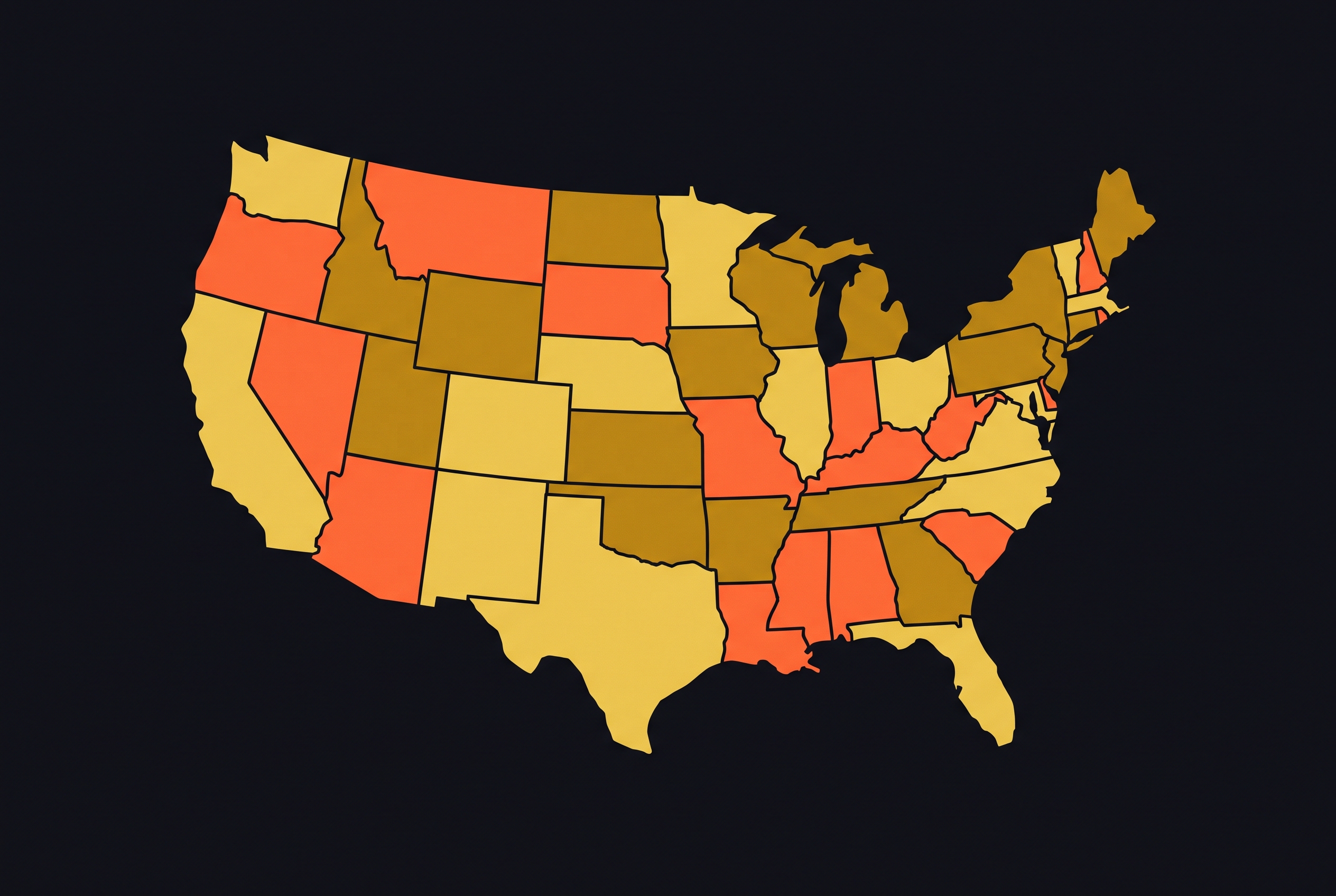
Three states currently have court orders or regulatory actions in place that prevent or severely limit sports event contract trading: Nevada, Massachusetts, and Michigan, joined by New York, where litigation has escalated so quickly as of late September 2026 that access there functions as a near-restriction in practice.
Nevada sits at the center of the restricted tier. The Ninth Circuit's unanimous August 28, 2026 ruling in KalshiEX, LLC v. Assad confirmed that Nevada's gaming regulators can enforce state law against Kalshi's sports event contracts, and as a result Kalshi, Crypto.com, and Robinhood cannot offer those contracts to Nevada users. The panel's framing left little room for ambiguity about where it stood on the substance-over-form debate. The ruling's reach may extend beyond sports: the court asked the district court to revisit Nevada's challenge to Kalshi's election contracts using the same reasoning. Geography matters here too. The Ninth Circuit's jurisdiction covers Alaska, Arizona, California, Hawaii, Idaho, Montana, Nevada, Oregon, and Washington, along with Guam and the Northern Mariana Islands, which makes this the single most consequential ruling for the industry's footprint anywhere in the country.
Massachusetts has its own court-ordered injunction blocking Kalshi from offering sports contracts, and the state's highest court has shown skepticism toward the platform's arguments, CBS Sports reported. As of September 4, 2026, Kalshi is waiting on a ruling from the state's Supreme Judicial Court that could shut the platform out of sports markets entirely, and the CFTC is actively contesting that state action. Polymarket is also caught up in the Massachusetts fight: it filed its own preemption suit against the state on February 10, 2026, the first such action Polymarket has brought on its own behalf. In both Massachusetts and Nevada, the restriction targets sports contracts specifically; non-sports markets, covering politics, economics, and other subjects, often remain available even where sports trading is blocked.
Michigan has blocked sports trading markets outright, with the state filing a civil suit alleging that the sports event contracts constitute unlicensed gaming activity. Michigan's status is categorized as Not Live. CBS Sports describes the matter as "far from final," noting that further legal moves from either side could shift Michigan's status in short order.
New York presents the fastest-moving situation on the map. New York's status is categorized as Escalating, as the state moves from Contested toward Restricted. On September 24, 2026, Attorney General Letitia James sued Polymarket US in state court, alleging it runs an unlicensed gambling business, a near-identical action to the lawsuit she filed against Kalshi on July 31, 2026. Polymarket moved the case to the Southern District of New York and filed a federal counter-suit against the state and the New York Gaming Commission. Two competing bills are working their way through the state legislature at the same time: the ORACLE Act (A9251), which would require a state gambling license before any prediction market could offer contracts on sports, elections, or other sensitive subjects, and the Prediction Market Regulation Act (S8889), which would instead require operators to get licensed through the New York Department of Financial Services. Sports markets remained technically live in New York as of September 30, 2026, but with active attorney general litigation against both major platforms running in parallel, that access could change with little warning.
States where active lawsuits or enforcement actions make access uncertain
A separate cluster of states falls into a middle tier: sports event contracts remain available to trade there today, but ongoing litigation or enforcement threats mean that availability could end abruptly. These are states where availability could end abruptly, so they are worth watching closely.
Maryland is the clearest example. Federal Judge Adam B. Abelson denied Kalshi's request for a preliminary injunction on August 1, 2025, ruling that state gaming authority can coexist alongside CFTC regulation, a defeat for the platforms at the district court level. That case has since moved up to the Fourth Circuit, which heard oral argument in early May 2026, and DLA Piper notes a ruling is pending that could move Maryland into either the restricted or cleared column. Whichever way that ruling goes, it will either move Maryland into the restricted column alongside Nevada and Massachusetts or clear the way for the platforms to operate there without the current cloud of uncertainty. For now, sports markets remain available through Kalshi in Maryland as of September 30, pending that appellate decision.
The broader pattern across these contested states is the same one driving the entire national map: a sports event contract's legal status is not fixed by federal regulation but by the posture of whichever court or attorney general is currently reviewing it in that particular state. Until the Third Circuit and Ninth Circuit conflict is resolved, whether by the Fourth Circuit, further appellate rulings, or the Supreme Court itself, traders should expect the map to keep shifting rather than settling into a stable, nationwide answer.
Methodology & sources
- Prediction Markets Legal Timeline 2026: States, Courts & Federal Regulation
Provided the legal timeline of key court dates, legislative actions, and the characterization of the Third Circuit ruling as the most significant judicial development to date.
- Prediction Markets at a Crossroads: The Continued Jurisdictional Battle Over Event Contracts
Provided analysis of CFTC Chair Michael Selig's actions, the statutory arguments over the swap definition, and the circuit court landscape.
- Are sports prediction markets legal? Status of Kalshi and Polymarket in all 50 states - CBS Sports
Provided state-by-state availability details, court quotations about sports bets versus swaps, and status updates for Nevada, Massachusetts, Michigan, and New York.
- Sports Events Contracts
Cited as a source for the market-based legal forecast pricing Supreme Court review probability and as a reference for the circuit split analysis.
- Prediction markets at a crossroads: Preemption, enforcement and rulemaking
Reported on the DOJ and CFTC jointly suing Arizona, Connecticut, and Illinois over state enforcement actions against prediction market platforms.